Ad Blocker Detected
Our website is made possible by displaying online advertisements to our visitors. Please consider supporting us by disabling your ad blocker.
When comparing the efficiency of robotic and traditional lawn mowers, the question isn’t just about cutting grass but about optimizing performance for specific terrains and user needs. Both options employ distinct mechanisms—one relies on autonomous sensors and boundary wires, while the other depends on manual operation and higher power output. As we analyze their operational advantages and limitations, it becomes clear that choosing the right mower involves more than just initial cost—it’s about understanding long-term suitability and maintenance demands.
Key Takeaways
- Robot mowers offer automated, precise, and frequent cutting, ideal for small to medium, uniform lawns; traditional mowers provide faster coverage for larger areas.
- Robot mowers operate quietly and with low maintenance costs, while traditional mowers are louder and require more ongoing upkeep.
- Traditional mowers deliver higher cutting power suitable for dense or uneven terrains; robot mowers excel on flat, moderate slopes.
- Cost-wise, robot mowers have a higher initial investment but lower long-term expenses; traditional mowers are cheaper upfront but cost more to maintain.
- Choice depends on lawn size, terrain complexity, maintenance preferences, and environmental considerations.
How Do Robot Lawn Mowers and Traditional Mowers Work?
While both robot lawn mowers and traditional mowers serve the purpose of cutting grass, they operate through fundamentally different mechanisms. Robot mowers utilize advanced equipment technology, employing sensors, GPS, and boundary wires to navigate and maintain the lawn autonomously. They rely on a combination of cutting algorithms and obstacle detection to optimize lawn care, ensuring even coverage and minimizing human intervention. Traditional mowers, by contrast, depend on manual operation, with blade rotation driven by internal combustion engines or electric motors, requiring human input for movement and direction. The robotic systems emphasize automation and precision, while conventional equipment prioritizes manual control and mechanical simplicity. Understanding these operational distinctions is essential for evaluating each mower’s suitability based on lawn size, terrain, and desired level of automation.
What Are the Key Advantages and Disadvantages of Each?
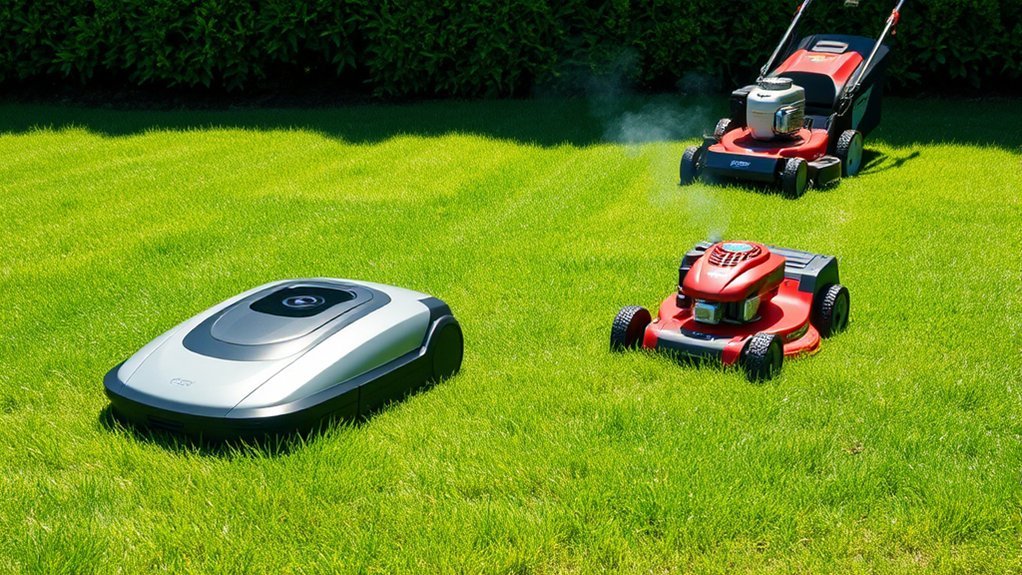
Both robot lawn mowers and traditional mowers offer distinct advantages and face specific limitations that influence their suitability for different users and terrains. Robot mowers excel in maintaining a consistent lawn aesthetic through frequent, incremental cuts, which promote healthy grass growth and minimize visible lines. They operate with notably lower noise levels, making them ideal for noise-sensitive environments. However, their limited cutting power and smaller cutting decks can be disadvantages on uneven or dense terrains, requiring more frequent intervention. Traditional mowers provide robust performance for larger or more challenging lawns, delivering faster coverage and higher cutting capacity, but they generate higher noise levels and may produce less uniform results. Ultimately, choosing depends on balancing these factors against individual lawn requirements and user preferences.
Which Factors Should Influence Your Lawn Mower Choice?
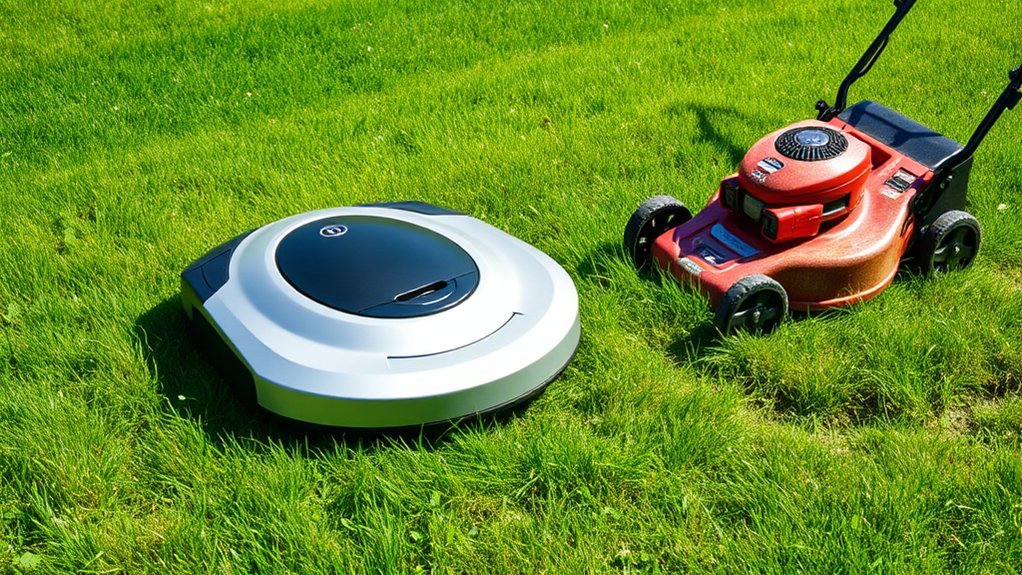
Selecting the right lawn mower hinges on a thorough evaluation of several critical factors that directly impact performance, efficiency, and suitability for your specific yard. Lawn size is paramount; larger areas require more robust power sources or increased cutting capacity, while smaller lawns benefit from lightweight, maneuverable models. Battery life is equally important, especially for electric mowers—longer battery endurance ensures consistent operation without frequent recharging, which is essential for extensive lawns. Additionally, terrain complexity, grass type, and maintenance preferences influence the choice. For instance, robot mowers excel in uniform, moderate slopes but may struggle with dense or uneven terrain. Ultimately, understanding these factors helps tailor your selection to optimize mowing efficiency, reduce operational downtime, and guarantee a sustainable, effective solution for your yard’s unique needs.
How Much Do Robot and Traditional Mowers Cost and Maintain?
Understanding the cost and maintenance requirements of robot and traditional mowers is essential for making an informed investment. Robot mowers typically have higher upfront costs, ranging from $1,000 to $3,000, but lower ongoing expenses due to minimal labor. Battery life is a critical factor, with most models offering 1-2 years before battery replacement is needed, impacting long-term costs. Noise levels are considerably lower in robot mowers, often operating at a fraction of traditional mower noise, reducing disturbance and potential noise-related maintenance issues. Traditional mowers have lower initial prices, generally between $200 and $800, but incur higher maintenance costs, including fuel, oil, and blade replacements. Overall, evaluating these factors helps determine the most economical choice over the mower’s lifespan.
Is a Robot Mower Right for Your Yard? Considerations and Recommendations
Determining whether a robot mower suits your yard requires evaluating several key factors, including lawn size, terrain complexity, and boundary management. Smart technology plays a vital role here, as advanced sensors and boundary wires guarantee precise navigation and efficient mowing. For large or irregularly shaped lawns, a robot mower’s ability to adapt to changing terrain and avoid obstacles is essential. Additionally, its environmental impact is markedly lower than traditional gas-powered models, reducing emissions and energy consumption. However, complex terrains with steep slopes or dense obstacles may challenge automation, requiring manual intervention or alternative solutions. We recommend analyzing your yard’s size and complexity carefully, considering smart technology features and environmental benefits, before investing in a robot mower to guarantee it aligns with your landscape’s specific needs.
Frequently Asked Questions
Can Robot Lawn Mowers Handle Uneven or Hilly Terrain Effectively?
Robot lawn mowers often excel in terrain adaptability, thanks to advanced sensors and powerful motors, enabling effective hill climbing ability on uneven or hilly terrain, though performance varies with mower model and slope steepness.
How Do Robot Mowers Perform in Different Weather Conditions?
Like a sturdy ship, robot mowers sail through varying weather; their weather resilience and seasonal performance adapt to rain, sun, or frost, maintaining efficient operation, though extreme conditions may still challenge their capabilities and longevity.
Are Robot Lawn Mowers Safe for Children and Pets?
Robot lawn mowers are generally safe for children and pets due to child safety features like sensors, automatic shut-off, and low blade exposure, but supervision is recommended to prevent accidental contact or interference during operation.
What Is the Typical Lifespan of a Robot Lawn Mower?
Ironically, robot lawn mowers often outlast expected battery life, typically around 3-8 years, with proper maintenance; neglecting maintenance drastically shortens lifespan, despite their advanced technology and seemingly endless battery endurance.
Do Robot Mowers Require Wi-Fi or Internet Connectivity?
We find that robot mowers typically require Wi-Fi setup for efficient operation, but they don’t depend on constant internet connectivity; their primary functions are local, with remote features relying on internet for updates, app control, and troubleshooting.
Conclusion
In the end, choosing between a robot and traditional mower isn’t just about convenience or power—it’s a paradox of automation versus manual mastery. While robots promise effortless maintenance, they often demand a precise setup and limited terrain flexibility. Conversely, traditional mowers, with their brute strength, require relentless effort. Ironically, the more we rely on technology to ease our chores, the more we might find ourselves caught in a balancing act of complexity and control.