Ad Blocker Detected
Our website is made possible by displaying online advertisements to our visitors. Please consider supporting us by disabling your ad blocker.
Some might assume that choosing between a robot mower and a push mower is a straightforward decision based solely on lawn size, but the reality involves a complex analysis of terrain, budget, and personal preferences for control. While robot mowers offer automated, consistent maintenance with minimal effort, push mowers provide flexibility for irregular shapes and smaller areas. Understanding these nuances is essential for selecting the best fit, which requires examining technical differences that could profoundly impact long-term satisfaction.
Key Takeaways
- Robot mowers are autonomous, ideal for large or flat lawns, while push mowers require manual effort, suitable for small or varied terrains.
- Robot mowers offer consistent, neat cuts with minimal user intervention; push mowers provide greater control but need active handling.
- Initial costs of robot mowers are higher, but they have lower ongoing expenses; push mowers are cheaper upfront but cost more in maintenance and fuel.
- Robot mowers operate quietly, environmentally friendly, and require setup of boundary wires; push mowers are noisier, less automated, and easier to store.
- Choice depends on lawn size, terrain, budget, and lifestyle preferences, balancing automation with manual control needs.
Understanding the Differences Between Robot Mowers and Push Mowers
While both robot mowers and push mowers serve the primary function of cutting grass, their operational mechanisms and design features differ considerably. Robot mowers utilize automated, sensor-driven systems to navigate and maintain consistent cutting patterns, promoting uniform lawn aesthetics. They operate on scheduled mowing frequency, which guarantees a regularly groomed appearance without manual intervention. In contrast, push mowers require manual operation, relying on user control to determine mowing patterns and frequency. This manual approach allows for tailored mowing intervals but demands more effort. Robot mowers excel in maintaining a neat, evenly cut lawn through their precise, programmable routines, whereas push mowers offer flexibility but can result in uneven mowing if not managed consistently. Understanding these differences clarifies their impact on lawn aesthetics and maintenance routines.
How Lawn Size and Terrain Influence Your Mower Choice
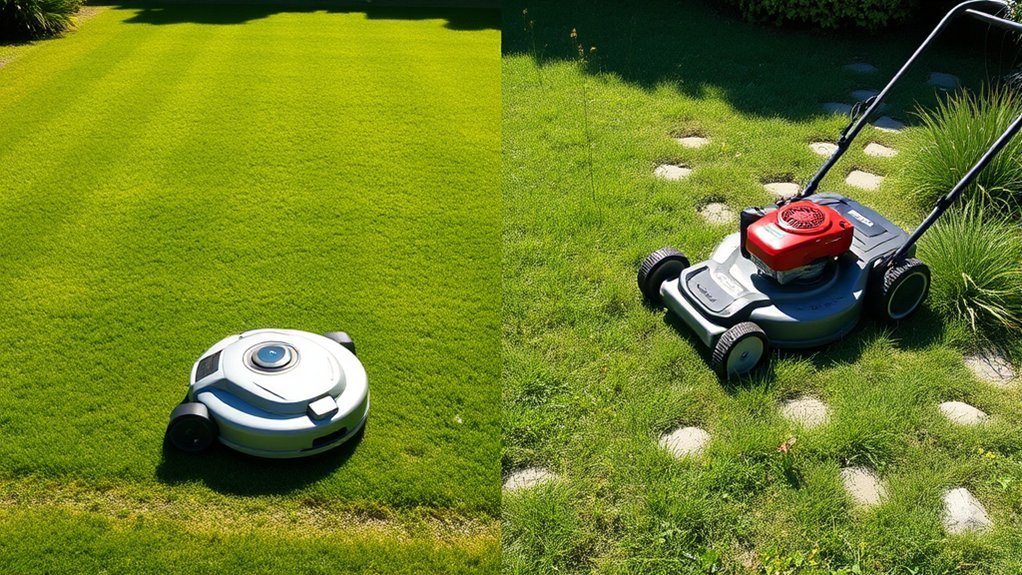
The size and terrain of your lawn are critical factors that directly influence the most suitable mower choice. Larger lawns generally favor robot mowers due to their ability to operate continuously with minimal oversight, maintaining lawn aesthetics efficiently. Conversely, push mowers are more practical for smaller, intricately landscaped areas, offering precise control for detailed trimming. Terrain complexity also matters; uneven or hilly terrain can challenge robot mower stability and safety, requiring models with advanced sensors and stability features to ensure mower safety and consistent cutting performance. For flat, uniform surfaces, both mower types perform well, but safety considerations—such as sharp blades and power sources—must be prioritized to prevent accidents. Ultimately, matching mower capabilities to lawn size and terrain guarantees excellent aesthetics and safety.
Comparing Cost, Maintenance, and Operating Expenses of Both Mowers
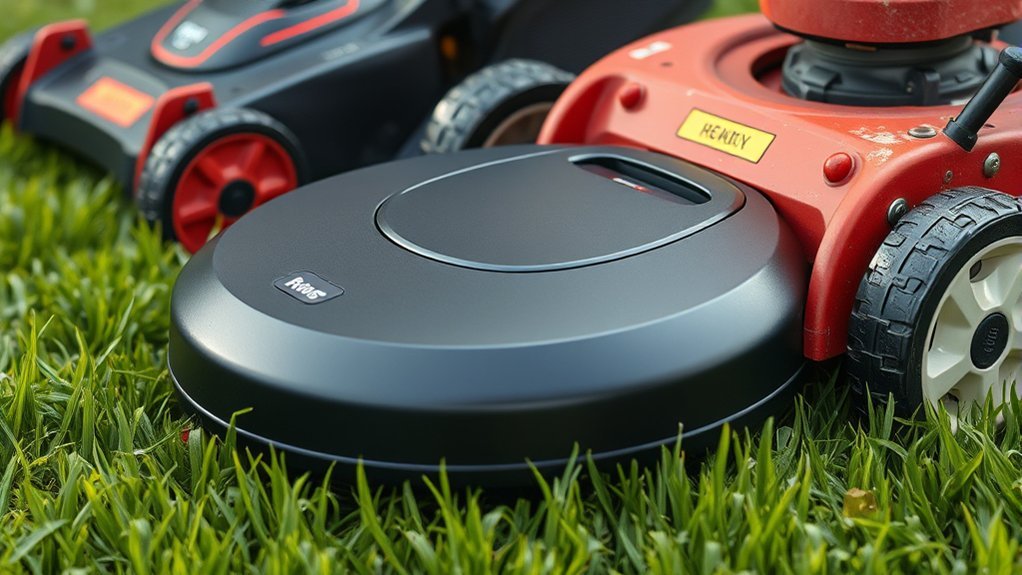
When evaluating the overall value of robot mowers and push mowers, it’s essential to consider not only their initial purchase price but also ongoing costs related to maintenance and operation. Robot mowers typically have higher upfront costs but incur lower daily operating expenses, thanks to minimal fuel use and reduced labor. Their maintenance mainly involves blade replacements and software updates, which can enhance mower durability over time. Push mowers generally have lower initial costs but entail ongoing expenses like fuel, oil, and wear-and-tear on parts, affecting mower durability. When it comes to lawn aesthetics, robot mowers provide consistent, precise cuts, reducing uneven patches. Conversely, push mowers may require more effort to maintain uniformity. Overall, balancing upfront investment with long-term expenses is key to choosing the most cost-effective option.
Evaluating Convenience: Hands-Free Automation vs. Manual Control
When evaluating convenience, we focus on ease of use and the degree of manual control each mower provides. Robot mowers offer automated operation with minimal user intervention, while push mowers require active manual handling and precise maneuvering. Understanding these differences helps determine which approach aligns best with user preferences for control and effort.
Ease of Use
While both robot and push mowers aim to simplify lawn maintenance, their ease of use hinges on distinct operational paradigms. Robot mowers leverage smart technology, offering autonomous operation that requires minimal manual intervention. Setup involves programming boundary wires and scheduling, which can be streamlined with user-friendly interfaces. Ergonomic design enhances usability, with intuitive controls and accessible maintenance points. Conversely, push mowers demand physical effort and manual operation, relying on straightforward mechanical controls rather than digital interfaces. Handling a push mower involves physical strength and coordination, but it offers immediate control without learning curves. Overall, robot mowers excel in convenience due to automation and smart tech, while push mowers depend on user effort and manual dexterity, making their ease of use context-dependent based on user preferences and physical capabilities.
Level of Control
The level of control offered by a mower considerably influences how users experience lawn maintenance, especially when comparing autonomous robotic models to traditional push mowers. Robotic mowers provide hands-free automation, allowing precise scheduling and consistent coverage that maintains garden aesthetics without manual intervention. This autonomy minimizes user input but limits real-time adjustments, impacting customization options. Conversely, push mowers offer manual control, enabling users to tailor mowing patterns, mowing height, and direction to specific landscape features, enhancing mower customization. While robotic mowers excel in convenience and uniformity, they restrict nuanced control over detailed landscaping. Push mowers require more effort but afford complete control over mowing, appealing to those prioritizing garden aesthetics through personalized mowing techniques.
Cutting Performance and Lawn Quality: Which Mower Delivers Better Results?
Although both robot mowers and push mowers are designed to cut grass efficiently, their performance regarding cutting quality and lawn finish varies considerably. Robot mowers typically produce a more uniform cut, maintaining consistent grass height through precise, programmed patterns, which enhances aesthetic appeal. Their blades are engineered for fine, mulching cuts, resulting in a smoother finish that promotes healthy grass growth. Push mowers, on the other hand, allow for manual control over grass height and cutting pattern, but may produce uneven cuts without skillful operation. While push mowers can achieve sharp, clean edges and tailored cuts, robot mowers excel in maintaining a consistent, manicured look over time. Ultimately, the choice hinges on the desired lawn aesthetic and precision of cut required.
Setting Up and Installing Your Robot Mower vs. Using a Push Mower
Setting up a robot mower involves configuring boundary wires, installing charging stations, and programming operational parameters, which can take several hours depending on yard complexity. In contrast, using a push mower requires minimal setup—primarily assembling handles and adjusting cutting height—often completed within minutes. User-friendliness varies markedly, as robot mowers demand technical understanding for installation, whereas push mowers emphasize straightforward operation and maintenance.
Setup Complexity and Time
While setting up a robot mower involves multiple steps that require careful planning and precise installation, it generally takes longer initially compared to preparing a push mower for use. The process includes configuring boundary wires, programming navigation zones, and integrating safety features like obstacle detection. Additionally, selecting warranty options tailored to the robot’s electronic components adds complexity. Push mowers, in contrast, require minimal setup—mainly assembling handles and filling fuel or oil.
| Setup Aspect | Robot Mower | Push Mower |
|---|---|---|
| Installation Time | 1-2 hours, detailed configuration | 10-15 minutes, straightforward |
| Additional Requirements | Boundary wires, app setup | Basic assembly, fuel/oil |
| Safety Features Integration | Sensor calibration, zone mapping | Manual safety checks |
| Warranty Options | Extended, electronic coverage | Standard, limited coverage |
Installation Requirements and Tools
Installing a robot mower involves a series of technical steps that require specific tools and precise execution, whereas using a push mower generally demands minimal equipment and straightforward assembly. For a robot mower, you need boundary wires, a power source, and mounting stakes, along with tools like wire strippers and screwdrivers to establish the perimeter and connect the charging station. Proper placement is vital to maintain garden aesthetics and guarantee efficient coverage. In contrast, a push mower requires only basic tools for assembly—typically just a handlebar attachment and blade adjustment. Storage considerations also differ; robot mowers need a designated, sheltered spot to protect their electronic components and charging station, whereas push mowers can be stored in a shed or garage with minimal setup.
User-Friendliness and Convenience
Although setting up a robot mower involves multiple precise steps, its user-friendliness primarily hinges on the initial installation process, which can be automated through guided programming and an intuitive user interface. Modern models leverage smart technology to simplify setup, offering features like automatic boundary detection and scheduled mowing via mobile apps. The user interface, often accessible through touchscreens or smartphone integrations, streamlines task customization, zone management, and system diagnostics. This contrasts sharply with push mowers, which require manual operation with minimal technological input, relying on physical effort and straightforward start controls. Overall, robot mowers are designed for convenience, minimizing user intervention after initial setup, while push mowers depend heavily on user physical effort and straightforward, less technologically integrated controls.
Battery Life, Power, and Efficiency: What You Need to Know
Battery life, power output, and efficiency are critical factors when comparing robot mowers to push mowers, as they directly influence performance and operational costs. Battery longevity determines how long a robot mower can operate before recharging, impacting mowing schedules and overall productivity. Push mowers, typically powered by gasoline or corded electric sources, offer consistent power output but lack the automatic recharge benefits of battery systems. In terms of effectiveness, robot mowers utilize advanced battery management systems to optimize energy use, extending run times and reducing energy waste. Power output in robot models varies based on motor design and battery capacity, affecting cutting performance, especially on thicker grass. Understanding these technical aspects helps in selecting a mower aligned with your yard size, terrain, and maintenance preferences.
Noise Levels and Environmental Impact of Robot and Push Mowers
Robot mowers operate at markedly lower noise levels compared to traditional push mowers, reducing acoustic pollution during operation. Their electric motors produce minimal emissions, contributing to a more eco-friendly landscape maintenance process. Analyzing these factors highlights the environmental advantages of automated systems over conventional gasoline-powered equipment.
Noise Emission Comparison
When evaluating noise emissions, it becomes evident that robot mowers generally produce markedly lower sound levels compared to traditional push mowers, leading to reduced environmental noise pollution. Robot mowers operate at decibel levels typically between 60 and 70 dB, comparable to ambient conversation, which minimizes disturbance during operation. Conversely, push mowers often generate noise exceeding 85 dB, contributing considerably to noise pollution. This reduction in noise not only benefits the environment but also allows for greater mower customization of mowing schedules without disturbing neighbors. Additionally, lower noise levels help maintain lawn aesthetics by enabling more frequent mowing without noise-related restrictions. The technical design of robot mowers incorporates noise-reduction features, such as optimized blade operation and motor efficiency, further enhancing their environmentally friendly profile.
Eco-Friendly Operation Benefits
Compared to traditional push mowers, robot mowers offer considerable eco-friendly advantages primarily through their lower noise emissions and reduced environmental impact. Their quieter operation minimizes noise pollution, supporting better landscape aesthetics by allowing more flexible mowing schedules without disturbing occupants or wildlife. Additionally, robot mowers typically use rechargeable batteries, eliminating emissions associated with gasoline engines, which markedly decreases carbon footprint. Their precision in mower customization enables consistent, targeted trimming, reducing unnecessary energy use and soil disturbance. This controlled operation preserves lawn health and biodiversity. Overall, robot mowers promote sustainable landscaping practices, combining energy efficiency with minimal ecological disruption. These benefits make them an environmentally conscious choice that aligns with modern expectations for green, low-impact yard care.
Which Mower Fits Different Budget Ranges and Lifestyle Needs?
Selecting the right mower depends heavily on both your budget and specific lawn maintenance needs. For those prioritizing precision in lawn aesthetics and efficient seasonal maintenance, robotic mowers offer consistent trimming with minimal oversight, though they come at a higher initial cost. Push mowers, on the other hand, generally have lower upfront expenses and can be more adaptable for varied lawn sizes and terrains. When considering budget and lifestyle, keep in mind:
- Small to medium lawns: Push mowers are cost-effective and straightforward.
- Large properties: Robotic mowers reduce time and effort but require a higher investment.
- Variable terrain or obstacles: Push mowers provide better control.
- Seasonal maintenance frequency: Robotic mowers excel with frequent, consistent trimming.
Choosing the appropriate mower aligns with your financial constraints and desired lawn aesthetics, while accommodating seasonal maintenance needs.
Making the Final Decision: Pros and Cons of Robot Mowers and Push Mowers
Choosing between robot mowers and push mowers involves weighing their respective advantages and limitations regarding efficiency, cost, and usability. Robot mowers excel in automation, offering consistent, precise cutting with minimal user input, but their design aesthetics and build quality vary across brands, influencing durability and visual appeal. Push mowers, on the other hand, provide manual control and adaptability for diverse terrains, though they demand more physical effort and time. When making a final decision, consider brand reputation, which reflects product reliability and customer support, alongside aesthetic preferences. While robot mowers often feature sleek, modern designs, push mowers offer more traditional, rugged aesthetics. Ultimately, your choice hinges on balancing these factors with your lawn care needs, budget, and personal preference for ease or control.
Frequently Asked Questions
How Do Robot Mowers Handle Uneven or Sloped Lawns?
Robot mowers handle uneven or sloped lawns by adjusting their mowing algorithms for varying inclines, ensuring consistent lawn maintenance. They utilize advanced sensors for precise mowing, maintaining ideal cutting height and preventing slippage, consequently enhancing mowing precision on challenging terrains.
Are Robot Mowers Suitable for Complex or Obstacle-Filled Gardens?
We find robot mowers suitable for complex, obstacle-filled gardens, as they enhance garden aesthetics through precise navigation and consistent lawn maintenance, effectively handling diverse terrains and obstacles with advanced sensors and adaptive algorithms.
Can Robot Mowers Be Customized With Different Mowing Patterns?
Robot mowers offer limited customization options, primarily allowing users to set mowing schedules and zones, but they generally lack advanced customization of mowing patterns. Most models follow a random or predefined pattern, restricting precise pattern customization.
What Safety Features Do Robot Mowers Include for Children and Pets?
Like a vigilant guardian, robot mowers include child safety features like PIN codes, obstacle sensors, and emergency stop buttons, ensuring pet protection and child safety by preventing unintended operation or accidents on the lawn.
How Do Weather Conditions Affect the Performance of Each Mower Type?
Weather impact considerably affects mower performance; high lawn moisture can cause robot mowers to slip or clog sensors, while push mowers handle wet conditions better but risk damaging the grass. Both require weather consideration for ideal operation.
Conclusion
In weighing our options, choosing between robot and push mowers is like steering through a complex maze—each path offers distinct advantages. Robot mowers excel in consistent, hands-free operation with eco-friendly benefits, while push mowers provide direct control and affordability. Your decision hinges on lawn size, terrain, budget, and personal preference. By carefully analyzing these technical factors, you’ll find the mower that seamlessly integrates with your landscape needs, turning your yard into a well-orchestrated symphony of precision and control.