Ad Blocker Detected
Our website is made possible by displaying online advertisements to our visitors. Please consider supporting us by disabling your ad blocker.
Like a chess game with many strategic moves, choosing between a robot mower and a ride-on mower for large gardens involves weighing multiple factors. Each option presents unique advantages and limitations that can considerably influence maintenance, cost, and landscape management. As we examine their operation, terrain suitability, and technological features, you’ll find that making an informed decision depends on understanding these nuances — a task that becomes increasingly complex with the size and complexity of your garden.
Key Takeaways
- Ride-on mowers handle large, uneven, and complex terrains better than robot mowers, which are ideal for flat, open lawns.
- Robot mowers offer automated, low-maintenance operation, whereas ride-on mowers require manual control and regular servicing.
- For environmental impact, robot mowers are more eco-friendly with lower emissions and energy efficiency.
- Ride-on mowers generally have higher initial costs but accommodate attachments for versatility in large gardens.
- Robot mowers are more space-efficient and easier to store, suitable for smaller storage areas in large garden settings.
How Do Robot Mowers and Ride-On Mowers Differ in Operation?
Although both robot mowers and ride-on mowers are designed to maintain large gardens, their operational mechanisms differ considerably. Robot mowers operate autonomously, with battery life directly influencing their mowing patterns; shorter battery life means more frequent recharging and potentially irregular coverage. These mowers typically follow programmed or sensor-guided paths, ensuring consistent, systematic coverage of the designated area. In contrast, ride-on mowers are manually operated, relying on human control to determine mowing patterns, which often results in less uniform coverage but allows for quicker, larger-scale cutting. Battery life in robot mowers is critical for continuous operation, while ride-on mowers depend on fuel or electricity but are less constrained by operational time per charge. This fundamental difference shapes their suitability for various large garden maintenance needs.
Which Garden Size and Terrain Suit Each Mower Type?
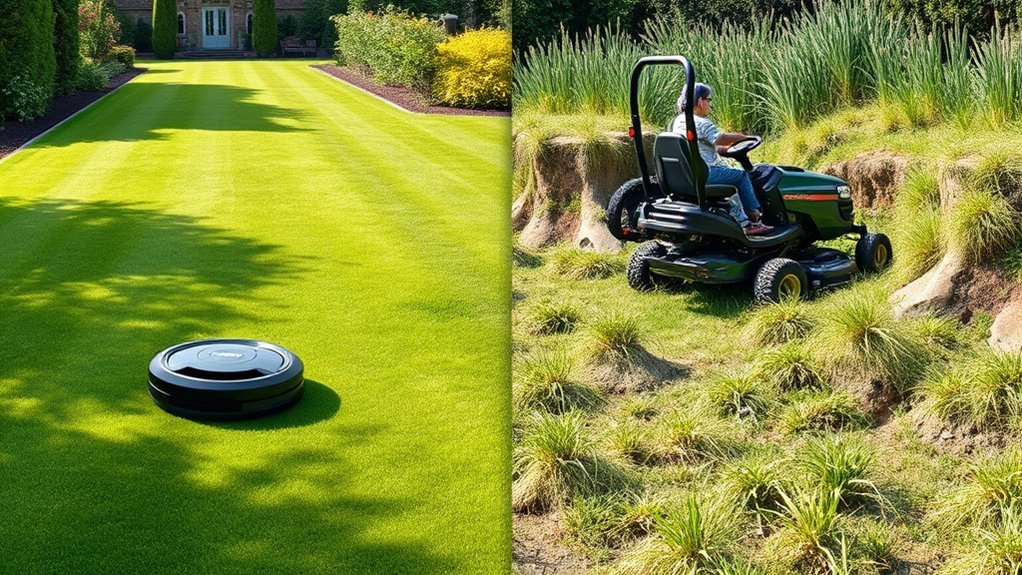
When selecting between robot mowers and ride-on mowers, understanding how each performs across different garden sizes and terrains is essential. Robot mowers are well-suited for small to medium gardens with relatively flat, even terrain, making them ideal for ongoing garden landscaping tasks. They require minimal mower storage space, fitting into compact areas, but may struggle on uneven ground or steep inclines. Conversely, ride-on mowers excel in large, complex gardens with varied terrain, including slopes and dense vegetation. They handle larger mowing areas efficiently but demand more mower storage and maintenance space. Steep or rocky terrain can limit robot mower effectiveness, requiring careful terrain assessment before selection. Ultimately, matching mower capabilities to garden size and terrain ensures suitable mowing efficiency and landscape management.
What Are the Cost Implications of Choosing a Robot or Ride-On Mower?
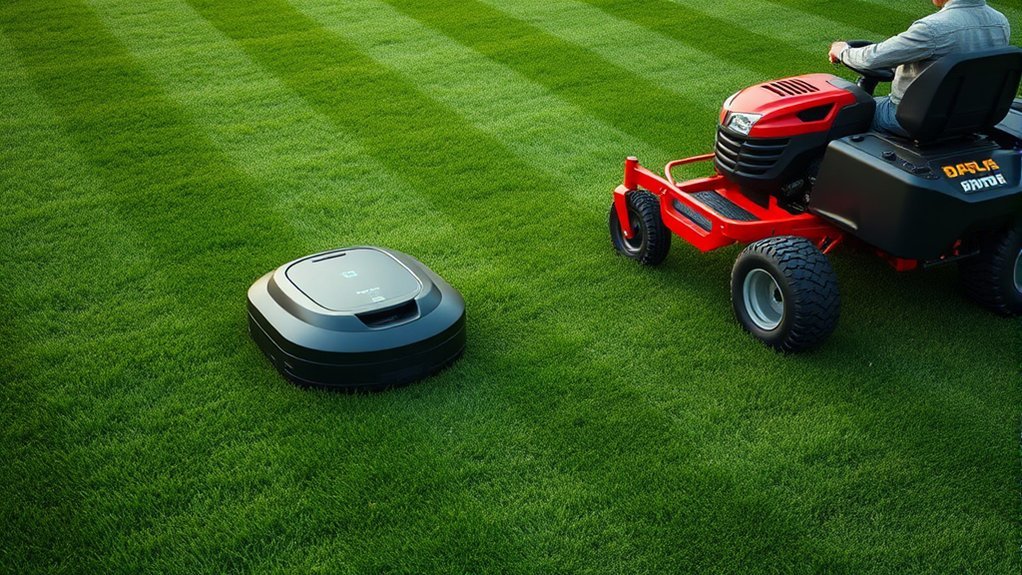
Choosing between a robot mower and a ride-on mower involves careful consideration of their respective costs, both upfront and ongoing. Pricing strategies vary considerably: robot mowers generally have a higher initial purchase price, reflecting advanced automation technology, while ride-on mowers often have more flexible pricing options. Maintenance and operational costs tend to be lower with robot mowers, but warranty coverage can influence long-term expenses. Many manufacturers offer all-inclusive warranties for robot mowers, which can mitigate potential repair costs, whereas ride-on mowers may require periodic part replacements and servicing. Ultimately, the decision depends on balancing immediate investment with long-term value, factoring in warranty coverage and the expected lifespan of each mower type. Analyzing these elements helps clarify the true cost implications for large garden maintenance.
How Do Maintenance and Operating Costs Compare?
Maintenance and operating costs differ considerably between robot mowers and ride-on mowers, impacting long-term affordability. A thorough cost analysis reveals that robot mowers typically have lower fuel and maintenance expenses but may incur higher initial costs due to advanced technology. Conversely, ride-on mowers often require more frequent servicing, oil changes, and fuel, leading to higher ongoing expenses. Technological advancements have improved robot mower durability and efficiency, reducing repair costs over time. Additionally, robot mowers benefit from programmable features that optimize power use, further lowering operating costs. To deepen understanding, consider these factors:
- Initial purchase price and depreciation
- Frequency and cost of routine maintenance
- Long-term energy and fuel expenses
What Features and Technology Should You Consider?
Selecting the right mower for large gardens involves evaluating key features and technological capabilities that influence performance, efficiency, and user convenience. Battery life is essential for robotic mowers, as longer-lasting batteries enable extended operation without frequent recharging, reducing downtime across large areas. For ride-on mowers, fuel efficiency and power management are equally important. Cutting height is another important feature, affecting the quality and consistency of the lawn finish; adjustable cutting heights allow for tailored mowing depending on grass type and growth conditions. Advanced models may offer programmable height settings and sensors to optimize cutting precision. Overall, focusing on robust battery performance and versatile cutting height adjustments ensures the mower can meet the demands of large gardens with efficiency and accuracy.
How Do Convenience and User Experience Vary?
When comparing convenience and user experience, ease of operation and maintenance requirements are key factors to contemplate. Robot mowers typically offer automated functions that minimize user input but may require regular software updates and blade checks. Conversely, ride-on mowers demand more manual effort for operation and upkeep, impacting overall user convenience.
Ease of Operation
While both robot mowers and ride-on mowers aim to simplify lawn care, their ease of operation varies considerably due to design and user interaction. Robot mowers offer a hands-free experience, often programmed via smartphone apps, making them accessible for diverse garden designs and maintaining consistent lawn aesthetics. Conversely, ride-on mowers require manual steering and physical control, which can be more physically demanding but provide direct engagement.
- Robot mowers excel in minimal user input, ideal for large, complex gardens
- Ride-on mowers demand skillful handling, especially on uneven terrain
- User familiarity with technology influences overall convenience and efficiency
Understanding these differences helps determine which mower aligns with specific garden layouts and user preferences, balancing ease of operation with desired lawn outcomes.
Maintenance Requirements
How do the maintenance requirements of robot mowers compare to those of ride-on mowers in regards to convenience and user experience? Robot mowers generally demand less ongoing maintenance, primarily limited to blade sharpening, software updates, and occasional cleaning. They operate autonomously, ensuring consistent mowing patterns that help preserve garden aesthetics. Ride-on mowers require regular engine servicing, oil changes, and more complex repairs, which can be time-consuming and costly. Additionally, ride-on mowers often need manual adjustments to mowing patterns, affecting the overall user experience.
| Aspect | Robot Mower | Ride-On Mower |
|---|---|---|
| Maintenance Tasks | Minimal, mainly blades & software | Frequent, engine & mechanical |
| Impact on Garden Aesthetics | Consistent, precise mowing patterns | Variable, depends on operator |
| User Convenience | High, low upkeep | Moderate, higher upkeep |
Which Mower Is More Eco-Friendly and Sustainable?
Electric robot mowers generally outperform ride-on mowers in regard to eco-friendliness and sustainability, primarily because they produce zero emissions during operation. They are usually powered by batteries that can be charged via solar charging, further reducing their carbon footprint. Additionally, many manufacturers implement battery recycling programs to minimize environmental impact at the end of their lifespan. In contrast, ride-on mowers typically rely on internal combustion engines, emitting greenhouse gases and contributing to air pollution. The energy source used for charging robot mowers greatly influences their sustainability; solar charging enhances eco-friendliness by utilizing renewable energy. Overall, robot mowers tend to be more sustainable due to their lower emissions, renewable energy options, and emphasis on battery recycling practices.
How to Decide Between a Robot Mower and Ride-On for Your Large Garden?
Choosing between a robot mower and a ride-on mower for a large garden depends on several practical considerations. Garden design plays a vital role; irregular shapes or complex layouts may favor ride-on mowers for maneuverability, while open lawns suit robots. Evaluating mower accessories is essential, as ride-on mowers often require additional attachments like grass collectors or mulchers, which can impact functionality. Conversely, robot mowers typically come with integrated cutting systems but may lack customization options. Budget constraints also influence decision-making; robots tend to have higher upfront costs but lower ongoing maintenance. Additionally, storage space needs differ—robot mowers demand minimal space, whereas ride-on mowers require more storage. Ultimately, analyzing your garden’s size, complexity, and your maintenance preferences will guide the ideal choice.
Frequently Asked Questions
Can Robot Mowers Handle Uneven or Hilly Terrain Effectively?
Robot mowers can handle uneven or hilly terrain if they feature advanced terrain navigation and slope adaptability. While some models excel on moderate slopes, steep or complex terrains may challenge their effectiveness, making ride-on mowers preferable for such conditions.
What Safety Features Are Common in Robotic and Ride-On Mowers?
Both robotic and ride-on mowers prioritize child safety with features like child lock systems and obstacle detection. Emergency stop buttons are standard, allowing quick shutdowns, ensuring safety during operation and preventing accidents in busy or uneven terrains.
How Long Does It Take for a Robot Mower to Complete Large Gardens?
We find that robot mowers typically complete large gardens within 2 to 8 hours, depending on battery life and mowing speed. These factors directly influence efficiency, with longer battery life and higher speeds reducing overall mowing time.
Are There Specific Garden Features That Limit Mower Options?
In our analysis, garden features like complex layouts and shrub obstacles considerably limit mower options, requiring careful consideration of terrain, maneuverability, and obstacle avoidance capabilities to guarantee effective coverage without damage or inefficiency.
What Is the Typical Lifespan of Each Mower Type?
Typically, robot mowers last 3-8 years, depending on battery life and maintenance, while ride-on mowers often endure 8-15 years with proper upkeep. Both require ongoing maintenance costs impacting their overall longevity and performance.
Conclusion
In summary, choosing between a robot mower and a ride-on mower depends on your garden’s size, terrain, and maintenance preferences. Studies show that ride-on mowers can cover up to 3 acres per hour, making them ideal for large, varied landscapes, while robot mowers excel in smaller, flat areas with minimal effort. Evaluating your specific needs and budget will guarantee you select the most efficient, cost-effective, and sustainable option for your garden.