Ad Blocker Detected
Our website is made possible by displaying online advertisements to our visitors. Please consider supporting us by disabling your ad blocker.
It’s interesting how, just as technology has advanced to automate home chores, the choice between robot mowers and lawn tractors remains a nuanced decision driven by specific yard needs. While both aim to maintain lawns efficiently, their design and functionality differ considerably, often influencing long-term satisfaction and cost. Understanding these distinctions is vital, especially when factors like terrain, size, and smart features come into play—details that can ultimately determine which option best suits your landscape.
Key Takeaways
- Robot mowers are ideal for small, flat yards, offering automated, low-maintenance lawn care, while lawn tractors suit large, uneven terrains needing more power.
- Robot mowers feature AI, sensors, and smart features for autonomous operation; lawn tractors rely on manual or programmed controls.
- Initial costs for robot mowers are higher, but they have lower ongoing maintenance; lawn tractors have higher purchase and upkeep expenses.
- Robot mowers operate quietly and efficiently with minimal user intervention, whereas lawn tractors are louder and require more hands-on management.
- The choice depends on yard size, terrain complexity, and desired automation; small, flat lawns favor robot mowers, larger landscapes favor lawn tractors.
How Do Robot Mowers and Lawn Tractors Differ in Design and Functionality
While both robot mowers and lawn tractors are designed to maintain grass, their core differences lie in their structural design and operational mechanisms. Robot mowers leverage artificial intelligence to navigate complex terrains efficiently, employing sensors and real-time data processing to adapt to obstacles and terrain variations. Their compact design minimizes footprint, and advancements in battery technology enable longer operation with quick recharging cycles. Lawn tractors, on the other hand, feature larger, more robust construction with mechanical systems driven by traditional engines or electric motors. They rely on manual or programmable controls rather than AI, emphasizing power and capacity for extensive lawns. The integration of modern battery technology in electric models enhances sustainability, but overall, the fundamental distinction remains in their autonomous capabilities and design architecture.
Which Equipment Is Best for Different Yard Sizes and Terrain Types
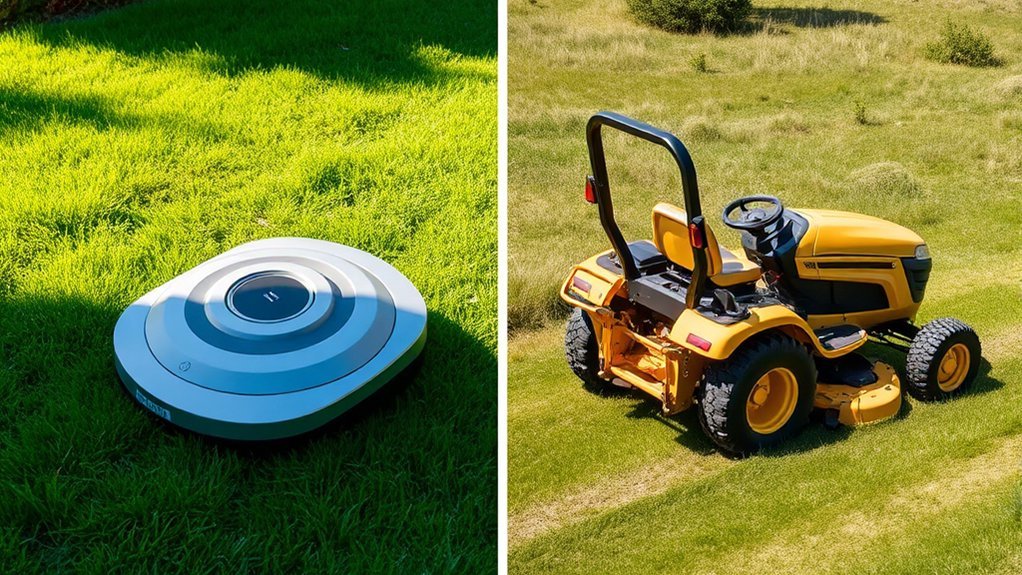
Selecting the appropriate mowing equipment depends heavily on the size and terrain of your yard. For small, flat areas, robot mowers efficiently maintain garden aesthetics with minimal environmental impact, thanks to their electric operation and precise cutting patterns. They excel in confined spaces, reducing noise and emissions. Conversely, larger or uneven terrains favor lawn tractors, which provide higher power and stability for diverse topographies, ensuring consistent coverage. Tractors handle rougher terrain better, preserving the landscape’s integrity and aesthetic appeal. Steep slopes or complex landscapes may require specialized equipment, as both options have limitations. Ultimately, matching equipment to yard size and terrain optimizes garden aesthetics while considering environmental impact, promoting sustainable maintenance practices and efficient lawn care.
Comparing Costs and Maintenance Needs of Robot Mowers vs Lawn Tractors
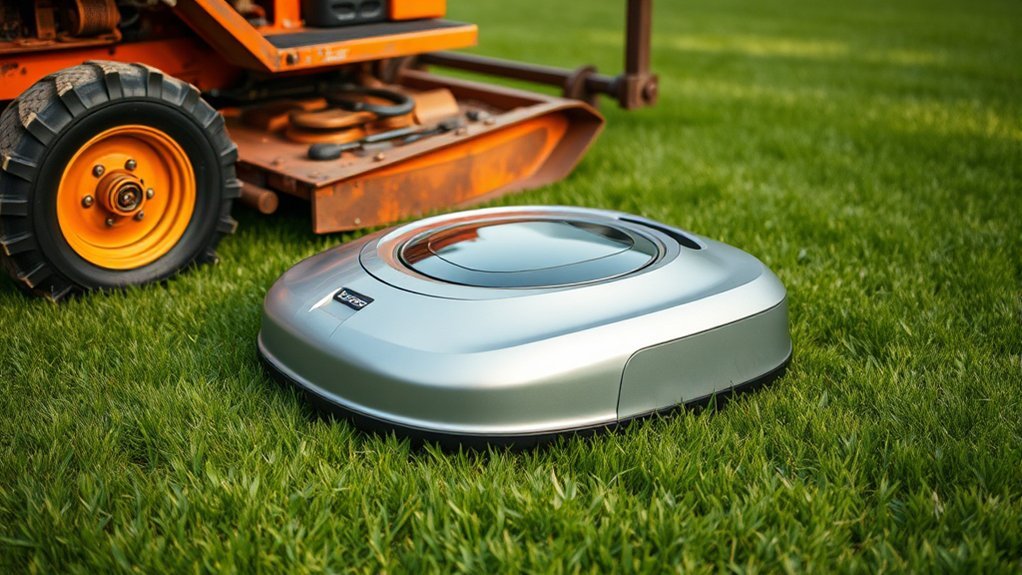
When comparing the costs and maintenance needs of robot mowers versus lawn tractors, it’s essential to analyze both initial investments and ongoing expenses. First, robot mowers typically have a higher upfront cost due to advanced technology, but lower long-term operating costs. Second, key factors include battery life, which affects runtime and replacement frequency; noise levels, as robot mowers operate quietly, reducing disturbance and potential maintenance from noise-related wear. Third, maintenance for robot mowers is minimal—mainly battery replacements and occasional blade sharpening. Conversely, lawn tractors involve higher initial purchase prices, more complex engine maintenance, and regular oil changes. Overall, robot mowers offer lower ongoing costs and simpler upkeep, but with higher initial investment, especially considering battery longevity.
Evaluating Convenience and Smart Features in Modern Lawn Care Equipment
Modern lawn care equipment incorporates a range of smart features designed to enhance convenience and optimize maintenance. Smart technology enables remote operation, scheduling, and real-time monitoring, reducing manual intervention. User interfaces vary from simple digital displays to advanced mobile apps, providing intuitive control and customization options. These interfaces allow users to adjust mowing patterns, receive alerts, and troubleshoot issues efficiently. In robot mowers, integrated sensors and GPS navigation improve precision and obstacle detection, minimizing user effort. Lawn tractors, equipped with modern control panels, often include programmable settings for automated tasks. Overall, these smart features streamline lawn maintenance, offering a combination of automation and user-friendly controls that markedly improve the convenience of modern lawn care equipment.
Making the Right Choice: Factors to Consider When Choosing Between a Robot Mower and a Lawn Tractor
Choosing the appropriate lawn care equipment requires a careful assessment of several key factors influenced by the landscape and user preferences. When deciding between a robot mower and a lawn tractor, consider these aspects:
- Smart technology: Robot mowers incorporate advanced automation and scheduling features, ideal for minimal user intervention. Lawn tractors, while less tech-intensive, offer robust power for larger or more complex terrains.
- Noise levels: Robot mowers operate quietly, suitable for maintaining peace during active hours, whereas lawn tractors generate higher noise, which may be disruptive.
- Terrain and size: Larger, uneven lawns may favor a lawn tractor’s power and durability, while smaller, flat areas benefit from the precision and convenience of a robot mower.
Assessing these factors ensures an informed, landscape-specific choice.
Frequently Asked Questions
How Long Do Robot Mowers Typically Operate on a Full Charge?
Robot mowers typically operate for 60 to 90 minutes on a full battery charge, depending on battery life and terrain. They usually require 1-2 hours of charging time to replenish, ensuring continuous, efficient mowing cycles.
Can Robot Mowers Handle Uneven or Sloped Lawns Effectively?
We find that robot mowers can handle uneven terrain and slopes effectively, thanks to advanced terrain adaptability and precise slope navigation features; however, performance varies with degree of incline and mower specifications, requiring careful selection for challenging landscapes.
Are Robot Mowers Suitable for Thick or Tall Grass?
We find robot mowers struggle with thick or tall grass due to dense grass density and limited mower height adjustment, which hampers cutting efficiency. They’re best suited for moderate grass height, not heavy, overgrown lawns needing a more powerful mower.
What Safety Features Are Included in Modern Robot Mowers?
Modern robot mowers include safety sensors that detect obstacles and prevent accidents, enhancing safety, while battery life guarantees consistent operation. These features collectively optimize user protection and operational efficiency in automated lawn maintenance systems.
How Do Lawn Tractors Perform in Winter or Off-Season Conditions?
Lawn tractors struggle in winter, often requiring winter storage and seasonal maintenance. They perform poorly in snow and cold, demanding careful preparation and maintenance to guarantee peak operation after off-season conditions.
Conclusion
Ultimately, choosing between a robot mower and a lawn tractor hinges on your yard’s size and terrain. For instance, a homeowner with a compact, flat backyard might find a robot mower more efficient and cost-effective, while someone managing a large, uneven lawn may prefer the power and durability of a lawn tractor. Analyzing operational costs, maintenance, and smart features helps guarantee a decision that balances performance with convenience, optimizing your lawn care strategy.