Ad Blocker Detected
Our website is made possible by displaying online advertisements to our visitors. Please consider supporting us by disabling your ad blocker.
Did you know that robot lawn mowers typically operate on rechargeable batteries and use obstacle sensors for safety, making them highly autonomous and low-maintenance? While they excel on small to medium, flat lawns, ride-on mowers are designed for larger, uneven terrains and often require more physical effort and higher upfront costs. Understanding these fundamental differences can influence your decision, but there are many more factors—like cost, safety, and environmental impact—that warrant careful consideration.
Key Takeaways
- Robot mowers are autonomous, suitable for small to medium flat lawns, while ride-on mowers are manual and ideal for large, uneven terrains.
- Robot mowers have higher upfront costs but lower ongoing maintenance and operational expenses compared to ride-on mowers.
- Ride-on mowers offer faster, more powerful cutting for extensive, rugged landscapes, unlike robot mowers with limited speed and power.
- Robot mowers are eco-friendly, quiet, and require minimal maintenance, whereas ride-on mowers need regular engine servicing and fuel.
- Choice depends on lawn size, terrain complexity, budget, and desired convenience.
How Do Robot Lawn Mowers and Ride-On Mowers Differ in Design and Function?
While both robot lawn mowers and ride-on mowers are designed to maintain grass, their structural and functional distinctions are significant. Robot design emphasizes compactness and automation, featuring streamlined bodies with integrated sensors, obstacle detection, and autonomous navigation systems. These mowers operate on rechargeable batteries, utilizing cutting-edge sensors and programming to map and adapt to terrain. Mower functionality in robots includes precise, consistent cutting patterns, often with customizable schedules, reducing manual intervention. Conversely, ride-on mowers are larger, with robust frames and user-controlled steering and speed mechanisms, relying on internal combustion engines or larger batteries. Their mower functionality centers on manual operation, providing high power and capacity for extensive lawns but lacking the autonomous features and intricate sensor integration found in robot designs.
Which Lawn Size and Terrain Are Best Suited for Each Mower Type?
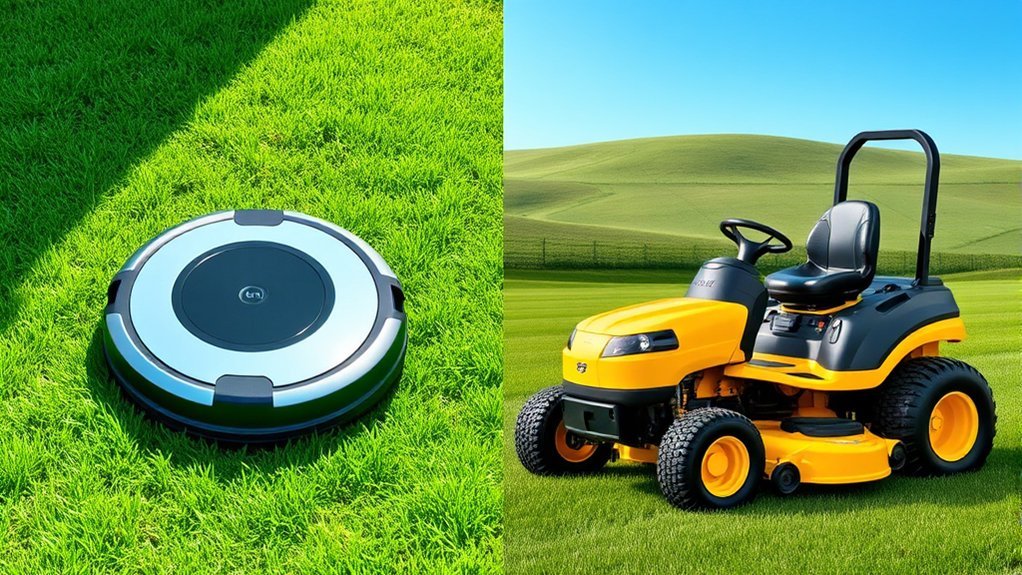
When selecting between robot and ride-on mowers, understanding ideal lawn size and terrain features is essential. Robot mowers excel on smaller, relatively flat areas with minimal obstacles, while ride-on mowers are better suited for large, uneven terrains with complex topography. Analyzing these factors guarantees the chosen mower matches the specific dimensions and terrain characteristics of the lawn.
Suitable Lawn Dimensions
Choosing the appropriate mower depends heavily on the size and terrain of your lawn, as each type is tailored for specific conditions. Robot lawn mowers excel on small to medium-sized lawns with intricate layouts, where precision enhances lawn aesthetics. They are ideal for flat to gently sloped terrains, requiring minimal seasonal adjustments due to their consistent mowing pattern. Conversely, ride-on mowers suit larger, open expanses, effectively managing expansive areas with varied topography. Their capacity for covering extensive ground makes them suitable for lawns with uneven terrain, where seasonal adjustments, such as blade height modifications, maximize cutting efficiency. Properly matching mower size to lawn dimensions ensures peak performance, reduces maintenance, and maintains the desired aesthetic regardless of seasonal changes.
Terrain Compatibility Factors
Selecting the right mower for your lawn’s terrain hinges on understanding the specific compatibility factors related to size and topography. Robot lawn mowers excel on flat, even surfaces and smaller areas, leveraging artificial intelligence to navigate obstacles efficiently. Their battery lifespan is optimized for such terrains, but steep slopes or rugged landscapes can challenge their stability and coverage. Ride-on mowers, however, are better suited for larger, uneven terrains due to their robust construction and higher power output. They can handle inclines and complex topography more effectively, though they require more maintenance. Terrain complexity directly influences mower choice; artificial intelligence in robot mowers enhances precision but may struggle with severe slopes, while a ride-on mower’s mechanical design ensures reliable performance on diverse terrains.
What Are the Cost Considerations for Robot Mowers Versus Ride-On Mowers?
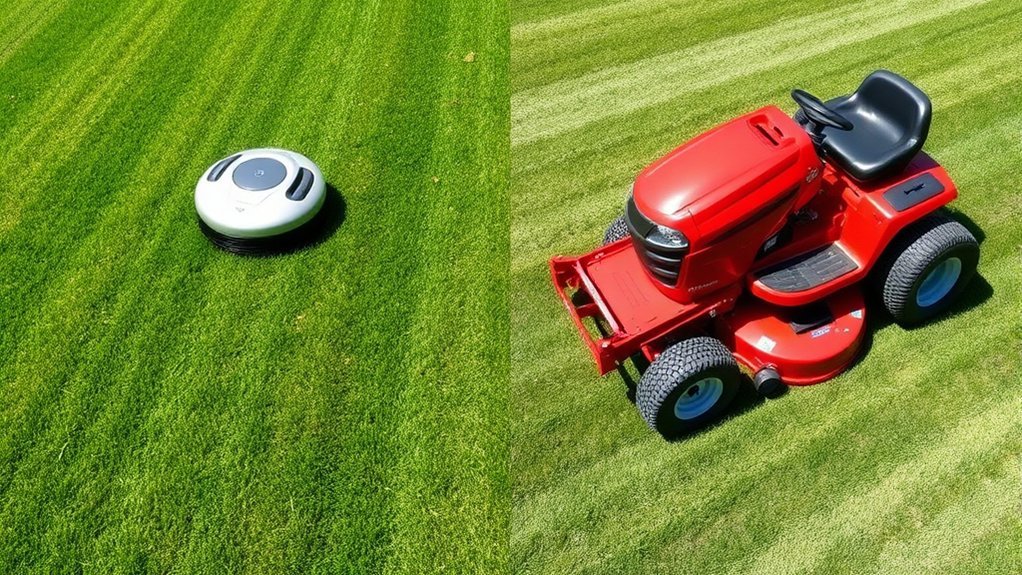
Although robot mowers typically have a higher initial purchase price, their ongoing operational costs can be markedly lower than ride-on mowers, which often require more frequent maintenance, fuel, and repairs. In a detailed cost comparison, robot mowers benefit from lower fuel and maintenance expenses due to their electric operation and minimal moving parts. Additionally, their warranty coverage often extends to battery replacement and electronic components, reducing unexpected costs. Ride-on mowers, conversely, incur higher fuel costs, regular oil changes, and more substantial repairs due to their complex mechanical systems. While the upfront investment in robot mowers is substantial, the reduced long-term expenses and all-encompassing warranty coverage can lead to significant savings over time, making them a cost-effective choice for many homeowners seeking efficient lawn management.
How Do Maintenance and Operating Costs Compare Between the Two Options?
When comparing maintenance and operating costs between robot and ride-on mowers, we find that robot mowers generally incur lower ongoing expenses due to their simplified mechanical design and electric power source. Battery technology advancements, such as lithium-ion cells, have improved efficiency and lifespan, reducing replacement frequency and costs. Maintenance for robot mowers mainly involves blade sharpening or replacement and battery health monitoring, typically covered under warranty options, which help mitigate repair expenses. Ride-on mowers, on the other hand, require regular engine oil changes, spark plug replacements, and more extensive mechanical upkeep, leading to higher costs over time. Operating costs for robot mowers are also lower, as they consume less energy and need fewer consumables. Overall, robot mowers offer a more predictable, cost-effective maintenance profile thanks to streamlined components and all-encompassing warranty plans.
What Are the Key Safety Features and Risks of Robot and Ride-On Mowers?
Both robot and ride-on mowers incorporate a range of safety features designed to minimize operator risk, yet each presents distinct safety considerations rooted in their operational mechanisms. Robot mowers typically include safety protocols like obstacle detection sensors, lift and tilt sensors that halt blades if lifted, and boundary wires to prevent unintended movement. Ride-on mowers often rely on seat sensors that disable blades when the operator leaves, emergency stop buttons, and blade engagement controls.
Both robot and ride-on mowers prioritize safety with sensors, emergency stops, and boundary systems to reduce operator risk.
Key safety features include:
- Obstacle detection and avoidance systems
- Automatic blade shutoff when lifted or overturned
- Emergency stop mechanisms
- Operator presence sensors
- Boundary or perimeter sensors
Effective risk management involves understanding these safety protocols and addressing mechanical or operational hazards to mitigate accidents.
Which Mower Offers Greater Convenience and Time Savings?
When comparing convenience and time savings, we focus on each mower’s efficiency and ease of operation. Robot mowers automate routine trimming with minimal user input, reducing manual effort, while ride-on mowers cover larger areas quickly with straightforward controls. Analyzing these aspects helps determine which option minimizes time investment while maximizing productivity.
Time Efficiency Benefits
Robot lawn mowers typically offer greater time efficiency and convenience compared to ride-on mowers due to their autonomous operation and programmable scheduling capabilities. They can consistently maintain the lawn, reducing the need for manual intervention and enabling users to allocate time elsewhere. These mowers operate quietly, minimizing noise levels that often disrupt daily routines or disturb neighbors, and their aesthetic appeal remains high because they can produce uniform cuts with precision sensors.
Key benefits include:
- Continuous, scheduled mowing without supervision
- Reduced downtime for maintenance or setup
- Minimized noise disturbance
- Consistent, high-quality cut for a uniform appearance
- Compact design that preserves landscape aesthetics
Ease of Use
Ease of use markedly influences the overall convenience and time savings associated with each mower type. Robot design plays a crucial role, as intuitive interfaces and programmable features simplify operation and reduce user intervention. A well-designed robot lawn mower requires minimal manual input, thanks to advanced sensors, automated navigation, and adaptive cutting algorithms, enhancing mower comfort by minimizing user fatigue. Conversely, ride-on mowers demand more physical effort and manual handling, which can be time-consuming and less ergonomic, especially during extended use. The robot’s streamlined operation and autonomous functionality translate to greater ease of use, allowing users to set schedules and forget about manual labor. Ultimately, the robot’s design fosters a more effortless mowing experience, offering superior convenience and significant time savings over traditional ride-on models.
How Do Performance and Cutting Quality Vary Between Robot and Ride-On Mowers?
While both robot and ride-on mowers are designed to efficiently maintain lawns, their performance and cutting quality differ markedly due to their underlying technologies and operational mechanisms. In a performance comparison, robot mowers excel in consistent, precise trimming but may struggle with uneven terrain or tall grass, impacting cutting precision. Ride-on mowers, equipped with larger blades and higher horsepower, deliver faster, more uniform cuts across varied surfaces. Key differences include:
- Robot mowers provide steady, repeatable cuts but may leave uneven patches
- Ride-on mowers handle dense, thick grass more effectively
- Cutting precision depends on blade design and maneuverability
- Robot mowers excel in detailed, repetitive trimming tasks
- Ride-on mowers offer superior performance on large, complex lawns
Understanding these distinctions helps optimize your lawn care based on performance needs.
What Features Should You Look for When Choosing Between Them?
When selecting between a robot mower and a ride-on mower, it’s essential to evaluate specific features that align with your lawn’s size, terrain, and maintenance needs. Key factors include cutting width, terrain adaptability, and mower customization options to optimize lawn aesthetics. For uneven terrain, look for models with adjustable cutting heights and robust traction. Consider battery life for robot mowers, ensuring sufficient coverage, and safety features like sensor systems. Mower customization options, such as blade types and programming, enhance performance.
| Feature | Robot Mower | Ride-On Mower |
|---|---|---|
| Cutting Width | Narrow, suited for precision | Wide, ideal for large lawns |
| Terrain Adaptability | Sensors for obstacle avoidance | Adjustable suspension |
| Customization | Programmable schedules, blades | Speed, cutting height, attachments |
Are There Environmental Benefits to Using Robot or Ride-On Mowers?
Choosing between a robot mower and a ride-on mower involves considering not only performance and convenience but also their environmental impacts. Robot mowers generally operate on rechargeable batteries, often powered by renewable energy sources, notably reducing carbon emissions compared to traditional gas-powered ride-ons. They produce minimal noise pollution, which benefits urban and suburban environments. Ride-on mowers, while sometimes more powerful, tend to emit higher levels of greenhouse gases if gasoline-powered. Additionally, their larger engines contribute to increased noise pollution and air quality concerns.
- Reduced greenhouse gas emissions with electric robot mowers
- Lower noise pollution levels
- Use of renewable energy sources for battery charging
- Minimal air and soil contamination
- Smaller carbon footprint during operation
Which Mower Is the Right Fit for Your Lawn Care Needs and Lifestyle?
Choosing the right mower depends on factors like lawn size, where robot mowers excel in small to medium yards and ride-on models suit larger areas requiring extensive coverage. Maintenance requirements and ease of operation vary considerably between the two, impacting long-term usability and labor time. Budget considerations also play a critical role, as initial costs and ongoing expenses differ, affecting overall value based on your specific lawn care needs and lifestyle.
Lawn Size Compatibility
Lawn size plays a crucial role in determining the most suitable mower type for your needs, as each option offers distinct advantages based on the area it’s designed to cover efficiently. For large lawns, ride-on mowers excel due to their high horsepower and broad cutting decks, ensuring efficient coverage without sacrificing garden aesthetics. Conversely, robot lawn mowers are ideal for small to medium-sized yards, offering precise, quiet operation that maintains a tidy appearance with minimal effort. When choosing, consider mower branding for durability and reliability, especially for extensive use. Keep in mind that:
- Larger lawns benefit from ride-on mowers’ power and speed
- Small lawns suit compact robot models for convenience
- Terrain complexity influences mower choice
- Garden aesthetics depend on consistent cutting patterns
- Maintenance requirements vary with size and mower type
Maintenance and Ease
While both robot and ride-on mowers require regular maintenance, their ease of use and time commitment differ considerably, affecting your lawn care routine and lifestyle. Robot mowers leverage smart technology for autonomous operation, enabling minimal user intervention, primarily requiring routine blade sharpening and software updates. Ride-on mowers, however, demand more hands-on maintenance, such as engine tune-ups, belt checks, and fluid replacements, but offer ergonomic design features for operator comfort.
| Aspect | Robot Mower | Ride-On Mower |
|---|---|---|
| Maintenance Frequency | Low (Blade sharpness, software updates) | Higher (Engine, belts, fluids) |
| Ease of Use | Automated, user-friendly | Manual operation, controls |
| Technological Integration | Smart technology, sensors | Less automation, simpler controls |
Budget and Cost
When evaluating the budget and overall cost, it’s essential to take into account both the initial investment and ongoing expenses associated with each mower type. Robot lawn mowers typically have a higher upfront cost but lower seasonal maintenance, making them ideal for urban gardening where space is limited. Ride-on mowers often require a significant initial purchase and regular service costs, especially for larger lawns. For smaller, intricately landscaped yards, robots can reduce labor and time. Conversely, ride-ons are better suited for extensive lawns requiring frequent seasonal maintenance.
- Initial purchase price
- Regular maintenance costs
- Fuel or electricity consumption
- Durability and lifespan
- Suitability for lawn size and terrain
Frequently Asked Questions
Can Robot Mowers Handle Uneven or Hilly Terrain Effectively?
Robot mowers can handle uneven or hilly terrain effectively, thanks to advanced terrain adaptability features and efficient battery technology. Their smart sensors and motor power guarantee stable operation on challenging slopes, optimizing battery efficiency during extended mowing sessions.
How Long Does It Take to Set up and Program Each Mower Type?
Setting up a robot mower takes about 30-60 minutes, focusing on boundary wire placement and programming, while a ride-on mower needs roughly 1-2 hours for assembly and tuning; battery life and noise levels influence operational efficiency.
Are There Specific Lawn Conditions That Favor One Mower Over the Other?
We find robot lawn mowers ideal for small, flat, and intricately landscaped gardens, enhancing aesthetics with minimal noise, while ride-on mowers suit larger, uneven terrains where powerful cutting and maneuverability are essential.
What Is the Typical Lifespan of Robot Versus Ride-On Mowers?
Robot lawn mowers typically last 3-8 years depending on battery life and cutting efficiency, while ride-on mowers often last 8-15 years, with durability influenced by engine quality and maintenance practices.
Do Robot Mowers Require Wi-Fi or App Connectivity for Operation?
We find that robot mowers often require Wi-Fi or app connectivity for smart home integration, managing battery life efficiently, and enabling remote control. This technical setup guarantees seamless operation, monitoring, and maintenance, enhancing our lawn care experience.
Conclusion
Ultimately, choosing between a robot lawn mower and a ride-on mower hinges on our specific lawn size, terrain, and lifestyle. While the precision and low maintenance of robots suit smaller, flat areas, the rugged efficiency of ride-ons caters to larger, uneven landscapes. Both options align with our environmental values and safety priorities. Making an informed choice guarantees our outdoor spaces remain meticulously maintained, transforming an ordinary chore into a seamless, satisfying experience that feels almost destined.