Ad Blocker Detected
Our website is made possible by displaying online advertisements to our visitors. Please consider supporting us by disabling your ad blocker.
Ensuring the safety of robotic lawn mowers through obstacle detection is a complex challenge that combines multiple sensor technologies and sophisticated algorithms. While these systems are designed to prevent collisions, understanding their limitations and maintenance requirements is vital for peak performance. As advancements continue, the potential for more reliable and intelligent obstacle detection grows, prompting us to contemplate what innovations might shape future safety standards and operational reliability.
Key Takeaways
- Regularly test and calibrate sensors to ensure accurate obstacle detection and minimize false alarms.
- Keep sensor surfaces clean and free from debris to maintain reliable detection performance.
- Use multiple sensors like ultrasonic, infrared, and bump sensors for comprehensive obstacle awareness.
- Understand sensor limitations, such as environmental influences, to enhance safety and avoid false positives.
- Incorporate future innovations like machine learning and multi-modal sensors for improved obstacle recognition and safety.
How Do Robotic Lawn Mowers Detect Obstacles?
Robotic lawn mowers utilize a combination of sensors and detection systems to identify obstacles and navigate safely around them. Central to this process are advanced navigation algorithms, which interpret sensor data to determine the mower’s position and avoid collisions. These algorithms optimize paths by integrating obstacle detection with mapping capabilities, ensuring efficient coverage without unnecessary overlap. Battery life considerably influences obstacle detection performance, as prolonged operation relies on energy-efficient sensor management and navigation computations. Mowers adjust their routes dynamically when sensors detect unexpected obstacles, maintaining safety and operational efficiency. By continuously refining navigation algorithms and managing power consumption, these systems enhance obstacle detection accuracy while conserving battery life, ensuring reliable and safe lawn maintenance.
Key Sensors Used in Obstacle Detection Systems
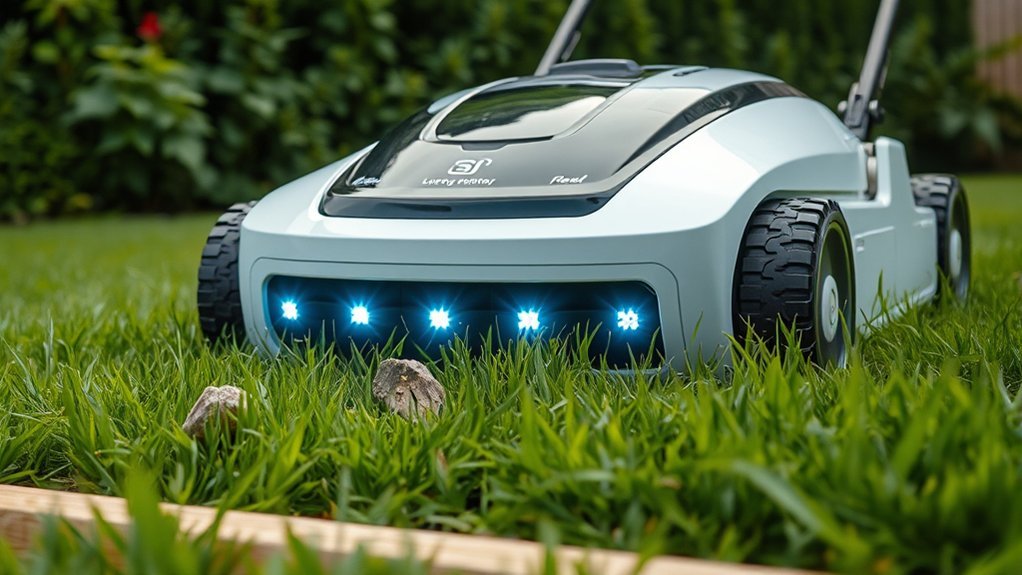
To effectively detect obstacles, robotic lawn mowers rely on a suite of specialized sensors that gather real-time environmental data. These sensors include ultrasonic, infrared, and bump sensors, each with distinct detection mechanisms. Accurate sensor calibration is critical to guarantee reliable obstacle detection, minimizing false positives or negatives. Environmental factors such as terrain variability, lighting conditions, and debris can influence sensor performance, requiring adaptive calibration protocols. Ultrasonic sensors measure distance via sound waves, while infrared sensors detect proximity through reflected light, both sensitive to environmental interference. Bump sensors provide physical feedback upon contact. Consistent calibration accounts for environmental fluctuations, maintaining sensor accuracy and safeguarding the mower’s obstacle detection efficacy. Proper sensor management ensures safer operation across diverse outdoor conditions.
Common Limitations of Obstacle Detection Features
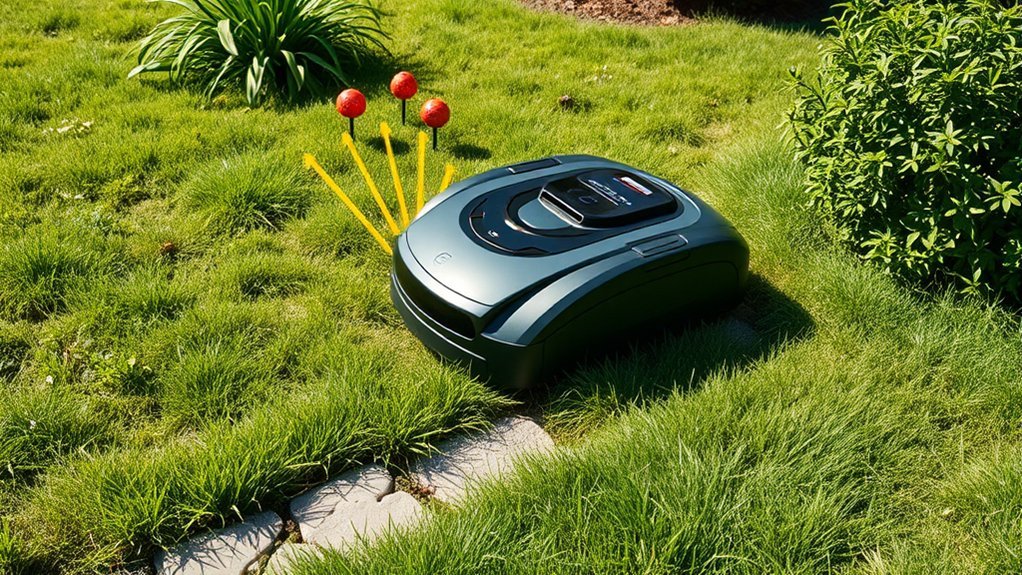
Despite advancements in sensor technology, obstacle detection systems in robotic lawn mowers face inherent limitations that can compromise safety and efficiency. Software glitches can cause system malfunctions, leading to missed obstacles or incorrect responses. These glitches may result from firmware errors, sensor data misinterpretation, or communication failures between components. Additionally, false alarms pose significant challenges, triggering unnecessary stops or evasive maneuvers. False positives often stem from environmental factors like tall grass, shadows, or debris that mimic obstacle signals. Such inaccuracies reduce efficiency, increase mowing time, and may cause wear on mechanical parts. While sensor improvements have minimized some issues, these limitations highlight the need for ongoing software refinement and calibration to enhance reliability and safety in obstacle detection systems.
Tips to Maximize Safety With Your Robot Mower’s Sensors
Maximizing safety with your mower’s sensors requires proactive calibration and regular maintenance to guarantee accurate obstacle detection. Proper safety training ensures users understand sensor limitations and emergency procedures, reducing risk. Regularly test sensors to verify responsiveness, especially after updates or mechanical adjustments. Keep sensor surfaces clean and free of debris to prevent false readings. Implement routine calibration protocols aligned with manufacturer guidelines to maintain detection accuracy. Additionally, establishing clear emergency procedures equips users to respond swiftly in sensor failure scenarios. Use the following table as a quick reference:
| Tip | Action | Purpose |
|---|---|---|
| Conduct Safety Training | Educate on sensor capabilities | Reduce user errors |
| Regular Sensor Testing | Verify obstacle detection | Prevent accidents |
| Sensor Surface Maintenance | Clean sensors periodically | Improve detection accuracy |
| Routine Calibration | Follow manufacturer procedures | Ensure sensor precision |
| Emergency Procedures Review | Practice response plans | Minimize damage and injury |
Future Innovations in Obstacle Detection for Robotic Lawn Mowers
Advancements in obstacle detection technology are poised to markedly enhance the safety and efficiency of robotic lawn mowers. Future innovations focus on refining autonomous navigation through integrated sensor systems that adapt in real-time. Enhanced sensor calibration will ensure precise data interpretation, reducing false positives and missed obstacles. We anticipate the deployment of multi-modal sensors—combining LiDAR, ultrasonic, and visual cameras—to create thorough environmental mapping. Machine learning algorithms will process sensor data more accurately, enabling adaptive obstacle recognition and dynamic path planning. These developments will improve the mower’s ability to operate safely around complex objects and variable terrain. Ultimately, these innovations aim to optimize operational reliability, minimize human intervention, and elevate safety standards through smarter, more responsive obstacle detection systems.
Frequently Asked Questions
How Do Weather Conditions Affect Obstacle Detection Accuracy?
Weather interference, such as rain or fog, can impair sensor calibration, reducing obstacle detection accuracy. These conditions cause sensor signal distortion, making it challenging for robot lawn mowers to reliably identify obstacles and maintain safe operation.
Are There Specific Obstacles That Robotic Mowers Cannot Detect?
Studies show 15% of robotic mower failures involve undetected obstacles. We find that small, transparent, or metallic objects challenge sensor calibration, reducing obstacle identification accuracy, especially with complex terrains or unusual shapes.
How Often Should Sensors Be Maintained or Replaced?
We recommend calibrating obstacle sensors every 3-6 months to guarantee peak performance. Regular sensor maintenance is essential; replace any damaged or malfunctioning obstacle sensors promptly to maintain safety and prevent operational failures.
Can Obstacle Detection Systems Be Overridden or Disabled?
Obstacle detection systems can be manually overridden or disabled, but we strongly advise against it unless system calibration or troubleshooting necessitates it, as doing so compromises safety and increases the risk of accidents or damage.
What Safety Standards Govern Robotic Mower Obstacle Detection?
We rely on strict safety standards like ISO 3691-4 and EN 60335-2-106 for obstacle detection. Proper sensor calibration guarantees accurate obstacle identification, reducing accidents by up to 60%. These standards guide us in designing safer, reliable robotic mowers.
Conclusion
In summary, while current sensor technologies considerably enhance robotic mower safety, ongoing research suggests that integrating multi-modal sensors and machine learning could further reduce false positives and improve obstacle detection accuracy. Although some skeptics argue these advancements may increase system complexity, our analysis indicates that the potential benefits—such as reduced accidents and enhanced reliability—justify this evolution. Embracing these innovations will be essential for the continued safety and efficiency of autonomous lawn maintenance systems.