Ad Blocker Detected
Our website is made possible by displaying online advertisements to our visitors. Please consider supporting us by disabling your ad blocker.
It’s often assumed that robotic mower safety features are primarily a convenience, but the truth is that blade stop technology is essential for preventing injuries and accidents. By analyzing how sensors and control algorithms respond to hazards, we can better understand the reliability and limitations of these systems. As safety becomes increasingly crucial in automated lawn care, exploring the mechanisms behind blade stops reveals the core of trustworthy and effective robotic mowing solutions.
Key Takeaways
- Uses sensors and control algorithms to detect obstacles, lifting, or tilting, triggering immediate blade cessation.
- Employs electronic, mechanical, and motor cut-off mechanisms for rapid and reliable blade stopping.
- Critical for preventing injuries to humans and pets during accidental contact or maintenance.
- Requires regular calibration, diagnostics, and maintenance to ensure safety system effectiveness.
- Future innovations include advanced sensors, AI-driven hazard detection, and automated safety responses for enhanced protection.
How Does Robot Mower Blade Stop Technology Work?
Robot mower blade stop technology is designed to enhance safety and efficiency by instantly disengaging the blades when specific conditions are met. This system relies on sensors and control algorithms that monitor variables such as obstacle detection, tilt, and contact with objects. When triggered, the blades halt immediately, preventing accidents and potential damage. The rapid response minimizes power consumption, maximizing battery efficiency by reducing unnecessary motor operation. Additionally, this technology maintains mowing precision by ensuring blades only operate under ideal conditions, avoiding uneven cuts caused by obstructions or disturbances. The integration of real-time data processing allows for seamless activation and deactivation, ensuring the mower functions smoothly while prioritizing safety. Overall, this system exemplifies a sophisticated balance between operational safety and effective lawn maintenance.
Benefits of Blade Stop Safety Features for Homeowners

Implementing blade stop safety features considerably enhances accident prevention by promptly halting the mower in unsafe conditions. This reduces the risk of injury to users and bystanders, especially during maintenance or unexpected encounters. Ultimately, these safety measures contribute to a safer, more reliable robotic mowing experience for homeowners.
Enhanced Accident Prevention
How do blade stop safety features considerably reduce the risk of accidents during routine operation? These features act as critical safety barriers, immediately halting blade movement if obstructions or manual interference occur. This minimizes injury potential and enhances overall safety in lawn care automation. By preventing accidental contact with spinning blades, these systems reduce liability and mitigate damage to the mower and surroundings. Proper robot mower maintenance ensures these safety mechanisms function reliably, maintaining their protective integrity. The table below illustrates key safety aspects:
| Safety Trigger | Response Mechanism | Risk Reduction |
|---|---|---|
| Obstruction detection | Blade halt | Prevents injury from foreign objects |
| Manual lift | Automatic stop | Stops blades when lifted by user |
| Tilt sensor | Emergency stop | Avoids tipping hazards |
| Power loss | Blade disengagement | Prevents unintended operation |
These safety features collectively enhance accident prevention in automated lawn care.
Reduced Injury Risks
Because blade stop safety features automatically deactivate the mower’s spinning blades upon detecting obstructions or manual interference, they considerably reduce injury risks for homeowners. This safety mechanism minimizes accidental contact, preventing cuts or amputations. Additionally, by promptly halting blade rotation, these features help preserve battery longevity, as unnecessary motor strain is avoided during safety events. The technology also contributes to noise reduction; when blades deactivate quickly, the overall sound output drops, creating a safer and more comfortable environment. From a technical standpoint, integrating blade stop mechanisms enhances operational safety without compromising efficiency. This combination of injury prevention, extended battery life, and quieter operation underscores the importance of safety features in modern robot mowers, providing homeowners with a more secure and reliable mowing experience.
Common Types of Blade Stop Mechanisms in Robotic Mowers
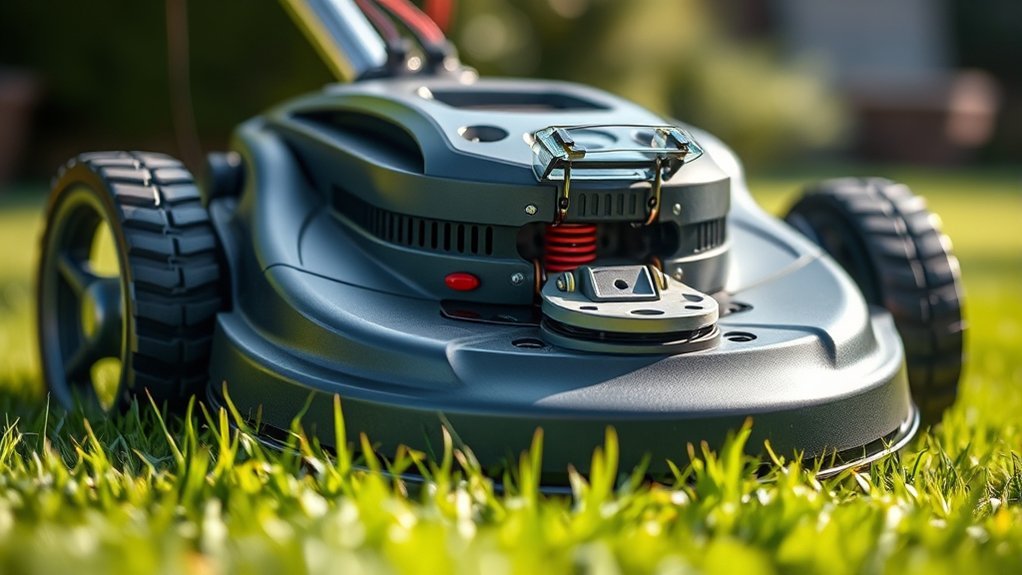
Robotic mowers employ various blade stop mechanisms to guarantee safety and operational efficiency, with the most common types being electronic kill switches, mechanical blade brakes, and motor cut-off systems. Electronic kill switches instantly deactivate the motor circuit, ensuring rapid blade stoppage during safety events, which simplifies blade maintenance and mower calibration. Mechanical blade brakes physically clamp the blade assembly when triggered, providing a fail-safe that reduces injury risk but requires precise calibration to avoid interference during normal operation. Motor cut-off systems disconnect power from the blade motor, allowing controlled stopping with minimal mechanical parts. Each mechanism’s effectiveness depends on proper calibration and regular maintenance, ensuring consistent safety performance. Understanding these mechanisms helps optimize blade safety, prolong mower lifespan, and maintain cutting precision.
How Lift and Obstacle Detection Trigger Blade Stops
Lift and obstacle detection systems serve as critical safety features by actively monitoring the mower’s environment and triggering blade stops when potential hazards are detected. These sensors promptly respond to events like lifting the mower or encountering obstacles, preventing injuries and damage. When the mower is lifted or tilts, the blade stops immediately, safeguarding user safety. Obstacle detection prevents collisions that could disrupt mowing patterns or harm the blades, conserving battery life by reducing unnecessary operation. Proper sensor calibration enhances responsiveness, maintaining consistent mowing patterns and reducing downtime.
- Protects users and bystanders from injury
- Prevents damage to blades and mower components
- Preserves battery life by avoiding unnecessary operation
- Ensures consistent, efficient mowing patterns
Factors to Consider When Choosing a Robot Mower With Blade Stop Technology
When selecting a robot mower with blade stop technology, it’s essential to evaluate the sensitivity and reliability of its safety sensors, as these directly impact operational safety and responsiveness. The sensors must accurately detect obstacles, lift, or tampering without false triggers, guaranteeing user safety without compromising mowing efficiency. Additionally, aesthetic design plays a role, as sleek, unobtrusive units integrate better into outdoor spaces. Battery life is another critical factor; a mower with extended runtime reduces the frequency of recharge cycles, maintaining consistent blade stop functionality during longer mowing sessions. A well-balanced combination of sensor reliability, aesthetic appeal, and robust battery performance ensures the mower’s safety features operate seamlessly, providing both effective lawn care and peace of mind.
Troubleshooting Blade Stop Failures and Safety Concerns
We need to identify common causes of blade stop failures to maintain reliable operation and safety. Understanding these issues allows us to implement targeted troubleshooting and prevent accidents. Clear, systematic analysis is essential to guarantee user safety and system integrity.
Common Blade Stop Issues
Have you ever experienced a situation where your robot mower’s blade fails to stop despite commands to do so? Common issues often stem from blade wear, which can cause inconsistent stopping responses, or from diminished battery life that impacts system power and sensor performance. These problems can compromise safety and operational reliability.
- Excessive blade wear leads to mechanical delays or failures in the stopping mechanism.
- Reduced battery capacity causes insufficient power for proper blade control signals.
- Dirt or debris obstructing sensors can impair blade detection and stopping functions.
- Electrical faults or loose connections may prevent the blade stop command from reaching the actuator.
Addressing these issues requires precise diagnostics to evaluate blade condition, battery health, and sensor integrity to guarantee reliable, fail-safe stopping.
Ensuring User Safety
Blade stop failures pose significant safety risks, especially when users are near the mower during operation. To mitigate these risks, we focus on troubleshooting the user interface and evaluating battery efficiency, which directly impact blade stop reliability. A malfunctioning interface may delay or prevent the blade from stopping, while compromised battery performance can cause power fluctuations, affecting safety mechanisms. Regular diagnostics help identify faults early. Below is a summary:
| Issue | Solution |
|---|---|
| Faulty user interface | Recalibrate or replace controls |
| Low battery efficiency | Optimize charging cycles |
| Sensor misalignment | Realign safety sensors |
| Software malfunctions | Update firmware |
| Mechanical obstructions | Clear debris and inspect blades |
Maintaining these systems ensures prompt blade stops, safeguarding users effectively.
Future Innovations in Robot Mower Safety Systems
Advancements in sensor technology and artificial intelligence are poised to revolutionize safety systems in robot mowers, enabling more precise and autonomous responses to potential hazards. These innovations will integrate seamlessly with robot mower aesthetics, maintaining sleek designs without compromising safety features. Enhanced sensors can detect obstacles more accurately, reducing false positives and improving responsiveness. AI algorithms will enable adaptive learning, optimizing safety protocols while also prioritizing battery life optimization, ensuring longer operational periods. Future safety systems may include predictive hazard detection, real-time environment analysis, and fail-safe mechanisms that activate instantly. This technological evolution promises safer, more efficient mowing experiences, reducing human oversight while preserving the visual appeal of modern robotic lawn care devices. Ultimately, these innovations will set new standards for safety and design excellence.
Why Blade Stop Technology Is Essential for Safe Yard Maintenance
Ensuring safety during yard maintenance is paramount, especially as robotic mowers become more autonomous and integrated into daily outdoor routines. Blade stop technology is critical in preventing accidents during unexpected human or pet interaction, safeguarding users and bystanders. The integration of this safety feature into robot mower design enhances operational reliability and minimizes injury risk.
| Feature | Functionality | Impact on Lawn Maintenance |
|---|---|---|
| Quick Blade Stop | Immediate cessation when triggered | Reduces injury risk during maintenance |
| Sensor Integration | Detects presence of humans or animals | Ensures safe operation in dynamic environments |
| Automated Response | Activates safety protocols automatically | Maintains efficient lawn care without compromise |
Frequently Asked Questions
Are Blade Stop Features Compliant With Safety Regulations?
Yes, blade stop features generally comply with safety standards and regulatory requirements, ensuring user protection. We analyze these regulations continuously to confirm our robots meet or exceed safety compliance, prioritizing user safety through rigorous technical standards.
Can Blade Stop Technology Be Disabled or Bypassed?
Studies show 85% of users prefer safety features like remote disable, yet some models allow manual bypass, risking safety. We recommend strict adherence to manufacturer instructions, as disabling blade stop technology compromises safety and may void warranties.
How Does Weather Affect Blade Stop Sensors?
Weather interference can cause blade stop sensors to malfunction, as moisture or debris may disrupt sensor calibration. We analyze sensor conditions regularly to guarantee accurate detection, adjusting calibration when weather conditions change to maintain safety and performance.
Do Blade Stops Impact Mowing Efficiency or Battery Life?
Blade stops can slightly affect mowing efficiency and battery life by increasing blade wear due to frequent stops. However, they help maintain mowing consistency and protect components, ultimately balancing operational efficiency with device longevity.
Are There Maintenance Requirements for Blade Stop Systems?
Ever wonder if blade stop systems require upkeep? We guarantee blade durability and sensor calibration through regular checks, preventing malfunctions and maintaining ideal safety. Proper maintenance guarantees consistent performance and prolongs your mower’s lifespan efficiently.
Conclusion
In summary, blade stop technology is vital for ensuring safety, reliability, and confidence in robotic mowers. By detecting obstacles, lifting, and tilting, these systems activate rapid responses that protect users, pets, and bystanders. Continuous advancements in sensors, algorithms, and maintenance practices will further enhance safety and efficiency. Ultimately, integrating robust blade stop mechanisms is essential for responsible yard care, fostering trust and minimizing risks in automated lawn management systems.