Ad Blocker Detected
Our website is made possible by displaying online advertisements to our visitors. Please consider supporting us by disabling your ad blocker.
Did you know that robotic mowers now account for over 20% of the global lawn equipment market, reflecting a significant shift toward automation? These devices offer a compact, sensor-based approach to lawn maintenance, contrasting sharply with the traditional, engine-powered rotary mowers designed for larger, more rugged terrains. Understanding the technical distinctions, operational efficiencies, and long-term implications of each can be essential in selecting the most suitable solution for your lawn’s specific needs.
Key Takeaways
- Robotic mowers are ideal for small to medium, even lawns with minimal maintenance, offering autonomous, scheduled mowing.
- Rotary mowers are better suited for large, uneven, or dense terrains, providing powerful manual operation for rugged landscapes.
- Robotic mowers have higher upfront costs but lower ongoing maintenance and environmental impact; rotary mowers are less expensive initially but costlier long-term.
- Robotic mowers operate quietly, produce fewer emissions, and require less manual effort, whereas rotary mowers are noisier and more labor-intensive.
- Performance depends on terrain, lawn size, and aesthetic preferences; robotic mowers excel in convenience, rotary mowers in rugged, large areas.
What Are the Main Differences Between Robotic and Rotary Mowers?
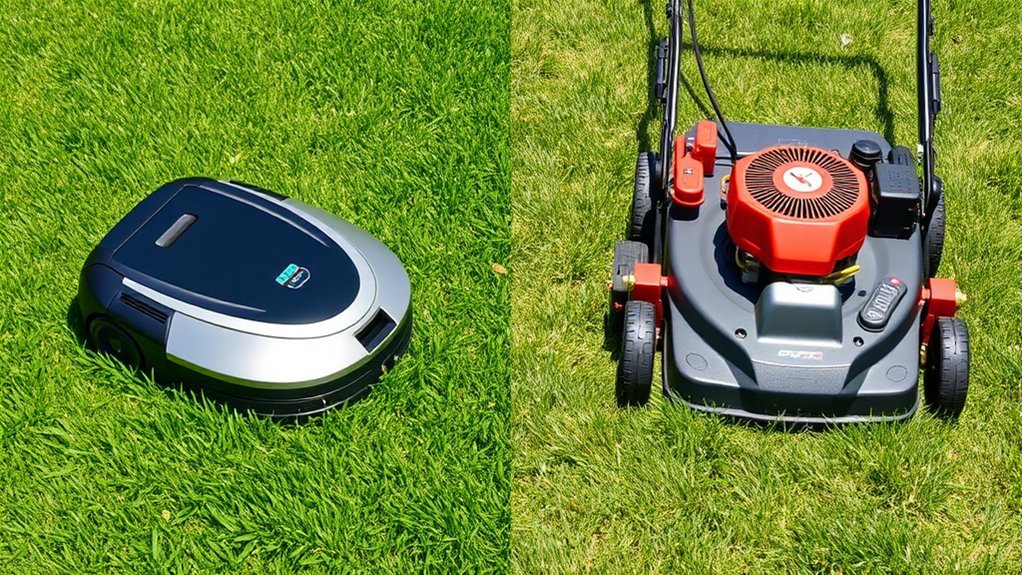
While both robotic and rotary mowers serve the primary function of cutting grass, their design, operation, and capabilities differ markedly. Robotic mowers are compact, autonomous units equipped with sensors and boundary wires, enabling precise, grid-like mowing that enhances lawn aesthetics through uniform coverage. They typically produce considerably lower noise levels, operating quietly and making them ideal for noise-sensitive environments. Rotary mowers, on the other hand, are larger, motor-powered devices with rotary blades, often requiring manual operation or push functionality. They tend to generate higher noise levels, which can be disruptive, especially in residential settings. The difference in design directly impacts lawn aesthetics, with robotic mowers providing consistent, neat cuts, while rotary mowers may require more manual adjustment for uniformity.
How Do Robotic Mowers Work and What Features Do They Offer?
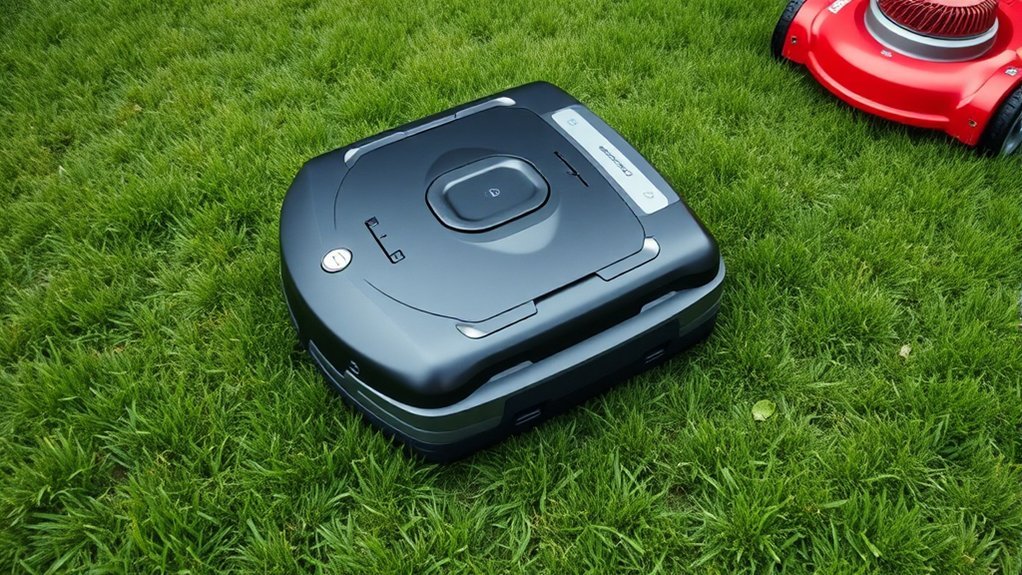
Robotic mowers utilize advanced navigation systems, such as perimeter wires or GPS, to precisely define mowing boundaries and optimize coverage. They employ sharp, rotating blades driven by specialized motors to guarantee efficient and consistent cutting, even on uneven terrain. Additionally, smart features like app connectivity, scheduling, and obstacle detection enhance their operational efficiency and user control.
Navigation and Boundary Setup
Robotic mowers employ advanced navigation systems and boundary-setting features to efficiently and accurately maintain lawn areas. These systems typically use a combination of GPS, ultrasonic sensors, or boundary wires to define the working perimeter. Key features include:
- Boundary wires or virtual fences, guaranteeing the mower stays within designated zones.
- Real-time mapping capabilities for optimized route planning.
- Obstacle detection sensors for collision avoidance.
- Battery management systems that monitor charge levels, allowing for automatic recharging and extended operation times, which is vital given their limited battery life.
Moreover, these features contribute to reduced noise levels during operation, minimizing disturbance. Proper boundary setup ensures thorough coverage while preventing the mower from wandering into unwanted areas, maximizing efficiency and lawn health.
Cutting Mechanism Technology
The cutting mechanism technology in robotic mowers is engineered for precise, efficient grass trimming through a combination of advanced blade design and control systems. These mowers typically utilize oscillating or rotary blades made from durable, high-grade steel, ensuring consistent cutting performance. Battery technology plays a vital role, providing a lightweight, high-capacity power source that supports extended operation without sacrificing cutting precision. Modern robotic mowers rely on smart motor controls that regulate blade speed and torque, optimizing cutting quality across varying grass conditions. Sensors detect grass height and density, adjusting blade activity for uniform results. This integration of sophisticated blade mechanics and robust battery systems guarantees a clean, accurate cut while maximizing energy efficiency and minimizing maintenance needs.
Smart Features and Connectivity
Advancements in smart features and connectivity have transformed how robotic mowers operate, allowing for highly automated and customizable lawn maintenance. These mowers utilize smart sensors to detect obstacles, boundary markers, and terrain variations, ensuring precise navigation. Connectivity apps enable remote control and real-time monitoring, enhancing user interaction. Key features include:
- Integration with smartphones via dedicated connectivity apps for scheduling, adjustments, and status updates.
- Use of smart sensors to optimize cutting paths, avoid obstacles, and adapt to lawn changes.
- Geofencing capabilities, allowing users to set boundaries digitally for enhanced area control.
- Data collection and analytics for maintenance insights and system diagnostics, improving overall efficiency.
These features collectively enhance operational accuracy, user convenience, and lawn care precision.
What Are the Advantages of Rotary Mowers for Lawn Care?
| Feature | Advantage |
|---|---|
| Robust Cutting Mechanism | Rotary mowers utilize high-speed rotating blades, offering precise and uniform cuts suitable for various grass types and terrain conditions. |
| Versatility | They excel in handling uneven terrain, thick grass, and areas requiring detailed trimming, supporting effective lawn aeration and grass fertilization. |
| Cutting Height Adjustment | Precise control over cutting height enables targeted lawn care, promoting healthy grass growth. |
| Maintenance | Simpler blade replacement and mechanical durability reduce downtime, ensuring consistent performance. |
| Terrain Adaptability | Capable of mowing slopes and irregular surfaces, Rotary mowers enhance overall lawn aesthetics and health. |
Rotary mowers are highly valued for their durability and adaptability, making them ideal for complex lawn care tasks like lawn aeration and grass fertilization.
Which Factors Should You Consider When Choosing Between a Robotic and Rotary Mower?
When selecting between a robotic and rotary mower, considering specific factors related to your lawn’s characteristics and maintenance preferences is essential. These include:
- Garden aesthetics: Robotic mowers deliver precise, uniform cuts that enhance visual appeal, whereas rotary mowers can handle varied terrain but may require more manual adjustments for a polished look.
- Lawn size and terrain: Larger or uneven lawns favor rotary mowers for their power and adaptability, while robotic mowers excel on smaller, flat lawns for consistent maintenance.
- Environmental impact: Robotic mowers typically consume less energy and produce fewer emissions, supporting eco-friendly gardening practices.
- Maintenance requirements: Rotary mowers demand regular blade sharpening and fuel management, whereas robotic models often require software updates and occasional battery replacements.
How Do Costs and Maintenance Compare for Robotic and Rotary Mowers?
Robotic and rotary mowers differ markedly in their upfront costs and ongoing maintenance expenses, impacting long-term value and budgeting. Robotic mowers tend to have higher initial prices but lower maintenance, mainly limited to blade replacements and software updates. Rotary mowers, conversely, are less expensive upfront but incur higher costs over time for engine servicing, blade sharpening, and fuel. This cost variation influences garden aesthetics, as robotic mowers provide consistent, precise trimming, enhancing visual appeal with minimal environmental impact through electric operation. Maintenance complexity and frequency vary substantially:
| Aspect | Robotic Mower | Rotary Mower |
|---|---|---|
| Initial Cost | Higher | Lower |
| Maintenance | Low, blade replacement, software | Higher, engine and blade servicing |
| Environmental Impact | Lower, electric, quieter | Higher, gas emissions, noise |
| Garden Aesthetics | Consistent, precise cuts | Variable, manual adjustments |
Which Mower Type Is Better for Different Lawn Sizes and Types?
The effectiveness of robotic versus rotary mowers largely depends on lawn size, terrain, and grass type, which influence operational efficiency and suitability. Smaller, flat lawns with uniform grass favor robotic mowers due to their precision and low maintenance, while larger or uneven terrains often require rotary mowers for power and coverage. Evaluating maintenance demands and costs is essential to determine the most economical and practical choice for varying lawn conditions.
Lawn Size Compatibility
Determining which mower type suits different lawn sizes depends on understanding their operational efficiencies and limitations. Robotic mowers excel with small to medium lawns, offering consistent cutting for enhanced lawn aesthetics and high mower durability due to their minimal mechanical stress. Conversely, rotary mowers are better suited for larger areas, providing rapid coverage and robust build quality for extensive use. Consider these factors:
- Lawn size: Small lawns favor robotic mowers; large lawns require rotary mowers.
- Cutting frequency: Robotic mowers maintain a neat appearance with frequent, incremental cuts.
- Operational endurance: Rotary mowers handle prolonged use on expansive lawns better.
- Durability needs: Rotary mowers are generally more rugged, accommodating tougher terrain and grass conditions.
Matching lawn size with mower capabilities ensures ideal lawn aesthetics and long-term mower durability.
Terrain and Grass Type
Lawn terrain and grass type considerably influence the performance and suitability of mowing equipment, especially when choosing between robotic and rotary mowers. Robotic mowers excel on even terrain with short to moderate grass height, but struggle on uneven surfaces or dense, tall grass. Rotary mowers, however, handle varied soil conditions and taller grass more effectively, providing higher power for thicker or coarse grass.
| Terrain Type | Suitable Mower Type | Grass & Soil Considerations |
|---|---|---|
| Flat, even terrain | Robotic | Short grass, well-drained soil |
| Uneven, hilly terrain | Rotary | Tall, coarse grass, compacted soil |
| Sloped areas | Rotary | Taller grass, uneven soil |
| Well-maintained lawns | Both | Grass height varies, soil stability |
Maintenance and Cost
When selecting between robotic and rotary mowers, understanding their maintenance requirements and costs is essential, especially as lawn size and complexity vary. Robotic mowers typically involve higher upfront costs but lower ongoing expenses, mainly due to minimal maintenance and automated operation, which benefits garden design by ensuring consistent, precise cuts. Rotary mowers, on the other hand, require more frequent blade sharpening, oil changes, and potential repairs, especially on larger lawns.
Key considerations include:
- Blade replacement frequency
- Power source and energy costs
- Compatibility with fertilizer application systems
- Adaptability to lawn size and terrain complexity
For smaller, intricate gardens, robotic mowers excel with lower long-term costs, while rotary mowers suit larger, more varied terrains despite higher ongoing expenses.
How Do Robotic and Rotary Mowers Impact Convenience and Time Savings?
Robotic and rotary mowers greatly influence convenience and time savings by automating the grass-cutting process and reducing manual effort in lawn maintenance. Robotic mowers operate on programmed schedules, enabling consistent mowing that minimizes user intervention, which enhances overall garden design by maintaining even turf coverage. Rotary mowers, although manually operated, save time by efficiently handling large or complex lawns when used with power tools. From an environmental impact perspective, robotic mowers are more energy-efficient, consuming less power over extended periods, and produce fewer emissions. Both types free up time for homeowners, allowing for more strategic garden planning or leisure activities. This automation streamlines maintenance routines, making it easier to sustain well-manicured lawns with less effort and greater precision.
What Are the Potential Drawbacks or Limitations of Each Mower Type?
While robotic and rotary mowers offer significant advantages in reducing manual effort and saving time, each has inherent limitations that can impact their practicality and effectiveness.
- Battery life: Robotic mowers depend on rechargeable batteries, which can limit mowing duration before recharging is needed, especially on larger lawns.
- Noise levels: Rotary mowers tend to generate higher noise, which can be disruptive, whereas robotic mowers operate more quietly but may struggle in noisy environments.
- Terrain adaptability: Robotic mowers often struggle with uneven or complex terrains due to limited power and mobility, while rotary mowers are typically more robust in handling such conditions.
- Operational range: The limited battery life of robotic mowers restricts their coverage area, requiring frequent recharging or multiple units for extensive lawns.
Which Mower Is the Best Fit for Your Lawn and Lifestyle?
Choosing the right mower depends heavily on the specific characteristics of your lawn and your personal maintenance preferences. For lawns prioritizing impeccable aesthetics, a robotic mower offers precise, uniform cuts that promote healthy, lush growth with minimal effort. Its consistent trimming enhances lawn aesthetics, especially on complex terrains. Conversely, rotary mowers excel on thicker, more resistant grass, providing powerful, aggressive cuts suitable for varied grass types. Mower noise is another factor; robotic mowers operate quietly, ideal for noise-sensitive environments, whereas rotary mowers tend to generate more noise, which might be disruptive. If your lifestyle demands minimal manual intervention and a focus on visual appeal, a robotic mower fits better. For larger, rugged lawns needing robust cutting power, a rotary mower remains the practical choice.
Frequently Asked Questions
Are Robotic Mowers Suitable for Uneven or Hilly Terrains?
Robotic mowers can handle uneven or hilly terrains thanks to advanced terrain adaptability features, though mowing precision may decrease on steep slopes. We recommend models with robust sensors and stability systems for maximum performance on challenging landscapes.
How Do Robotic and Rotary Mowers Affect Lawn Health and Turf Quality?
We find robotic and rotary mowers promote healthy lawns by maintaining consistent cutting height, reducing soil compaction, and distributing lawn nutrients evenly, which enhances turf quality and prevents patchiness caused by uneven wear or over-trimming.
Can Robotic Mowers Handle Complex Lawn Obstacles Effectively?
Robotic mowers excel at obstacle navigation through advanced sensors and AI algorithms, enabling precise lawn customization around complex features like trees and flower beds, though some challenging terrain may require manual intervention for ideal coverage and safety.
What Safety Features Are Included in Robotic Versus Rotary Mowers?
We find robotic mowers often include safety features like obstacle sensors that stop operation on detection, unlike rotary mowers. Their longer battery life and quieter operation reduce hazards, but rotary mowers lack such advanced safety systems.
How Environmentally Friendly Are Robotic and Rotary Mowers?
We find robotic mowers more environmentally friendly due to better battery efficiency and lower noise pollution, which reduces energy consumption and minimizes disturbance. Rotary mowers typically consume more power and generate higher noise levels, impacting environmental quality.
Conclusion
In summary, selecting the ideal mower hinges on balancing your lawn’s unique needs with your maintenance preferences. While robotic mowers excel in efficiency and quiet operation for smaller or complex terrains, rotary mowers provide robustness and speed for larger, demanding landscapes. By carefully evaluating factors like size, terrain, and eco-friendliness, you can confidently navigate the subtle nuances of each option—ensuring your lawn care approach aligns seamlessly with your lifestyle and environmental considerations.