Ad Blocker Detected
Our website is made possible by displaying online advertisements to our visitors. Please consider supporting us by disabling your ad blocker.
Studies show that robotic mowers can reduce lawn maintenance time by up to 60%, yet they often come with a higher upfront investment compared to traditional cylinder mowers. As we compare these two options, it becomes clear that each offers distinct advantages and challenges suited to different garden sizes, terrains, and user priorities. Understanding their performance, costs, and features can help you determine which mower aligns best with your lawn care needs—an assessment that’s more nuanced than it might seem at first glance.
Key Takeaways
- Robot mowers offer autonomous operation with digital controls, while cylinder mowers require manual effort and adjustments.
- Cylinder mowers provide precise, professional cuts ideal for flat, small to medium lawns; robot mowers ensure uniform coverage for larger areas.
- Robot mowers handle uneven terrain and obstacles better due to sensors and advanced navigation, unlike cylinder mowers.
- Operating costs differ: robot mowers run on rechargeable batteries; cylinder mowers use gasoline or electricity, impacting ongoing expenses.
- Environmentally, robot mowers are quieter, produce fewer emissions, and are more eco-friendly than petrol-powered cylinder mowers.
What Are the Main Differences Between Robot Mowers and Cylinder Mowers?
While both robot mowers and cylinder mowers are designed for lawn maintenance, their core differences lie in their operation, design, and suitability for various lawn types. Robot mowers operate autonomously, using sensors and boundary wires to navigate, which impacts lawn aesthetics by providing a consistently even cut. They prioritize user safety through obstacle detection and automatic shut-off features, minimizing risk during operation. In contrast, cylinder mowers rely on manual pushing or riding, with cutting actions involving a horizontal cylinder and blades, producing a clean, precise cut ideal for fine lawns. Cylinder mowers require direct human control, making user safety dependent on careful handling. The automated nature of robot mowers offers convenience, while cylinder mowers excel in delivering a highly precise finish.
How Do Robot Mowers and Cylinder Mowers Perform in Terms of Cutting Precision?
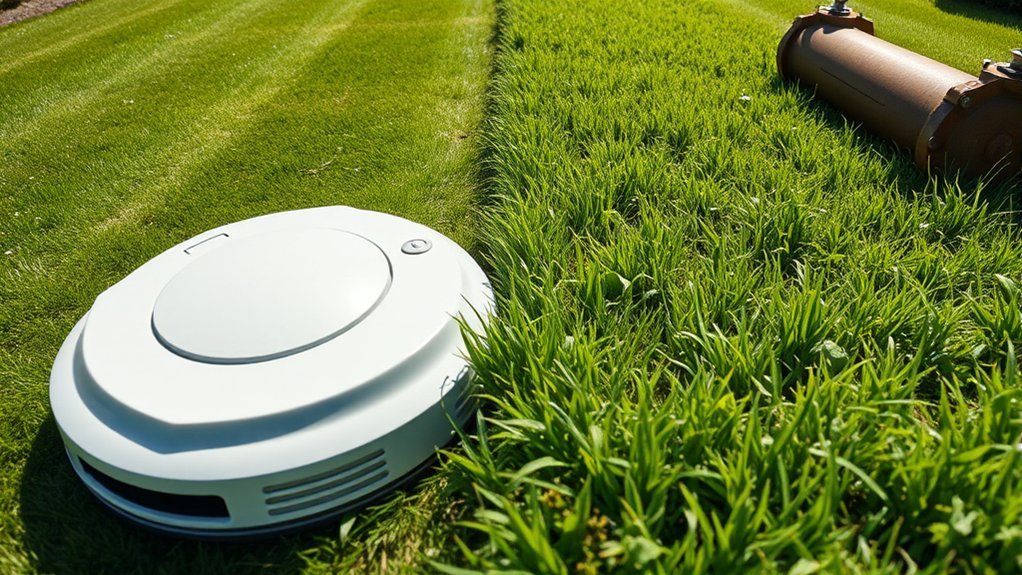
When comparing the cutting precision of robot mowers and cylinder mowers, it’s important to take into account the mechanisms each uses to achieve their results. Robot mowers rely on sensors and programmed patterns, ensuring consistent, random cutting that maintains overall lawn aesthetics. Cylinder mowers utilize a sharp, rotating blade cylinder that slices grass with high cutting accuracy, resulting in a clean, uniform finish.
Robot mowers use sensors for consistent, aesthetic cuts, while cylinder mowers deliver precise, uniform, professional-grade finishes.
Their performance can be summarized as:
- Robot Mowers: Adaptable to uneven terrain, but may produce slightly uneven cuts in complex areas.
- Cylinder Mowers: Offer superior precision, especially on flat surfaces, delivering sharp, even edges.
- Lawn aesthetics: Cylinder mowers excel in creating visually appealing, crisp lines.
- Cutting accuracy: Cylinder mowers generally outperform robot mowers in maintaining precise, professional-grade cut quality.
Which Mower Is Better for Large or Complex Lawns?
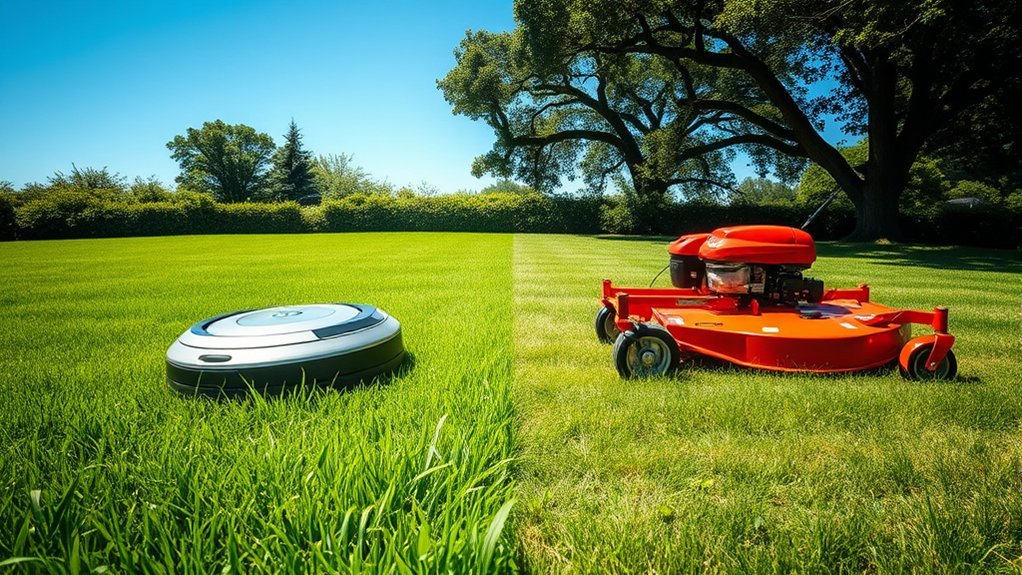
When evaluating large or complex lawns, navigation and obstacle handling become critical factors, as the mower must efficiently maneuver around diverse features. Coverage and efficiency are also essential, requiring the mower to sustain consistent performance across extensive areas without gaps. Additionally, terrain adaptability determines whether the mower can maintain ideal cutting quality on uneven or challenging surfaces.
Navigation and Obstacle Handling
Controlling large or complex lawns requires precise obstacle detection and adaptive path planning, which considerably influences a mower’s efficiency and effectiveness. Robot mowers excel here through advanced navigation systems that utilize real-time sensors and algorithms, adjusting routes dynamically. Key factors include:
- Sensor integration: Uses ultrasonic, infrared, or LIDAR sensors for obstacle detection, which is critical for complex terrains.
- Path algorithms: Employ adaptive algorithms that optimize coverage while avoiding obstacles, reducing missed patches.
- Battery technology: Impacts operational endurance, enabling longer, more thorough navigation cycles.
- Blade design: Affects maneuverability around objects, with some models featuring flexible blades for safer operation near obstacles.
Coverage and Efficiency
Robot mowers demonstrate notable advantages in coverage and efficiency, especially on large or complex lawns, due to their sophisticated navigation algorithms and modular mowing patterns. These systems optimize cutting paths, ensuring consistent coverage and minimizing missed spots, which enhances overall garden aesthetics. Their ability to methodically revisit areas reduces overlap, leading to more uniform grass height and healthier turf. Additionally, frequent, incremental mowing promotes natural lawn aeration, improving soil health and root growth. In contrast, cylinder mowers often require manual effort to achieve similar coverage, which can be less efficient on expansive or intricate landscapes. Overall, robot mowers are better suited for maintaining large or complex lawns with precision, promoting a healthier, more visually appealing garden with consistent mowing and effective lawn aeration.
Terrain Adaptability
Controlling large or complex lawns requires mowers with advanced adaptability to uneven terrain, obstacles, and varied grass conditions. Robot mowers excel here due to their integrated sensors, adaptive navigation algorithms, and safety mechanisms, ensuring they handle complex terrains without damage or safety risks. Cylinder mowers, while precise on flat surfaces, often struggle on uneven ground, risking blade damage or unsafe operation. For challenging terrains, consider these factors:
- Pet friendly features — Robot mowers with soft bumpers and pet detection systems prevent injuries.
- Safety mechanisms — Automatic stop functions and obstacle sensors enhance safety on complex lawns.
- Terrain sensors — Enable robot mowers to adjust cutting height and speed over varied terrain.
- Obstacle navigation — Advanced algorithms allow efficient maneuvering around rocks, trees, and slopes.
How Do Maintenance and Operating Costs Compare?
When comparing maintenance and operating costs, we consider initial purchase expenses, routine upkeep, and energy consumption differences. Robot mowers typically have higher upfront costs but lower ongoing maintenance, while cylinder mowers often require more frequent blade sharpening and manual adjustments. Energy consumption varies based on power sources, influencing long-term operational expenses for each mower type.
Upfront Purchase Expenses
Initial investment costs for robotic and cylinder mowers differ considerably, primarily due to their distinct technological complexities and build quality. Robotic mowers typically require a higher initial outlay because of advanced electronics, sensors, and safety features that enable autonomous operation. Conversely, cylinder mowers, being mechanically simpler, tend to have lower purchase prices but may lack the refined lawn aesthetics achievable by robots.
Key factors influencing upfront expenses include:
- Technology integration: robotic mowers feature sophisticated navigation and safety systems, increasing cost.
- Build quality: higher durability and precision in robotic units elevate initial expenses.
- Safety features: enhanced safety mechanisms in robotic models add to their price point.
- Aesthetic results: robotic mowers tend to produce cleaner, more uniform cuts, justifying the higher investment.
Routine Maintenance Costs
Routine maintenance costs for robotic and cylinder mowers differ markedly due to their contrasting mechanical and electronic components. Robotic mowers primarily depend on battery life, which influences replacement frequency and charging system maintenance. Regularly checking and replacing batteries incurs ongoing expenses, though advancements have extended battery longevity. Noise levels are also a factor; robotic models tend to operate more quietly, reducing the need for soundproofing or noise-related maintenance. Conversely, cylinder mowers involve more mechanical parts like blades and drive belts, requiring frequent sharpening, replacement, and lubrication, which elevate maintenance costs. While cylinder mowers generally have lower electronic component expenses, their mechanical upkeep can be more labor-intensive. Overall, robotic mowers tend to have higher routine costs due to battery management, but their quieter operation reduces ancillary maintenance needs.
Energy Consumption Differences
Have you ever considered how the energy consumption of robotic and cylinder mowers impacts their overall operating costs? Robotic mowers rely on batteries with limited life spans, making battery life a key factor. Their power source is rechargeable batteries, which influence cycle frequency and replacement costs. Cylinder mowers, on the other hand, typically run on gasoline or electric power, affecting fuel or electricity expenses.
Key differences include:
- Robotic mowers consume less energy per operation but require frequent charging, impacting long-term costs.
- Cylinder mowers often have higher immediate energy use but lower maintenance of power source.
- Battery replacements in robotic mowers add to ongoing expenses.
- Electric cylinder mowers may reduce energy costs compared to gasoline-powered models.
What Are the Key Convenience Features of Robot Mowers Versus Cylinder Mowers?
While both robot mowers and cylinder mowers serve the primary function of cutting grass, their convenience features differ considerably, impacting user experience and maintenance requirements. Robot mowers leverage smart technology, enabling autonomous operation, programmable schedules, and obstacle avoidance. Their intuitive user interface allows for remote management via smartphone apps, providing real-time status updates and customizable settings. In contrast, cylinder mowers rely on manual operation, requiring physical presence and manual adjustments. The following table highlights these distinctions:
| Feature | Robot Mower | Cylinder Mower |
|---|---|---|
| Smart Technology | Yes, with automation and apps | No |
| User Interface | Digital, touchscreens, apps | Manual controls, levers |
| Accessibility | Remote operation, scheduling | Physical, on-site operation |
| Maintenance Alerts | Automated notifications | Manual inspection required |
This tech-driven convenience enhances efficiency, minimizing user effort and streamlining lawn care.
How Do Environmental Impacts Differ Between the Two Mower Types?
Both robot mowers and cylinder mowers have distinct environmental footprints, shaped by their energy consumption, emissions, and material use. Robot mowers typically operate on electricity, producing lower emissions and reducing carbon footprint, but their battery manufacturing impacts biodiversity. Cylinder mowers often use petrol, emitting greenhouse gases and increasing noise pollution.
Robot mowers offer eco-friendly operation with lower emissions, but battery production can impact biodiversity.
Key differences include:
- Energy Source: Electric for robots, petrol for cylinders.
- Biodiversity Impact: Robot mowers minimize soil disturbance; petrol engines may harm local ecosystems.
- Noise Pollution: Robot mowers generate considerably less noise, reducing disturbance to wildlife.
- Material Use: Robots utilize lightweight, recyclable materials, whereas cylinders involve heavier metals and oils.
Which Mower Suits Different Budget Ranges and Garden Sizes?
Choosing the appropriate mower depends heavily on your garden’s size and your budget constraints. For small to medium gardens, cylinder mowers excel in delivering superior lawn aesthetics due to their clean, precise cuts, which promote healthy grass growth. They are generally more affordable upfront, making them suitable for budget-conscious homeowners, but they require manual operation, which impacts safety considerations, especially for larger or uneven terrains. Robot mowers, on the other hand, are ideal for larger gardens, offering consistent coverage with minimal effort. While their initial investment is higher, they provide convenience and uniform cutting, enhancing lawn aesthetics over time. Safety features, such as anti-collision sensors, are standard in robot mowers, reducing risks for users. Ultimately, your choice hinges on balancing garden size, budget, and desired safety features.
What Are the Common Challenges and Limitations of Each Mower Type?
Each mower type presents specific challenges that can impact its effectiveness and usability, which is essential to understand when selecting the right tool for your lawn. Regarding lawn aesthetics, robot mowers may struggle with uneven terrain, affecting cut quality and consistency. Cylinder mowers, while delivering a precise cut, can face mower durability issues in rough conditions, increasing maintenance needs.
Robot mowers may struggle on uneven terrain, while cylinder mowers face durability issues in rough conditions.
Common challenges include:
- Limited terrain adaptability for robot mowers, reducing lawn uniformity.
- Reduced cutting efficiency in dense or tall grass for both mower types.
- Wear and tear on cylinder blades, impacting mower durability and cut quality.
- Navigation limitations in obstructed or complex garden layouts, affecting overall lawn aesthetics.
Understanding these limitations helps in making an informed choice aligned with your lawn’s specific needs.
Which Mower Is the Right Choice for Your Lawn and Lifestyle?
Selecting the most suitable mower for your lawn and lifestyle depends on a precise assessment of your terrain, maintenance preferences, and scheduling flexibility. For larger, uneven, or complex terrains, a cylinder mower’s manual operation offers control and precision, but it requires consistent physical effort and regular maintenance. Conversely, a robot mower excels in routine scheduling, with features like extended battery life allowing for prolonged operation without manual intervention. Noise levels are a critical factor: robot mowers typically operate quietly, minimizing disruption, while cylinder mowers generate higher noise levels due to their mechanical cutting process. Consider your available time, physical capacity, and environmental constraints when choosing. Ultimately, matching mower capabilities to your terrain complexity, desired maintenance effort, and noise sensitivity ensures an ideal fit for your lawn and lifestyle.
Frequently Asked Questions
Can Robot Mowers Handle Steep or Uneven Terrain Effectively?
Robot mowers can handle steep or uneven terrain effectively, thanks to advanced sensors and adaptive algorithms that improve terrain adaptability and slope handling. They navigate complex landscapes safely, maintaining consistent cutting performance across challenging surfaces.
Are There Safety Concerns With Autonomous Robot Mowers?
We believe autonomous robot mowers present minimal safety hazards, thanks to advanced emergency features like obstacle detection and automatic shutoff, ensuring user protection. Rigorous testing and smart technology make these devices safe for even complex terrains.
How Do Battery Life and Charging Times Compare Between Models?
We find that battery longevity varies, with lithium-ion models offering longer runtime, while charging efficiency depends on the charging system—fast chargers reduce downtime, but overall, higher-capacity batteries guarantee extended mowing sessions with minimal interruption.
Do Cylinder Mowers Require More Storage Space?
Cylinder mowers generally require more storage space due to their larger size and equipment compatibility needs, making them less suitable for compact storage areas, whereas robot mowers are designed to be more space-efficient and easier to store.
Can Robot Mowers Be Programmed for Specific Lawn Patterns?
Yes, robot mowers can be programmed for specific lawn patterns, enhancing lawn aesthetics and mowing precision through customizable boundary settings and mowing schedules, allowing us to achieve professional-looking results with minimal effort and consistent quality.
Conclusion
In conclusion, choosing between a robot mower and a cylinder mower depends on your lawn’s size, complexity, and your maintenance preferences. Robot mowers are like diligent automatons, offering convenience and eco-friendliness, while cylinder mowers deliver precise, professional finishes for smaller, flat lawns. Understanding their performance, costs, and limitations helps us select the ideal tool—ensuring our lawns are maintained efficiently, just like a finely tuned machine working seamlessly to meet our needs.