Ad Blocker Detected
Our website is made possible by displaying online advertisements to our visitors. Please consider supporting us by disabling your ad blocker.
When evaluating lawn care options, we recognize that robot mowers and manual mowers each offer distinct advantages and limitations. Understanding the cost implications, efficiency, environmental impact, and operational complexity can considerably influence the ideal choice for varied yard sizes and user preferences. To make an informed decision, we must analyze how technological features align with specific lawn conditions and lifestyle demands—a nuanced assessment that can ultimately determine the most suitable mowing solution for your needs.
Key Takeaways
- Robot mowers save time and effort through automation, while manual mowers offer direct control and precision.
- They generally have higher upfront costs but lower ongoing maintenance compared to manual mowers.
- Robot mowers are quieter and more eco-friendly, reducing noise pollution and emissions.
- Manual mowers are better suited for small, flat, or complex terrains requiring precise trimming.
- Robot mowers provide consistent mowing cycles and smart features, enhancing lawn health and convenience.
Comparing Cost and Maintenance of Robot Mowers vs. Manual Mowers
While robot mowers often appear more cost-effective initially, a thorough comparison reveals significant differences in long-term expenses and maintenance requirements. In a pricing comparison, robot mowers typically have higher upfront costs due to advanced technology and integrated features. However, over time, manual mowers incur ongoing expenses for fuel, oil, and parts replacement, which can accumulate considerably. Durability factors also influence overall costs; robot mowers are designed with weather-resistant components and durable batteries, reducing maintenance frequency. Conversely, manual mowers rely on wear-prone blades and engines that demand regular servicing. Ultimately, while robot mowers may require a larger initial investment, their durability and lower maintenance demands can offer cost advantages over the lifespan, making them a financially strategic choice for long-term lawn care.
How Robot Mowers Impact Lawn Care Efficiency and Time Savings
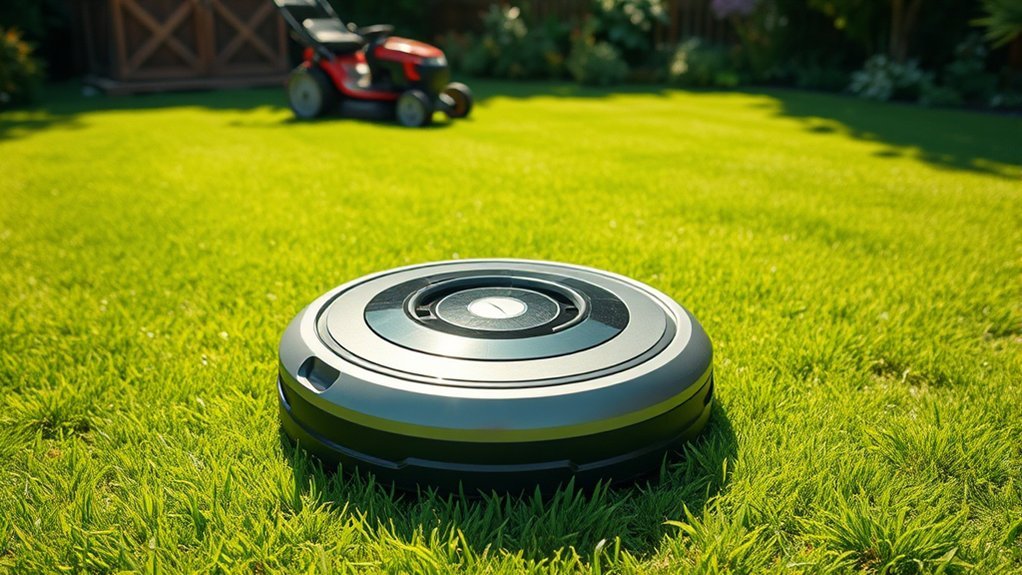
Robot mowers considerably enhance lawn care efficiency by automating routine mowing tasks, allowing users to allocate time to other activities. Leveraging smart technology, these devices operate autonomously, optimizing mowing patterns based on lawn size and terrain. This automation notably reduces manual labor and ensures consistent lawn maintenance, improving overall turf health. The integration of smart sensors and scheduling features enhances user convenience, enabling precise control via smartphone apps or automation settings. By maintaining a regular mowing cycle, robot mowers minimize the need for manual intervention, leading to substantial time savings. Consequently, users experience less lawn care stress and more flexibility, as these devices continuously work in the background, maximizing efficiency through intelligent, automated mowing processes.
Key Features to Consider When Choosing Between a Robot and Manual Mower
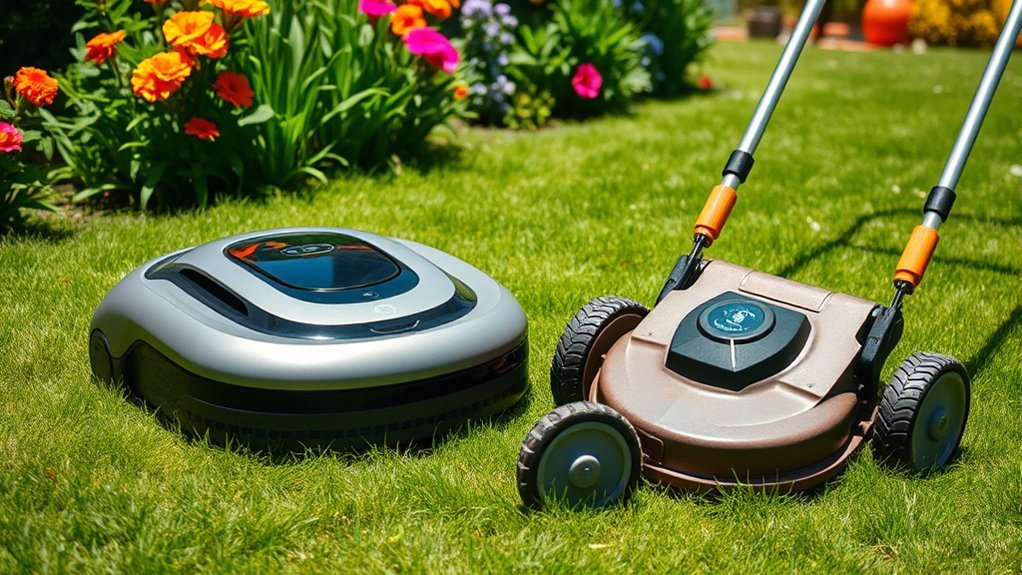
When selecting between a robot mower and a manual mower, it’s essential to evaluate specific features that align with your lawn’s size, terrain, and maintenance preferences. Critical factors include the ability to maintain consistent lawn aesthetics, ensuring even cut quality, and understanding how each mower impacts safety.
Choosing the right mower depends on your lawn size, terrain, and safety priorities for optimal results.
Key features to consider are:
- Cutting precision and adjustment options for varying grass heights
- Safety features such as obstacle detection and emergency stop mechanisms
- Power source and battery life for extended use
These elements directly influence lawn appearance and user safety, helping you choose a device that optimizes aesthetic appeal while minimizing hazards. Prioritizing these features guarantees the mower aligns with your lawn’s specific needs and your safety standards.
Pros and Cons of Robot Mowers for Different Yard Sizes and Types
Choosing the right robot mower depends heavily on yard size and terrain complexity, as these factors directly influence performance and efficiency. For smaller, flat lawns, robot mowers excel at maintaining consistent lawn aesthetics with minimal effort, ensuring a uniform cut and healthy grass growth. Larger or uneven terrains may challenge their navigation, leading to inconsistent cutting and potential gaps in coverage. Additionally, robot mowers can support pest control by reducing overgrown grass habitats, therefore minimizing pest breeding grounds. However, their effectiveness diminishes in highly complex terrains or dense foliage, where manual mowers provide greater control and precision. For different yard types, understanding these pros and cons helps optimize lawn care, balancing aesthetics, pest management, and operational efficiency based on specific yard characteristics.
Addressing Limitations: What Manual Mowers Offer That Robots Can’t
Manual mowers offer a level of control and precision that robotic models currently cannot match, especially in complex or challenging terrains. This manual accuracy allows for targeted trimming around obstacles, delicate landscaping features, and uneven surfaces where automation may falter. Direct control enables operators to adapt cuts instantly, ensuring ideal turf health and aesthetic quality.
Key advantages include:
- Precise maneuverability in confined or irregular areas
- Immediate responsiveness to terrain variations
- Customizable cutting depth and pattern adjustments
While robotic mowers excel in automation, manual mowers provide critical benefits in scenarios requiring nuanced, real-time adjustments. This direct control ensures a higher degree of accuracy in specific conditions, making manual tools indispensable where precision outweighs convenience.
Environmental and Noise Considerations for Both Mower Types
Both manual and robot mowers impact the environment and noise levels differently, influencing their suitability for various settings. We must consider noise pollution, which varies markedly between the quieter electric robot mowers and traditional gas-powered models. Additionally, eco-friendly power sources like batteries and solar options play an essential role in reducing overall environmental impact.
Noise Pollution Levels
While traditional gas-powered mowers are known for their loud operation, robotic mowers generally produce considerably lower noise levels, making them more environmentally friendly regarding acoustic pollution. This reduction benefits both lawn aesthetics and user convenience by minimizing disturbance during operation. Robotic mowers emit noise levels comparable to ambient background sounds, which allows for more flexible mowing schedules without disturbing neighbors. Key advantages include:
- Reduced noise pollution, supporting community harmony
- Less acoustic disruption, enabling early or late mowing
- Enhanced user experience through quieter operation
This lower noise profile not only contributes to a more sustainable environment but also ensures a more pleasant mowing experience, especially in noise-sensitive areas. Overall, robotic mowers’ quieter operation aligns with eco-conscious practices and improves the overall lawn care environment.
Eco-Friendly Power Sources
Electric and battery-powered mowers have gained popularity due to their potential for reducing environmental impact and noise pollution compared to traditional gas-powered models. Advances in battery technology, such as lithium-ion cells, have improved energy density and lifespan, making these mowers more sustainable and efficient. Additionally, integrating solar power systems can further enhance eco-friendliness by harnessing renewable energy to recharge batteries, reducing reliance on grid electricity. Solar panels mounted on mower stations or nearby structures allow for continuous operation without emitting greenhouse gases. These power sources markedly lower emissions and noise levels, making them preferable for environmentally conscious users. Overall, the combination of innovative battery technology and solar power options positions electric and robot mowers as more sustainable alternatives, aligning with ecological and noise reduction goals.
Which Mower Is Right for Your Lifestyle and Lawn? Making the Best Choice
Choosing the right mower depends heavily on your specific lawn size, terrain, and maintenance preferences. For larger or irregularly shaped lawns, robotic mowers with smart mowing capabilities provide consistent, autonomous coverage, enhancing lawn customization. Manual mowers may suit smaller, flat terrains where precise control is essential. Key considerations include:
- Lawn size: Larger areas benefit from robotic mowers with extended battery life.
- Terrain complexity: Uneven or hilly terrain may require a rugged manual mower.
- Maintenance routine: Automated systems reduce time spent on mowing but demand technological upkeep.
Balancing these factors helps determine whether smart mowing features or manual precision align with your lifestyle, ensuring ideal lawn health and efficiency.
Frequently Asked Questions
How Do Robot Mowers Handle Uneven or Sloped Terrain?
Robot mowers handle uneven terrain through advanced terrain adaptation and slope management features, ensuring stable operation on slopes. Their sensors detect incline and adjust mowing patterns, maintaining efficiency and safety across diverse terrains without manual intervention.
Are Robot Mowers Suitable for All Grass Types?
Robot mowers are generally suitable for most grass types, but compatibility depends on mower size limitations and grass density; thicker or more fibrous grass may challenge some models, requiring careful selection based on specific terrain and grass characteristics.
What Safety Features Do Robot Mowers Include?
We believe robot mowers’ safety features are astonishing—emergency stop buttons, collision sensors, and boundary wires—while their long battery life and low noise levels guarantee safe, efficient operation, minimizing risks and maximizing peace of mind for users.
Can Robot Mowers Be Programmed for Specific Lawn Zones?
Yes, robot mowers can be programmed for specific lawn zones using smart scheduling and zone customization features, allowing precise control over mowing patterns, optimizing coverage, and efficiently managing different areas with tailored settings for each zone.
How Do Robot Mowers Perform in Wet or Rainy Conditions?
Like a duck gliding smoothly, robot mowers handle wet conditions with moderate rain resistance, but soil adaptability decreases in heavy rain, risking soil damage and reduced cutting efficiency. We recommend cautious operation during persistent wet weather.
Conclusion
Ultimately, choosing between a robot and manual mower is like selecting the brush for a masterpiece—each stroke shapes the final landscape. As we analyze cost, efficiency, and environmental impact, we see that automation offers precision and time savings, while manual tools provide control and reliability. The right choice depends on your lawn’s unique terrain and your lifestyle. By understanding these symbols of technology and tradition, you can craft a landscape that’s both functional and inspiring.