Ad Blocker Detected
Our website is made possible by displaying online advertisements to our visitors. Please consider supporting us by disabling your ad blocker.
Imagine a lawn that maintains itself like a finely tuned machine, silently and efficiently. That’s the promise of robotic mowers, which offer a high level of automation and eco-friendliness, contrasting with traditional lawn care services that provide all-encompassing, tailored treatments but at a higher ongoing cost. As we consider the trade-offs between these options—cost, convenience, maintenance, and environmental impact—it’s clear the decision isn’t straightforward. Understanding the nuances can help us choose the best approach for your landscape.
Key Takeaways
- Robot mowers offer autonomous, scheduled grass cutting, while lawn care services provide comprehensive, manual landscape management.
- Initial costs are higher for robot mowers, but they typically save money long-term due to lower ongoing maintenance.
- Robot mowers are eco-friendly, quiet, and ideal for small to medium lawns, whereas traditional services handle complex landscapes.
- Traditional lawn care includes treatments like fertilization and aeration, which robotic mowers cannot perform.
- Robot mowers suit simple, flat terrains; professional services are better for uneven or intricate landscapes.
Understanding the Basics of Robot Mowers and Lawn Care Services
While both robot mowers and traditional lawn care services aim to maintain healthy, aesthetically pleasing lawns, they operate based on fundamentally different principles. Robot mowers utilize sophisticated sensors, GPS, and programmable algorithms to navigate and cut grass with precision, ensuring consistent lawn aesthetics. They adapt to seasonal adjustments by modulating cutting height and frequency automatically, responding to growth rates and weather conditions. In contrast, lawn care services rely on manual labor, with technicians adjusting mowing parameters based on visual assessments and seasonal needs. Robot mowers deliver uniform coverage through systematic, grid-pattern mowing, reducing human error. Seasonal adjustments are often pre-programmed or automated in robotic units, whereas traditional services depend on manual modifications. Both approaches aim to optimize lawn health and appearance, but they do so through distinct technological and operational frameworks.
Comparing Costs: Is a Robot Mower More Affordable Than Hiring a Pro?
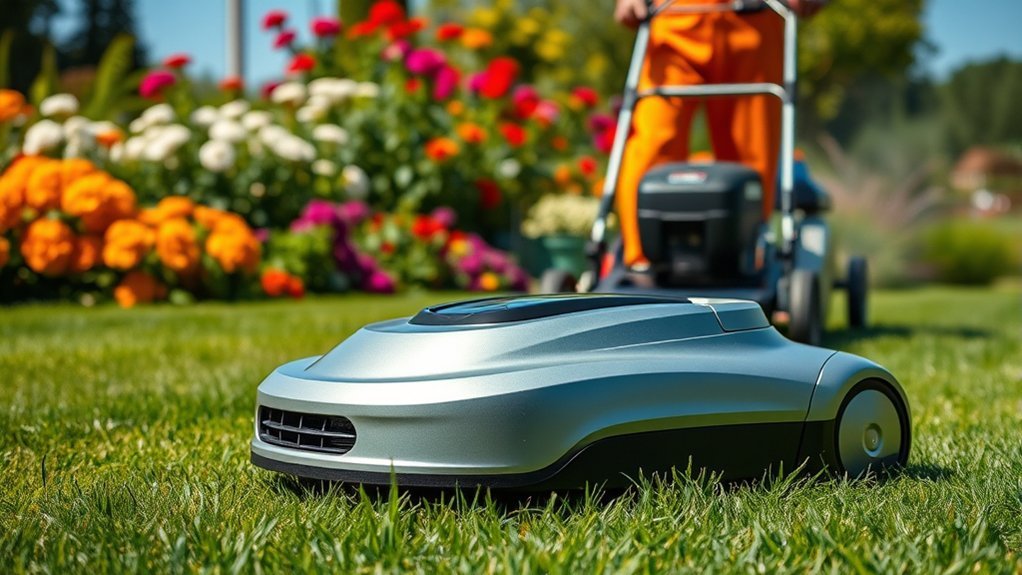
When comparing costs, we evaluate the initial purchase price of robot mowers against the ongoing service fees of professional lawn care. Maintenance expenses, including software updates and parts, impact long-term affordability, while labor costs for professionals can accumulate markedly over time. Analyzing these variables allows us to determine which option provides more cost-effective, sustainable lawn management.
Upfront Purchase Costs
Evaluating upfront costs reveals a significant difference between robot mowers and professional lawn care services. Robot mowers typically require an initial investment ranging from $1,000 to $3,000, depending on model features, cutting width, and automation capabilities. This cost covers hardware, sensors, and integration for maintaining garden aesthetics consistently. Conversely, hiring a lawn care service involves minimal upfront costs but incurs recurring expenses based on seasonal scheduling, often $30 to $80 per visit. While the professional service’s initial outlay is lower, ongoing costs can accumulate substantially over time. For homeowners prioritizing long-term savings and precise garden aesthetics, the upfront purchase of a robot mower may prove more economical, especially when considering the frequency of seasonal scheduling and the ability to automate mowing tasks without ongoing labor fees.
Maintenance Expenses
Are maintenance costs for robot mowers more manageable than ongoing expenses for professional lawn care? Robot mowers typically incur lower costs for routine maintenance, such as blade sharpening and battery replacement, which are predictable and often covered under warranties. Unlike lawn care services, they don’t require frequent visits for lawn fertilization or pest control, which can markedly add to ongoing expenses. Professional services often include seasonal treatments, soil testing, and targeted pest management, increasing overall costs. Robot mowers eliminate labor charges for mowing but may need periodic software updates and sensor calibrations. While initial investment might be higher, the absence of recurring service fees for fertilization and pest control can make robot mowers a more cost-effective option for maintaining a healthy, well-manicured lawn over time.
Long-Term Savings
Over the long term, robot mowers can offer significant cost savings compared to hiring professional lawn care services, primarily due to their lower recurring expenses. Unlike traditional lawn care, which includes regular service fees and labor costs, robot mowers require minimal maintenance and operational costs, such as electricity and occasional part replacements. This leads to consistent savings, especially when considering the enhanced lawn aesthetics achieved through precise, evenly cut grass. Additionally, robot mowers are designed with pet safety in mind, incorporating boundary sensors and programmed zones to prevent accidents, reducing liability and potential costs associated with pet injuries. Over years, these factors contribute to a more economical solution while maintaining high lawn quality and ensuring pet safety, making robot mowers a financially advantageous alternative.
How Each Option Maintains Your Lawn’s Health and Appearance
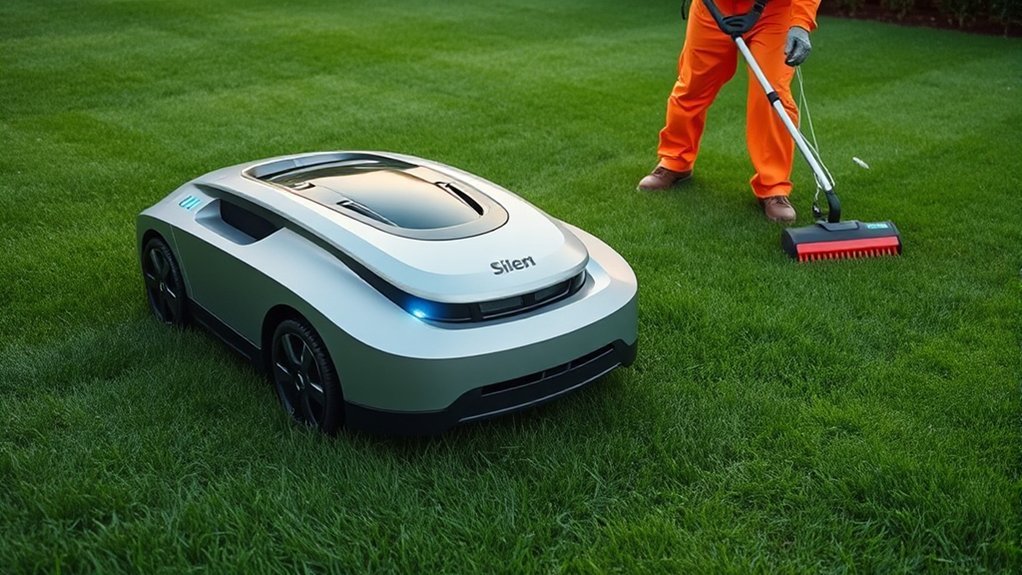
Both robot mowers and traditional lawn care services employ distinct methods to maintain a lawn’s health and aesthetic appeal, each with specific advantages rooted in their operational design. Robot mowers utilize precise, consistent cutting patterns that promote uniform grass height, enhancing lawn aesthetics and preventing disease by reducing thatch buildup. Their mulching blades return nutrients to the soil, fostering healthy growth. Conversely, traditional services often include fertilization, aeration, and overseeding, which improve soil quality and turf density. Regarding wildlife impact, robot mowers produce less noise and disturbance, supporting local ecosystems, whereas traditional methods may involve chemical treatments and equipment noise that can disrupt wildlife habitats. Both approaches aim for a vibrant, healthy lawn, but their environmental footprints differ markedly.
Convenience and Time Savings: Which Fits Your Lifestyle Better?
When evaluating convenience and time savings, robot mowers offer significant advantages through automation, requiring minimal manual intervention once programmed and installed. They operate on customizable schedules, adapting to seasonal variations in growth rates, which guarantees consistent lawn maintenance without daily oversight. This automation aligns with aesthetic preferences by maintaining a uniformly cut appearance, regardless of external conditions. In contrast, lawn care services involve scheduled visits that can be disrupted by weather or seasonal changes, potentially leading to delays. Robot mowers optimize your lifestyle by freeing up time and reducing effort, especially for routine trimming. Their ability to work autonomously, regardless of season, makes them a practical choice for those prioritizing convenience, efficiency, and a consistent aesthetic.
Customization and Lawn Size: When Does One Outperform the Other?
In evaluating lawn size suitability, robot mowers excel in smaller to medium areas due to their efficient, automated coverage, whereas larger properties often require the scalability of professional services. Customization flexibility varies: robot mowers offer programmable patterns and mowing schedules, but professional services can adapt to complex landscape features and specific lawn care needs more thoroughly. Understanding these distinctions helps determine when each option provides best performance based on lawn size and desired customization.
Lawn Size Suitability
Lawn size particularly influences whether a robotic mower or traditional lawn care service delivers ideal results, as each option offers distinct advantages depending on the area. Smaller lawns, typically under 0.5 acres, benefit from robotic mowers’ consistent cutting and seasonal adjustments, maintaining best lawn aesthetics with minimal effort. Larger properties, exceeding 1 acre, tend to favor professional services, which can efficiently handle extensive areas and complex terrain. The table below illustrates the suitability based on size:
| Lawn Size | Suitable Option |
|---|---|
| Up to 0.5 acres | Robotic mower |
| 0.5 – 1 acre | Both options with considerations |
| Over 1 acre | Traditional lawn care service |
| Uneven terrain | Professional service preferred |
Customization Flexibility
Customization flexibility plays a critical role in determining whether a robotic mower or a traditional lawn care service better suits specific lawn requirements. Robotic mowers leverage smart technology to adapt mowing patterns based on user preferences, allowing for precise adjustments in cutting height, scheduling, and zones. Advanced sensors enable tailored trimming, even on complex terrains, providing a high degree of customization for varying grass types and lawn layouts. Conversely, traditional lawn care services often offer bespoke treatments, such as fertilization or aeration, tailored to specific soil conditions or aesthetic goals. While robotic mowers excel in consistent, routine maintenance with customizable settings, their flexibility may be limited for lawns requiring specialized treatments. Ultimately, the choice hinges on the desired level of automation versus manual customization aligned with user preferences.
Long-Term Durability and Maintenance Requirements of Robot Mowers vs. Lawn Services
While robot mowers are designed for consistent operation, their long-term durability depends heavily on build quality, component resilience, and environmental exposure. High-quality models feature weatherproof casings, corrosion-resistant blades, and robust electronics, reducing wear over time. Regular seasonal maintenance, including blade sharpening and battery checks, extends lifespan and maintains performance. Many manufacturers offer equipment warranties covering defects and certain repairs, providing added security. Conversely, lawn care services rely on human labor and equipment that may require frequent replacements or repairs due to heavy use or environmental factors. Their maintenance involves scheduling service visits, which can be costly over years. Overall, robot mowers with solid build quality and extensive warranties tend to offer greater long-term durability with less ongoing maintenance compared to traditional lawn services.
Environmental Impact: Which Choice Is More Eco-Friendly?
Considering the environmental impacts, robot mowers generally present a more eco-friendly option compared to traditional lawn care services, primarily due to their lower energy consumption and minimal emissions. They operate quietly, reducing noise pollution, and are compatible with sustainable landscape design practices. Additionally, robot mowers can decrease the need for chemical pest control, as their precise cutting reduces stress on the grass and minimizes pest habitats. However, their reliance on electric power, often from renewable sources, further enhances environmental benefits.
| Aspect | Traditional Lawn Service | Robot Mowers |
|---|---|---|
| Energy Use | Gasoline or diesel engines | Electric, often renewable |
| Emissions | High | Low |
| Pest Control | Chemical applications | Reduced need through healthier turf |
| Landscape Impact | Potential soil compaction | Minimal disturbance |
Limitations and Challenges of Robot Mowers Compared to Professional Lawn Care
Despite their technological advancements, robot mowers face significant limitations when compared to professional lawn care services, particularly in scale, complexity, and adaptability. Robot mower durability remains a concern, especially under harsh weather conditions or on uneven terrain, risking damage that compromises operational efficiency. Their ability to handle intricate landscape features, such as ornamental beds or slopes, is limited, often requiring manual intervention. Additionally, robot mowers lack the all-encompassing coverage and flexibility of a professional lawn service, which can adapt to evolving lawn needs. From a legal standpoint, lawn service insurance offers coverage for damages or accidents, a safeguard that robot mower users often lack. These factors highlight the current constraints of robot mowers in delivering the same level of all-encompassing, reliable lawn care.
Making the Right Choice: Factors to Consider for Your Lawn and Budget
Choosing the appropriate lawn maintenance solution requires a careful assessment of your specific lawn characteristics and financial considerations. For effective decision-making, evaluate your garden design’s complexity, including terrain, plant diversity, and shading, which influence equipment suitability. Robot mowers excel in flat, uncomplicated lawns, but may struggle with intricate layouts requiring manual adjustments. Conversely, professional lawn care services offer tailored solutions, including pest control, to address weed and insect issues, ensuring a healthier landscape. Budget constraints are also essential; robot mowers have lower long-term costs but higher initial investments, while services may be more flexible but incur ongoing expenses. Ultimately, balancing your lawn’s technical needs against your financial capacity will guide you toward a solution that optimizes garden health, aesthetic appeal, and pest management.
Frequently Asked Questions
How Do Robot Mowers Handle Complex Landscaping Features?
Robot mowers navigate complex landscaping features by adapting to terrain variations and avoiding obstacles through advanced sensors and algorithms, ensuring precise trimming around landscaping obstacles, slopes, and uneven terrain for consistent, efficient lawn maintenance.
What Safety Features Are Included in Robot Mower Models?
Think of robot mowers as vigilant guardians; they include safety features like obstacle detection, emergency stop, and boundary sensors. Their battery life guarantees consistent operation, while low noise levels maintain peaceful, secure yard environments.
Can Lawn Care Services Adapt to Seasonal Lawn Needs?
Lawn care services can adapt seasonally by adjusting lawn fertilization schedules and pest control treatments, ensuring ideal growth and health. We tailor these strategies based on weather patterns and grass conditions, maintaining a vibrant, resilient lawn year-round.
Are There Restrictions on Robot Mower Use in Shared or HOA Properties?
Like steering through a maze, HOA regulations and shared property rules often restrict robot mower use, requiring homeowners to review HOA policies thoroughly. We’ve encountered HOAs that specify operational hours and safety measures, ensuring compliance and community harmony.
How Do Robot Mowers Perform in Extreme Weather Conditions?
In extreme weather, robot mowers rely on advanced weather sensors to detect conditions, while battery durability may decrease in freezing or scorching temperatures, potentially interrupting operation and requiring manual intervention for peak performance and safety.
Conclusion
Ultimately, choosing between a robot mower and a lawn care service hinges on your lawn’s complexity and your priorities. While robotic mowers offer consistent, eco-friendly maintenance with minimal manual effort, professional services provide thorough, tailored treatments for larger or intricate landscapes. Balancing cost, customization, and environmental impact helps us make an informed decision—whether we value automation and sustainability or prefer expert care for the best lawn health. The right choice aligns with both our lawn’s needs and our long-term goals.