Ad Blocker Detected
Our website is made possible by displaying online advertisements to our visitors. Please consider supporting us by disabling your ad blocker.
Studies show that nearly 60% of homeowners with lawns over half an acre consider automated mowing solutions for their landscape management. As we compare robot mowers and self-propelled models, it’s clear each offers distinct technological advantages suited to different terrain and maintenance needs. Understanding their operational mechanics, benefits, and limitations can substantially influence your choice—yet, selecting the right mower depends heavily on your specific lawn conditions and how much manual effort you’re willing to invest.
Key Takeaways
- Robot mowers offer autonomous, precise, and quiet operation ideal for flat, small to medium lawns, while self-propelled mowers are better for larger, uneven terrains.
- Robot mowers use sensors and boundary wires for navigation; self-propelled models rely on operator control and manual steering.
- Cost varies: robot mowers typically cost $800–$3,000, whereas self-propelled mowers range from $300–$1,200.
- Maintenance for robot mowers is minimal; self-propelled models require engine oil, blade, and engine upkeep.
- Robot mowers provide consistent, manicured cuts with less physical effort; self-propelled mowers depend on operator skill for quality.
How Do Robot Mowers Work and What Are Their Main Features?
Robot mowers operate through an embedded system of sensors, GPS, and boundary wires that allow them to navigate and maintain a defined area with high precision. Their robot navigation relies on complex algorithms that optimize mowing paths, reducing overlap and ensuring thorough coverage. Mowing algorithms process data from sensors detecting obstacles, slope, and grass height, enabling adaptive adjustments in real-time. Boundary wires create a virtual perimeter, preventing the mower from leaving designated zones, while GPS enhances outdoor navigation accuracy in larger spaces. Sensors such as bump, tilt, and grass detection contribute to safe operation and efficient mowing cycles. This combination of advanced navigation technology and intelligent algorithms allows robot mowers to perform autonomous, precise, and efficient lawn maintenance without human intervention.
What Are the Benefits of Using a Robot Mower?
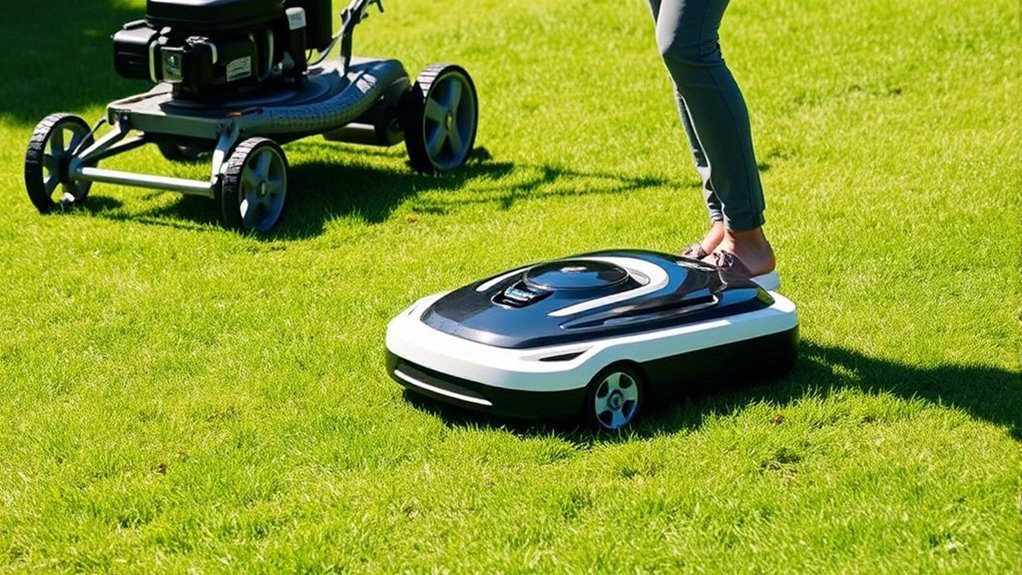
The advanced navigation systems and intelligent algorithms embedded in robot mowers translate directly into significant operational benefits for users. These systems optimize mowing paths, ensuring thorough coverage and consistent grass cutting, which promotes healthier turf growth. By maintaining uniform height, robot mowers facilitate better absorption of lawn fertilizer and improve soil health. Their precise cutting patterns reduce the need for manual interventions, preserving grass seed viability and minimizing wear on the lawn. Additionally, their ability to operate autonomously allows for regular mowing schedules, which enhance overall lawn quality. The consistent cutting also helps prevent overgrowth, reducing the risk of pest infestations. Overall, robot mowers improve lawn maintenance efficiency, leading to a more vibrant, evenly cut, and healthier landscape.
How Do Self-Propelled Mowers Operate and What Advantages Do They Offer?
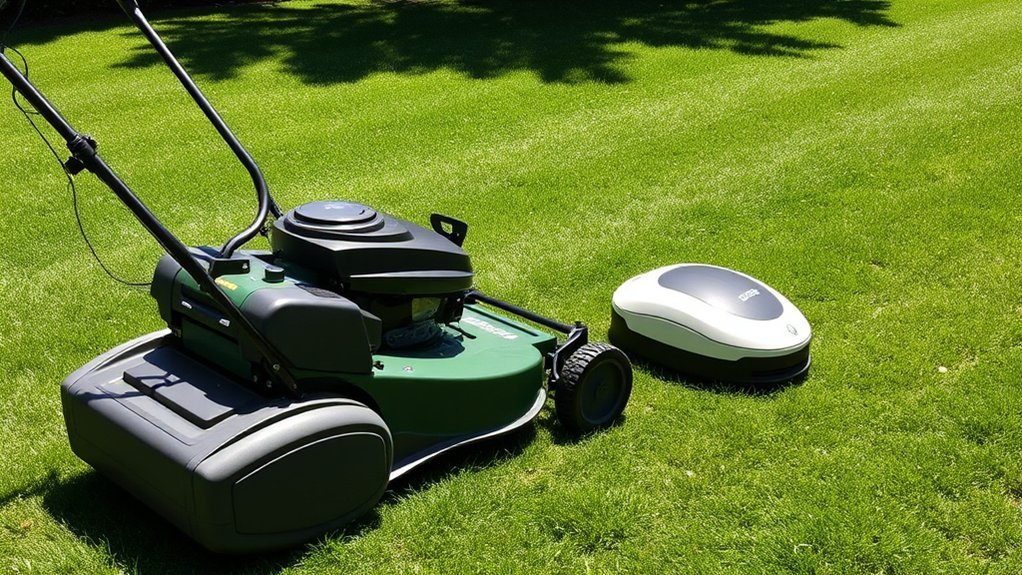
Self-propelled mowers operate through an integrated drive system that actively powers the wheels, allowing the mower to move independently across the lawn without manual pushing. This system typically includes a transmission connected to an engine or motor, which provides variable speed control for efficient lawn maintenance. The operator guides the mower using ergonomic handles, while the self-propulsion mechanism reduces physical effort, especially on uneven terrain. These mowers utilize advanced engineering to optimize power transfer and traction, making them suitable for larger or more complex gardening tasks. Their design enhances productivity by allowing continuous operation with minimal fatigue. As a versatile gardening tool, self-propelled mowers streamline lawn care, combining mechanical efficiency with user comfort, ultimately offering a significant advantage in maintaining well-kept lawns.
Which Factors Should You Consider When Choosing Between a Robot Mower and a Self-Propelled Mower?
When selecting between a robot mower and a self-propelled mower, several key factors influence the best choice for your lawn care needs. These include lawn aesthetics, noise levels, terrain complexity, maintenance, and energy consumption. A detailed comparison helps determine suitability based on these aspects:
| Factor | Robot Mower | Self-Propelled Mower |
|---|---|---|
| Lawn Aesthetics | Precise, uniform cut for a manicured look | Variable, depending on operator skill |
| Noise Levels | Much quieter, minimally disruptive | Louder, may disturb household or neighbors |
| Terrain Suitability | Best for flat, even surfaces | Handles varied terrains better |
| Maintenance | Low, mostly software updates and blade checks | Regular engine, oil, and blade maintenance |
| Energy Efficiency | Runs on rechargeable batteries | Gas or electric, higher energy use |
Are There Any Limitations or Downsides to Each Mower Type?
Are there inherent limitations or disadvantages associated with each mower type that could impact their overall effectiveness? Yes, both robot and self-propelled mowers have specific downsides. Robot mowers often face restrictions in handling complex terrains and may struggle with battery safety during prolonged use, risking overheating or reduced lifespan. Noise levels tend to be lower, but certain models can still produce disruptive sounds, especially during charging cycles. Self-propelled mowers generally deliver higher cutting power but are bulkier, more expensive, and produce higher noise levels, which could disturb neighbors. Additionally, they require more maintenance and are less suitable for uneven terrain. Both types may have operational limitations that affect their efficiency depending on lawn size, terrain complexity, and user expectations.
- Limited terrain adaptability for robot mowers
- Battery safety concerns over extended operation
- Higher noise levels in self-propelled models
- Increased maintenance requirements
- Cost and size constraints impacting usability
How Much Do Robot Mowers and Self-Propelled Mowers Typically Cost?
Robot mowers generally range from $800 to $3,000, with budget models offering basic features and premium versions including advanced navigation and connectivity. Self-propelled mowers tend to start around $300 for basic models and can exceed $2,500 for high-end, feature-rich units. When considering long-term costs, factors like maintenance, energy consumption, and lifespan considerably impact overall value.
Price Range Comparison
Understanding the typical price ranges for robot mowers and self-propelled mowers is essential for making an informed purchasing decision, as costs can vary considerably based on features, brand, and capacity. Robot mowers generally range from $500 to $3,000, with higher-end models offering advanced navigation, customizable mowing schedules, and minimal noise levels, which benefit lawn aesthetics. Self-propelled mowers usually cost between $300 and $1,200, depending on engine power, cutting width, and build quality. Key factors influencing price include:
- Cutting technology and precision
- Battery life and charging time
- Noise level reduction features
- Terrain adaptability and size capacity
- Material durability and brand reputation
These elements directly impact the overall value and suitability for specific lawn types and aesthetic preferences.
Budget vs Premium Models
When evaluating the cost differences between budget and premium models, it becomes clear that price considerably impacts features, build quality, and performance for both robot and self-propelled mowers. Budget models generally range from $300 to $700, offering basic technology integration such as manual controls and limited sensors, which can restrict operational efficiency. Premium models, costing $1,200 to $3,500 or more, incorporate advanced features like GPS navigation, customizable mowing patterns, and sophisticated cutting systems. These enhancements improve precision and reduce environmental impact through optimized mowing routes and energy-efficient operation. The higher cost reflects superior build materials, durability, and smarter technology integration, which collectively lead to more reliable performance and a reduced ecological footprint over time.
Long-Term Cost Factors
Over the long term, the overall costs of robot and self-propelled mowers extend well beyond their initial purchase prices, as ongoing expenses substantially influence total ownership costs. Key factors include maintenance requirements, replacement parts, and energy consumption, all affecting lawn aesthetics and mowing frequency. Robot mowers typically incur higher upfront costs but lower operational expenses, while self-propelled mowers may require more frequent repairs due to mechanical complexity. Additional long-term costs involve battery replacements for robots and fuel or electricity for both types. Properly evaluating these expenses helps determine the true cost-effectiveness over years of consistent lawn care.
- Routine maintenance and part replacements
- Energy or fuel costs over time
- Battery longevity and replacement needs
- Impact of mowing frequency on wear
- Effect on lawn aesthetics and health
Which Mower Is Best Suited for Your Lawn Size and Terrain?
Selecting the appropriate mower depends heavily on your lawn’s size and terrain, as these factors directly influence operational efficiency and maintenance requirements. For large, flat lawns, a self-propelled mower offers sustained power and speed, reducing mowing time and accommodating heavy-duty tasks like applying lawn fertilizer uniformly. If your terrain includes uneven ground or slopes, a robot mower with precise boundary controls and adaptive navigation proves more effective, minimizing turf damage. Consider how garden furniture placement impacts access; cluttered areas may require a smaller, maneuverable model. For lawns with varied terrain, combining a robot mower for daily maintenance and a self-propelled mower for initial clearing ensures ideal turf health and appearance. Tailoring your choice to these factors guarantees a well-maintained, attractive lawn.
Frequently Asked Questions
Can Robot Mowers Handle Steep Slopes or Uneven Terrain Effectively?
Robot mowers generally struggle with steep slopes due to limited slope navigation and terrain adaptability, often risking slippage or tipping. For uneven terrain, they may require specific models with enhanced traction and stability features to operate effectively.
How Often Do Robot Mowers Require Maintenance or Repairs?
They say “prevention is better than cure,” and we find robot mowers need minimal maintenance, mainly checking battery longevity and blade maintenance every few months, with repairs typically rare unless encountering mechanical issues or battery degradation.
Are There Specific Brands or Models Recommended for Large Lawns?
For large lawns, we recommend brands like Husqvarna Automower and Robomow, considering lawn size and terrain, as they offer models with extensive cutting capacities, durable components, and advanced navigation systems, ensuring efficient, reliable performance over expansive areas.
Do Self-Propelled Mowers Require More Storage Space Than Robot Mowers?
Self-propelled mowers generally require more storage space due to their larger size and manual components, impacting space considerations. Robot mowers are more compact, often stored easily in smaller areas, making them more efficient for limited storage requirements.
What Safety Features Are Included in Modern Robot and Self-Propelled Mowers?
Modern robot and self-propelled mowers include safety features like emergency stop buttons and obstacle detection via artificial intelligence, which enhances safety, while battery longevity guarantees consistent operation; these features protect users and prolong mower lifespan efficiently.
Conclusion
In conclusion, selecting between a robot mower and a self-propelled mower depends on your lawn’s size, terrain, and maintenance preferences. Notably, studies show that robot mowers can reduce lawn maintenance time by up to 60%, highlighting their efficiency. While robot mowers excel on flat, well-maintained lawns with precise navigation, self-propelled models offer versatility for uneven terrain and larger areas. Careful evaluation of your landscape and needs guarantees the best performance and long-term satisfaction with your choice.