Ad Blocker Detected
Our website is made possible by displaying online advertisements to our visitors. Please consider supporting us by disabling your ad blocker.
Many assume that the choice between robot and ride-on mowers hinges solely on lawn size, but this oversimplifies the issue. The true comparison involves analyzing terrain complexity, maintenance costs, environmental impact, and user convenience. Each option offers distinct advantages and limitations that can greatly influence long-term satisfaction. To determine which mower type truly suits your needs, it’s essential to examine these factors in detail—an analysis that reveals more than just surface-level differences.
Key Takeaways
- Choose a robot mower for small, flat lawns requiring precise, low-maintenance, and eco-friendly mowing solutions.
- Opt for a ride-on mower for large, uneven, or complex terrains needing high power and manual control.
- Consider initial costs: robot mowers are higher upfront but cheaper to maintain long-term; ride-on mowers have lower initial but higher ongoing costs.
- For environmental impact and noise reduction, robot mowers are more sustainable and quieter options.
- User preference for automation versus manual control influences the best choice between the two mower types.
Understanding the Core Differences Between Robot and Ride-On Mowers
While both robot mowers and ride-on mowers serve the primary purpose of maintaining lawns, their core differences lie in design, operational mechanics, and user interaction. Robot mowers leverage smart technology, utilizing sensors and programmable algorithms to navigate and mow autonomously, offering consistent coverage with minimal human input. They prioritize energy efficiency by optimizing mowing routes and operating during low-energy periods, reducing power consumption. Conversely, ride-on mowers feature larger engines and manual controls, requiring user operation and direct engagement. Their mechanical design emphasizes power and capacity for larger or more complex terrains but lacks the integrated smart systems found in robot models. Understanding these fundamental distinctions helps inform decisions based on technological integration, energy use, and intended lawn maintenance approach.
Evaluating Lawn Size and Terrain Suitability for Each Mower Type
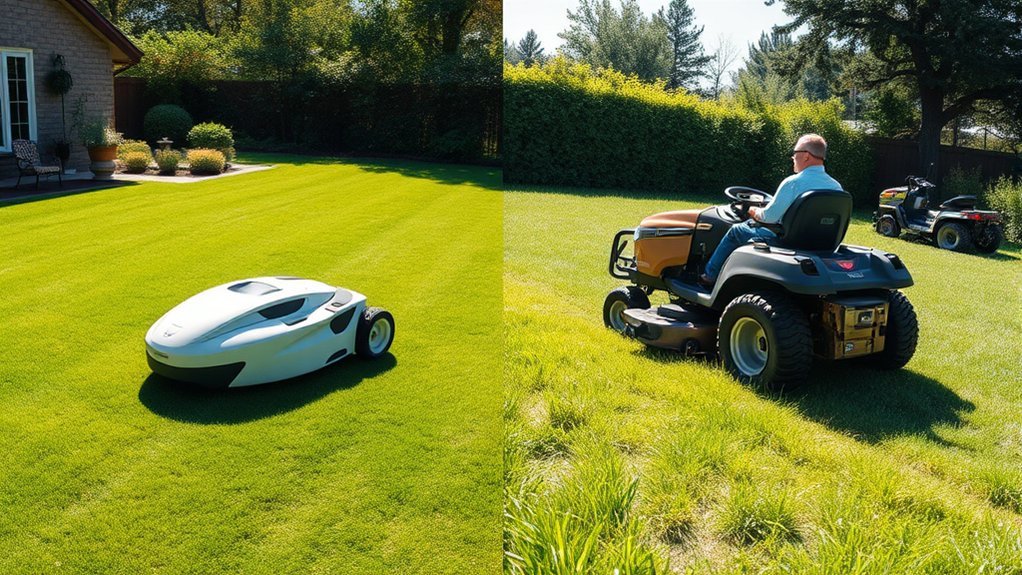
Evaluating lawn size and terrain conditions is vital for determining mower suitability. Robot mowers excel in smaller, flat areas, while ride-on models handle larger, uneven landscapes more effectively. Examining these factors allows us to match equipment capabilities with specific yard requirements for ideal performance.
Lawn Size Compatibility
Understanding the lawn size and terrain is essential when choosing between a robot mower and a ride-on mower, as each is optimized for different scales and conditions. For smaller lawns, robot mowers excel due to their precision and ability to maintain consistent lawn aesthetics with minimal input. Conversely, ride-on mowers are better suited for larger areas, offering higher mowing speeds that reduce overall labor time. To clarify, consider the following:
| Lawn Size | Suitable Mower Type | Key Consideration |
|---|---|---|
| Small | Robot mower | Mowing speed, precision |
| Medium | Both options | Terrain complexity |
| Large | Ride-on mower | Coverage, mowing speed |
This comparison highlights how size influences mower choice, balancing lawn aesthetics and efficiency.
Terrain Adaptability
Evaluating terrain adaptability is essential in determining whether a robot mower or a ride-on mower is better suited for a specific lawn, as each type has distinct performance capabilities across different landscape features. Robot mowers excel on relatively flat, uniform terrain, benefiting from robot customization that enhances navigation and obstacle avoidance. However, rugged or uneven terrain increases their maintenance frequency, requiring more frequent adjustments and repairs. Ride-on mowers, by contrast, handle varied topographies, including slopes and rough patches, with greater stability and power. They are better suited for large or complex landscapes where terrain complexity demands robust equipment. Ultimately, understanding the specific terrain features and maintenance demands informs the best choice, aligning mower capabilities with lawn characteristics for efficient operation.
Comparing Cost, Maintenance, and Long-Term Value
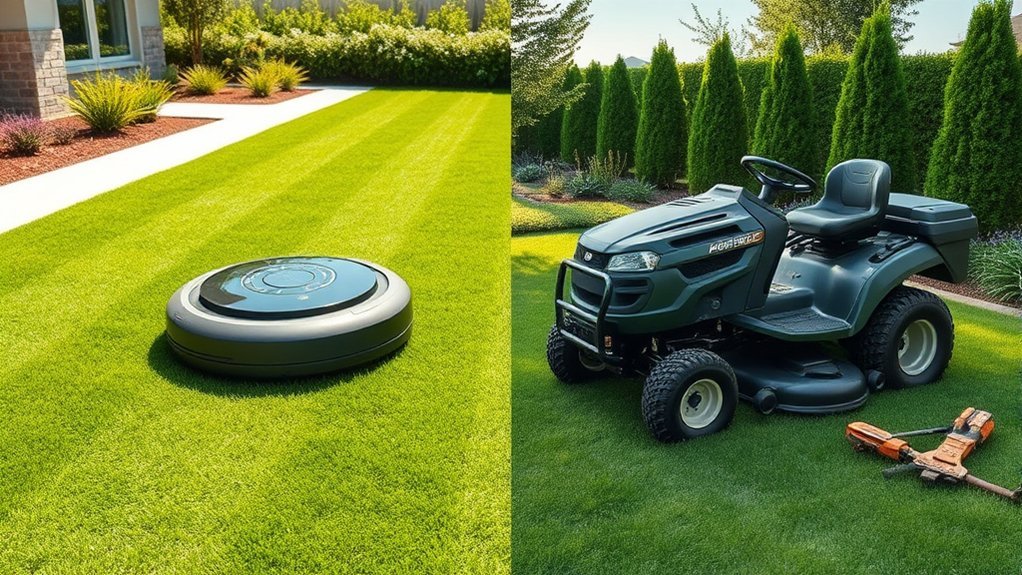
When comparing robot mowers and ride-on mowers, cost, maintenance requirements, and long-term value are critical factors that influence overall investment decisions. Robot mowers generally have a higher initial price but lower ongoing maintenance costs, thanks to fewer moving parts and automated operation. Ride-on mowers often demand more frequent maintenance and repairs, impacting long-term expenses. Aesthetic appeal plays a role, as robot mowers offer a sleek, unobtrusive presence, enhancing yard appearance without clutter. Brand reputation also affects value, with established brands typically providing better durability and customer support, translating into higher long-term reliability. While robot mowers excel in efficiency and modern design, ride-on mowers may offer more power for larger or tougher terrains, influencing overall value depending on specific needs.
Assessing Ease of Use, Convenience, and User Control
When evaluating ease of use, we consider how intuitive the operation is and the accessibility of control options for users with varying technical skills. Automated systems typically offer convenience through remote or app-based controls, while manual models rely on direct operation, impacting user engagement. Analyzing these factors helps determine which mower type aligns best with user preferences for simplicity and control.
User-Friendly Operation
While both robot mowers and ride-on mowers aim to simplify lawn maintenance, their user interfaces considerably impact ease of operation. Robot mowers leverage smart technology, offering intuitive controls via mobile apps or onboard displays, which streamline programming and adjustments. Their automation reduces manual effort and enhances convenience, especially with features like scheduled mowing. Battery life plays a critical role; longer-lasting batteries ensure uninterrupted operation and minimal user intervention. Conversely, ride-on mowers often feature simpler mechanical controls but require more direct user input for navigation and adjustments. While they may lack advanced smart technology, their straightforward interface appeals to users valuing tactile control. Overall, robot mowers excel in automation and ease of use through sophisticated interfaces, but ride-on mowers provide familiar, manual operation that some users find more accessible.
Accessibility and Control Options
How do accessibility and control options influence the overall ease of use and user experience for robot and ride-on mowers? These features substantially affect operational efficiency, safety, and user satisfaction. Robot mowers often include voice control and remote operation capabilities, enabling precise, hands-free management, especially in complex terrains. Ride-on mowers typically rely on manual controls but may incorporate remote operation for auxiliary functions. Consider the following comparison:
| Feature | Robot Mower | Ride-On Mower |
|---|---|---|
| Voice Control | Common for hands-free operation | Rare or absent |
| Remote Operation | Available for flexible control | Usually limited to specific tasks |
| User Interface | Smartphone apps, voice commands | Physical controls, dashboards |
| Ease of Access | Automated, minimal effort | Manual, requires physical input |
Manual vs. Automated Ease
Manual and automated mower systems differ considerably in their ease of use, convenience, and user control, directly impacting operational efficiency and user satisfaction. Manual mowers require physical effort, offering tactile control but demanding more user engagement and energy, especially during extended use. In contrast, automated systems leverage smart technology to optimize mowing schedules, terrain adaptation, and obstacle navigation, reducing user effort. The convenience of automated mowers hinges on battery life, which limits operational duration and necessitates recharging, unlike manual models that operate continuously. Automated mowers provide greater user control through smartphone apps and customizable settings, whereas manual systems depend solely on direct physical interaction. Ultimately, the choice hinges on balancing technological sophistication with practicality, considering how smart technology enhances ease of use and how battery life influences operational reliability.
Considering Environmental Impact and Noise Levels
When evaluating robotic and ride-on mowers, considering their environmental impact and noise levels reveals considerable differences that can influence our choices. Robotic mowers typically operate on electric batteries, offering higher battery efficiency and reducing pollution levels compared to gasoline-powered ride-on models. This shift decreases exhaust emissions and minimizes air pollution, aligning with eco-friendly standards. Additionally, robotic mowers generate markedly less noise, often operating at sound levels well below those of traditional ride-ons, which can disrupt both humans and wildlife. Ride-on mowers, reliant on internal combustion engines, produce higher pollution levels and generate more noise pollution, making them less suitable for environmentally sensitive areas. Overall, robotic mowers tend to be the more sustainable and quieter option, appealing to environmentally conscious consumers.
Which Mower Is Right for Your Lawn? Making the Final Decision
Choosing the right mower for your lawn depends on a careful assessment of your specific needs, terrain, and maintenance preferences. Smart technology integration in robot mowers offers precise, autonomous operation, making them ideal for consistent, low-maintenance cutting in complex landscapes. Conversely, ride-on mowers excel on large, flat terrains, providing power and speed for extensive lawns. When considering aesthetic appeal, both options can produce a manicured look, but robot mowers often deliver a more uniform cut thanks to advanced sensors and adaptive algorithms. The decision ultimately hinges on your lawn’s size, complexity, and your desire for technological features. Evaluating these factors helps determine whether smart technology-driven robot mowers or traditional ride-on models better align with your lawn care goals.
Frequently Asked Questions
How Do Robot and Ride-On Mowers Handle Uneven or Sloped Terrain?
Robot and ride-on mowers both handle uneven terrain, but robot mowers excel in terrain adaptability and slope navigation through advanced sensors, while ride-on mowers rely on mechanical stability and design features for effective performance on slopes.
What Safety Features Are Included in Each Mower Type?
We find that robot mowers feature smart navigation with safety sensors, while ride-on mowers prioritize physical safety guards. Both depend on battery life; efficient safety depends on sensor quality and system integration for obstacle detection and user protection.
Can Robot Mowers Mow During Rain or Wet Conditions?
Robot mowers generally don’t mow during rain or wet conditions due to limited rain resistance, which can compromise mowing efficiency and safety. We find that wet grass reduces cutting quality and risks damaging sensitive electronic components.
How Long Does Each Mower Type Typically Last Before Replacement?
Robot mowers typically last 3-8 years, depending on battery life and usage, with superior cutting precision maintaining efficiency. Ride-on mowers often last 8-15 years, but their longevity depends on engine durability and maintenance quality.
Are There Specific Brands or Models Recommended for Beginners?
We recommend beginner-friendly brands like Husqvarna Automower and WORX Landroid, which feature smart technology and excellent battery life, ensuring reliable performance and ease of use. These models provide intuitive controls, making them ideal for newcomers.
Conclusion
Ultimately, choosing between a robot mower and a ride-on mower hinges on our lawn’s unique landscape and our priorities. Like a carefully crafted blueprint, our decision reflects a balance of efficiency, sustainability, and convenience. We must weigh the landscape’s demands against our commitment to eco-friendliness and ease of use. In this calculus, the right mower isn’t just a tool—it’s a strategic investment, transforming lawn care into a thoughtfully optimized process.