Ad Blocker Detected
Our website is made possible by displaying online advertisements to our visitors. Please consider supporting us by disabling your ad blocker.
When comparing the time savings of robotic lawn mowers to manual mowing, it’s essential to evaluate various factors such as yard size, terrain complexity, and model features. While many homeowners find that robotic mowers considerably reduce mowing time, the actual efficiency gains can vary widely. Understanding these differences helps us determine whether investing in a higher-end model is justified. Let’s explore how different models and yard conditions influence overall time savings and what you can expect.
Key Takeaways
- Robot mowers operate autonomously, reducing manual effort and enabling frequent, systematic mowing for faster yard maintenance.
- Larger yards or complex terrains increase mowing time, but advanced navigation tech shortens operational duration.
- Features like longer battery life, high-quality blades, and precise sensors optimize efficiency and reduce overall mowing time.
- Smart models with GPS or lidar ensure thorough, minimal-overlap coverage, saving time compared to basic bump sensor mowers.
- Proper landscape design and routine maintenance maximize robot mower efficiency and time savings during lawn care.
How Do Robot Lawn Mowers Save Time Compared to Manual Mowing?
Although manual mowing requires significant time and effort, robot lawn mowers streamline the process by operating autonomously, thereby reducing the overall time spent maintaining a lawn. They efficiently cover large areas through scheduled, systematic mowing patterns, minimizing overlaps and missed spots common with manual efforts. This automation allows homeowners to allocate time to other gardening tips or lawn care activities, such as fertilizing or pruning. Robot mowers also work consistently regardless of weather conditions, preventing delays often caused by manual mowing schedules. Their ability to operate multiple times a week ensures a consistently manicured lawn, reducing the need for intensive manual grooming sessions. Overall, robot lawn mowers optimize lawn care routines by automating repetitive tasks, conserving significant time and effort while maintaining a well-kept yard.
Comparing Different Robot Lawn Mower Models: Features That Impact Time Savings
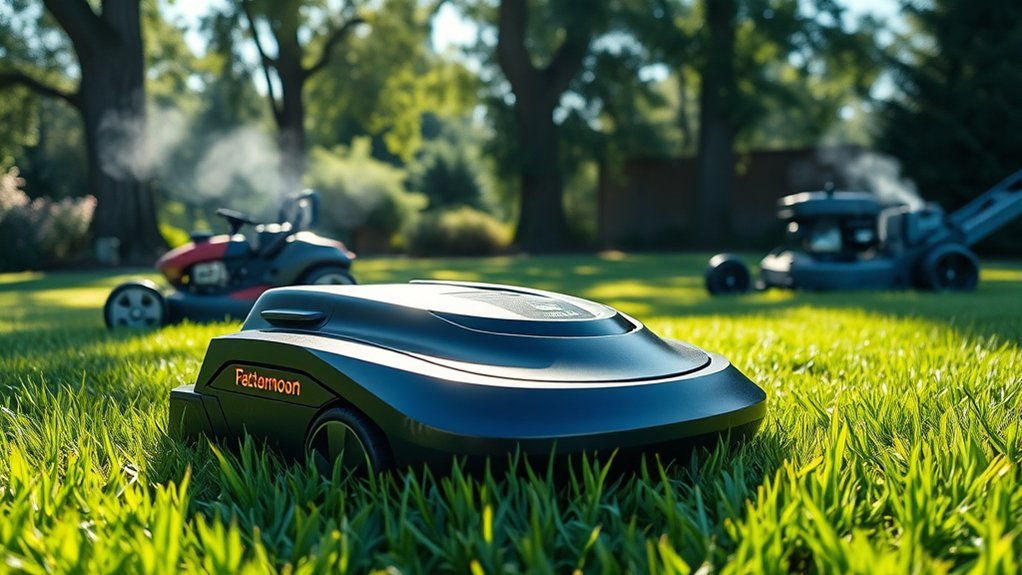
When comparing robot lawn mower models, we focus on cutting efficiency features like blade design and mowing patterns, which directly influence time savings. Navigation technology capabilities—such as GPS mapping and obstacle detection—also play a vital role in optimizing coverage and reducing mowing duration. Analyzing these technical aspects helps identify which models deliver the greatest efficiency gains for users.
Cutting Efficiency Features
Have you ever wondered how different features in robot lawn mowers influence their cutting efficiency and overall time savings? One key factor is battery life; longer-lasting batteries enable extended mowing sessions, reducing the need for frequent recharges and increasing coverage per session. Noise levels also matter, as quieter models allow for earlier or later mowing without disturbing occupants or neighbors, facilitating flexible scheduling. Additionally, cutting blades and their design impact efficiency—sharp, durable blades maintain clean cuts and minimize mowing time. Overall, models with optimized battery capacity, low noise output, and high-quality blades deliver superior efficiency, ensuring extensive coverage in less time. Evaluating these features helps identify models that maximize time savings without sacrificing cutting quality.
Navigation Technology Capabilities
Navigation technology is a critical factor that directly influences the efficiency and time savings of robot lawn mowers. Advanced navigation systems, such as GPS and lidar, enable precise, grid-like coverage, reducing overlaps and missed spots. This minimizes mowing time and optimizes battery longevity by preventing unnecessary recharges. Noise levels also vary based on navigation, with quieter models typically equipped with more sophisticated sensors that operate smoothly without disturbing the surroundings.
| Navigation System | Impact on Time Savings |
|---|---|
| GPS & Lidar | Precise, efficient paths; reduces overlap |
| Ultrasonic Sensors | Moderate accuracy; potential for missed patches |
| Basic Bump Sensors | Less efficient; increased re-mowing |
How Long Does a Robot Lawn Mower Take to Complete a Typical Yard?
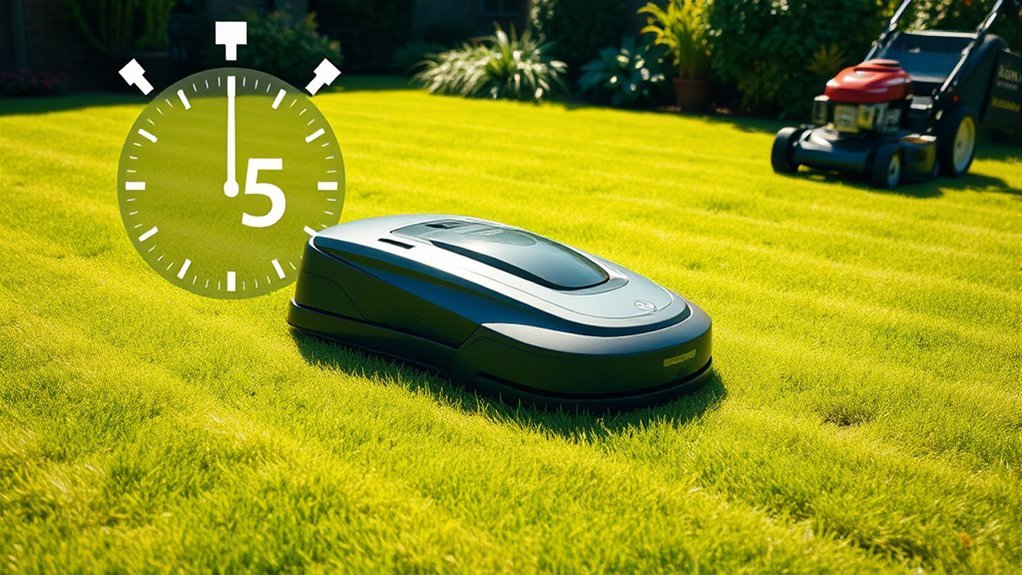
The time a robot lawn mower needs depends largely on yard size, mower model efficiency, and terrain complexity. Larger yards or uneven terrain can extend mowing durations, even with high-efficiency models. By examining these factors, we can better estimate how long a typical mowing session will take.
Yard Size Impact
How long a robot lawn mower takes to complete a typical yard largely depends on its size, as larger areas require more time to mow thoroughly. Yard size directly influences mowing duration, impacting garden aesthetics and seasonal maintenance routines. Smaller lawns, typically under a quarter-acre, can often be mowed in under an hour, providing consistent coverage that maintains a tidy appearance. Conversely, larger yards—over half an acre—may require several hours, especially if the mower operates in multiple sessions or zones. The efficiency of the mower’s navigation and the complexity of the terrain also affect time, but overall, yard size remains the primary factor. Understanding this relationship helps homeowners plan mowing schedules that support both aesthetic goals and seasonal upkeep.
Mower Model Efficiency
Different mower models vary considerably in their efficiency, directly affecting the time needed to complete a typical yard. The efficiency depends on factors such as cutting speed, battery capacity, and navigation algorithms. Some models are tailored for rapid lawn maintenance, covering large areas quickly, while others prioritize precision or energy conservation. Seasonal adjustments also influence mowing times; during peak growth periods, more frequent cuts may be necessary, extending total maintenance time. Conversely, in dormant seasons, mowing may be quicker due to slower grass growth. Understanding these differences helps homeowners select a model aligned with their lawn size and maintenance schedule, ensuring ideal time savings. Ultimately, mower model efficiency plays a critical role in minimizing lawn maintenance duration without compromising cut quality.
Terrain and Obstacles
Terrain and obstacles considerably influence the duration a robot lawn mower takes to complete a typical yard. Variations such as uneven ground, slopes, and physical obstructions can extend mowing times, especially when the mower needs to navigate around garden aesthetics like flower beds or trees. Seasonal adjustments, like increased debris in fall or snow cover in winter, further impact efficiency. The mower’s ability to adapt relies on its sensors and programming, which determine how effectively it handles complex terrains. Key factors include:
- Slope steepness and terrain irregularities affecting travel speed
- Obstacle density requiring additional maneuvering time
- Seasonal debris and changing garden aesthetics that necessitate route adjustments
These elements collectively influence the overall time, emphasizing the importance of yard layout and maintenance in optimizing robotic mowing efficiency.
Factors That Influence the Actual Time Savings You’ll Experience
Several key factors directly impact the actual time savings achieved with a robot lawn mower. Garden aesthetics influence mowing patterns; well-maintained, uniform lawns allow for consistent coverage, reducing overlap and unnecessary passes. Seasonal maintenance also plays a role: during peak growing periods, more frequent mowing is necessary, which can diminish time savings unless the mower is equipped for rapid, efficient operation. Conversely, in off-peak seasons, less frequent mowing can exaggerate time savings. Additionally, lawn size, shape, and complexity affect how efficiently the mower can operate, but seasonal growth rates and aesthetic standards ultimately determine how much time homeowners save. Recognizing these factors helps set realistic expectations for the performance and benefits of robot lawn mowers in various garden conditions.
Real-World Time Savings: Case Studies of Homeowners Using Robot Mowers
Real-world examples reveal how homeowners actually experience time savings with robot lawn mowers. These case studies highlight measurable reductions in manual lawn care, enabling residents to allocate time elsewhere. Key observations include:
- Consistent scheduling that minimizes manual intervention, promoting smart gardening practices.
- Enhanced lawn health through precise, evenly distributed mowing, supporting eco-friendly landscaping.
- Significant reduction in weekly maintenance time—often by 50% or more—allowing homeowners to focus on other outdoor projects or leisure activities.
These examples demonstrate that robot mowers deliver tangible benefits beyond convenience, fostering sustainable, efficient lawn management. By automating routine tasks, homeowners integrate eco-conscious principles into their landscaping routines while saving valuable time—proof of the growing impact of smart gardening technologies in everyday life.
Are Higher-End Models Worth the Extra Time Savings?
While higher-end robot lawn mower models typically come with advanced features and enhanced durability, it’s essential to assess if the extra time savings justify their higher costs. These models often reduce mowing time through larger cutting areas and smarter navigation, improving user convenience. However, they also tend to require more complex mower maintenance, which can offset time benefits.
| Feature | Impact on Time Savings |
|---|---|
| Advanced sensors | Minimize downtime, optimize mowing routes |
| Larger battery capacity | Longer operation, less recharge time |
| Enhanced durability | Fewer repairs, consistent performance |
| Higher initial cost | Potentially offset by reduced maintenance |
Ultimately, the decision hinges on balancing immediate time savings with ongoing mower maintenance and budget considerations.
Tips to Maximize Your Robot Lawn Mower’s Efficiency and Time Benefits
To maximize your robot lawn mower’s efficiency and fully leverage its time-saving potential, it’s essential to optimize both its setup and daily operation. Effective garden design can reduce mowing complexity, such as by creating clear boundaries and minimizing obstacles. Consistent lawn care routines, including regular edge trimming and debris removal, ensure uninterrupted operation. Additionally, proper scheduling aligned with growth patterns prevents overworking the mower.
Key strategies include:
- Designing a landscape that minimizes obstacles and maximizes open space
- Establishing a consistent mowing schedule aligned with grass growth cycles
- Maintaining a clean, obstacle-free mowing area to prevent stoppages and damage
Frequently Asked Questions
Can Robot Lawn Mowers Handle Uneven or Sloped Terrains Efficiently?
We find that robot lawn mowers with advanced terrain adaptability and slope navigation efficiently handle uneven or sloped terrains, maintaining consistent cutting performance and safety. Their design optimizes performance across diverse landscape challenges.
How Often Should I Schedule My Robot Mower to Optimize Time Savings?
We recommend scheduling your robot mower every 2-3 days to maximize mowing efficiency and maintain a well-kept lawn. Adjust frequency based on growth rate and weather, ensuring consistent coverage without overworking the mower, balancing time savings effectively.
Do Robot Lawn Mowers Require Regular Maintenance That Affects Their Efficiency?
We find that robot lawn mowers require regular maintenance, which impacts efficiency, especially regarding battery lifespan and charging frequency; keeping blades sharp and batteries healthy guarantees consistent performance and ideal time savings.
Are There Specific Grass Types That Impact the Mower’s Mowing Time?
Certain grass types, especially dense or thick varieties, can increase mowing time due to higher resistance. Maintaining mower blade sharpness is essential for efficiency; dull blades slow down cutting and may require more passes, impacting overall time savings.
How Do Weather Conditions Influence the Robot Mower’s Mowing Schedule and Time?
Weather impact considerably influences our robot mower’s mowing schedule; rain delays or halts operation, while dry, consistent conditions enable efficient, predictable mowing times, ensuring ideal performance and accurate time management in variable weather conditions.
Conclusion
In sum, selecting the right robot mower, optimizing yard layout, and understanding model features profoundly influence time savings. By analyzing various factors—from terrain to technology—we can appreciate how deliberate decisions maximize efficiency and minimize manual effort. Ultimately, careful consideration and strategic adjustments transform robotic mowing from a simple convenience into a significant, sustained savings of time, transforming tedious tasks into tailored, time-efficient triumphs.