Ad Blocker Detected
Our website is made possible by displaying online advertisements to our visitors. Please consider supporting us by disabling your ad blocker.
Studies show that approximately 70% of homeowners with large lawns prefer ride-on mowers for their power and efficiency, yet the rising popularity of robotic models suggests shifting priorities toward automation. As we compare these two options, it’s essential to evaluate how their differing capabilities align with lawn size, terrain complexity, and maintenance demands. Understanding their distinct advantages and limitations can help determine which mower best fits your specific landscape and lifestyle.
Key Takeaways
- Ride-on mowers offer higher power and better performance for large, complex lawns, while robot mowers excel in automation and smaller areas.
- Ride-on models require active operation and maintenance, whereas robot mowers operate autonomously with minimal user involvement.
- Mechanical upkeep is higher for ride-on mowers, but they tend to have a longer lifespan and higher initial costs.
- Robot mowers typically have lower upfront costs and maintenance expenses, with energy use and battery replacement being key factors.
- Ride-on mowers provide a uniform cut suitable for dense lawns, while robot mowers promote healthier turf through frequent, smaller cuts.
How Do Ride-On and Robot Mowers Differ in Power and Performance?
While both ride-on and robot mowers are designed to maintain lawns, they differ markedly in terms of power and performance capabilities. Ride-on mowers typically feature larger engines, offering greater cutting power and the ability to handle dense or tall grass efficiently. Their battery life is often limited by engine size and fuel capacity, but they generally provide longer operational periods compared to robot mowers. In contrast, robot mowers rely on rechargeable batteries, which limit their runtime but allow for quieter operation. Noise levels are notably lower with robot mowers, making them suitable for noise-sensitive environments. Ride-on mowers, however, produce substantial noise due to their engines, which can be disruptive. These differences highlight the contrasting performance profiles essential for selecting the appropriate mower based on lawn size and environmental considerations.
Which Mower Is Better for Large and Complex Lawns?
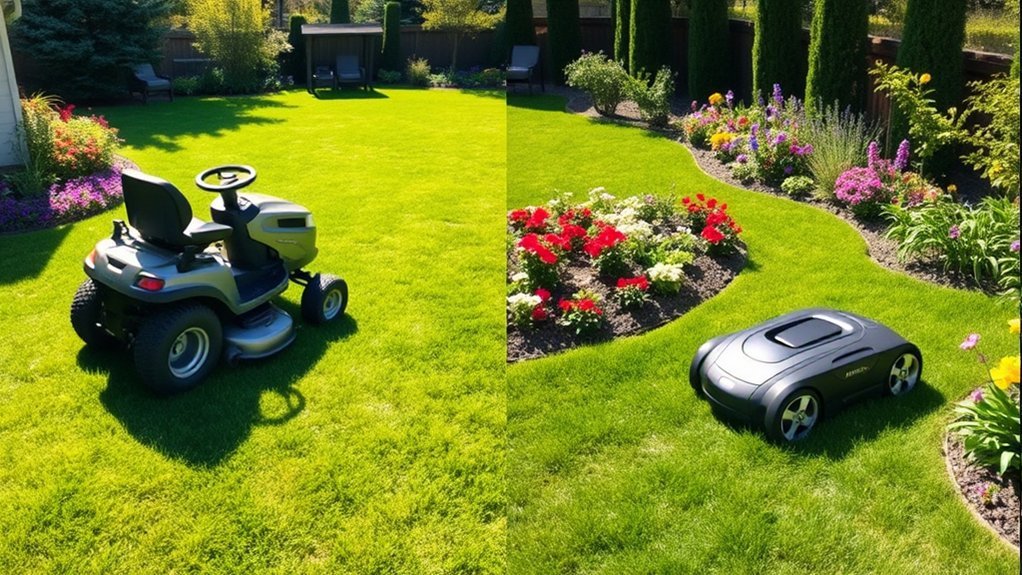
When evaluating options for large and complex lawns, ride-on mowers generally outperform robot mowers in regards to power, maneuverability, and efficiency. They handle varied terrain and obstacles more effectively, making them suitable for intricate landscaping. Additionally, modern ride-on models incorporate smart technology, optimizing cutting paths and fuel efficiency. Concerning environmental impact, ride-on mowers can be more eco-friendly when equipped with advanced engines or electric options, reducing emissions during extended use.
Consider these key points:
- Superior power and torque for challenging terrains
- Enhanced maneuverability around obstacles
- Advanced smart technology for optimized performance
- Potential for reduced environmental impact with electric models
Comparing Ease of Use and Maintenance Requirements
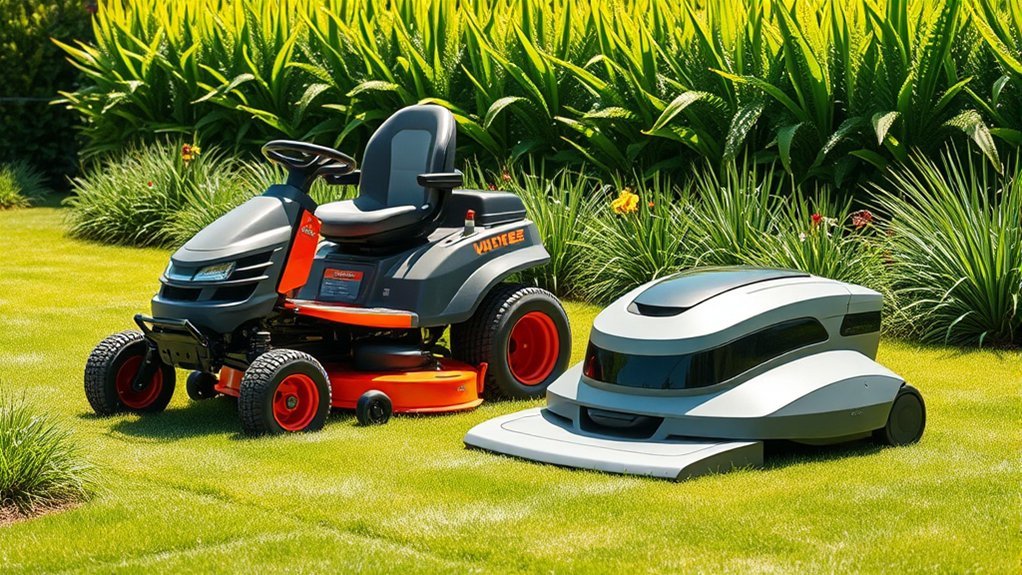
Ease of use and maintenance requirements vary markedly between ride-on and robot mowers, impacting user convenience and operational efficiency. Ride-on mowers typically demand more initial setup, regular engine maintenance, and blade servicing, which can be time-consuming. Conversely, robot mowers excel in user comfort through autonomous operation, reducing physical effort and supervision. Noise levels are a critical factor; robot mowers operate quietly, minimizing disturbance, while ride-on mowers generate higher noise, potentially requiring safety measures. Maintenance for robot mowers is generally limited to battery management and software updates, simplifying ongoing upkeep. Overall, robot mowers offer a streamlined experience with lower maintenance demands and enhanced user comfort, whereas ride-on mowers require more active involvement but may suit larger or more complex terrains better.
Cost Considerations: Upfront Investment and Long-Term Expenses
When evaluating cost considerations, we focus on initial purchase prices, ongoing maintenance, and operational efficiency. These factors directly impact long-term expenses and determine the overall value of each mower type. Analyzing these elements helps identify which option provides the most cost-effective solution over its lifespan.
Initial Purchase Price
How does the initial purchase price influence the overall cost-effectiveness of ride-on versus robot mowers? The upfront cost significantly impacts long-term value, factoring in brand reputation and environmental impact.
- Ride-on mowers generally entail higher initial investments due to larger size and more powerful components, but they often boast a strong brand reputation for durability.
- Robot mowers typically have a lower purchase price, making them accessible initially but may require additional investments for advanced features.
- The environmental impact influences initial costs, as eco-friendly models with lower emissions tend to be priced higher.
- Long-term considerations include potential savings on fuel and emissions, which can offset the initial price difference over time.
Ultimately, the initial purchase price shapes the overall value, balancing upfront affordability with sustainable, environmentally conscious operation.
Maintenance and Repairs
Are maintenance and repair costs significant factors in evaluating the long-term affordability of ride-on versus robot mowers? Yes, they influence total ownership costs considerably. Ride-on mowers generally require more frequent repairs due to complex mechanical parts, with battery life impacting their electric models and increasing replacement costs. Conversely, robot mowers typically have fewer moving parts, reducing repair needs, but their batteries degrade over time, necessitating replacements that can be costly. Noise levels also play a role; higher noise levels in ride-on mowers may lead to additional maintenance for mufflers and soundproofing components. Overall, while robot mowers tend to have lower maintenance expenses, their battery degradation and replacement costs are key considerations, affecting their long-term affordability.
Operating Cost Efficiency
Operating cost efficiency encompasses both the initial investment required to purchase the mower and the ongoing expenses associated with its maintenance and operation. Robot mowers generally have lower upfront costs but may incur higher long-term expenses due to increased energy consumption and frequent replacements. Conversely, ride-on mowers tend to require a larger initial investment but often boast superior fuel efficiency and durability.
Consider these key factors:
- Fuel consumption: Ride-on mowers typically consume more fuel but offer greater coverage per hour.
- Energy efficiency: Robot mowers are designed for ideal energy use, reducing electricity costs over time.
- Maintenance costs: Robotic units often require specialized parts, influencing long-term expenses.
- Operational lifespan: Ride-on mowers generally last longer, potentially offsetting higher initial costs through extended usability.
How Do They Impact Lawn Health and Cutting Quality?
Both ride-on and robot mowers considerably influence lawn health and cutting quality through their respective operational patterns. Ride-on mowers deliver a uniform cut, which helps maintain consistent lawn height, promoting ideal turf density and overall health. Their ability to handle larger areas efficiently ensures thorough coverage, supporting even distribution of lawn nutrients. Conversely, robot mowers tend to operate more frequently and with smaller cutting increments, encouraging a finer, healthier turf surface. This regular cutting pattern also facilitates soil aeration by preventing thatch buildup and promoting better soil contact, which enhances nutrient absorption. Both types, when properly maintained, can improve soil aeration and ensure a consistent, high-quality cut, ultimately fostering a healthier, more resilient lawn.
Which Mower Fits Your Lifestyle and Yard Care Goals?
Choosing the right mower depends heavily on your specific yard size, terrain, and personal maintenance preferences. To align with your garden aesthetics and noise level considerations, evaluate these factors:
Selecting the ideal mower depends on yard size, terrain, aesthetics, noise, and maintenance preferences.
- Yard size and terrain: Larger, flat areas favor ride-on mowers for efficiency, while robot mowers excel in smaller, even terrains.
- Garden aesthetics: Robot mowers provide a neat, uniform cut that enhances visual appeal, whereas ride-on mowers can be more customizable for varied landscaping.
- Noise levels: Robot mowers operate quietly, ideal for noise-sensitive environments, while ride-on mowers generate more sound but cover larger areas faster.
- Maintenance goals: Automated options reduce manual effort but may require more technical upkeep; ride-on mowers demand regular mechanical maintenance but offer greater control.
Frequently Asked Questions
How Do Ride-On and Robot Mowers Handle Uneven Terrain?
We find that ride-on mowers excel in terrain adaptability, maintaining cutting efficiency on uneven surfaces, while robot mowers often struggle with steep slopes, requiring specific features for effective performance on challenging terrain.
Are There Any Safety Concerns With Autonomous Robot Mowers?
Autonomous robot mowers pose minimal safety concerns if equipped with sensors and fail-safes, but battery longevity remains essential for consistent operation and user safety during maintenance or unexpected shutdowns, ensuring reliable, secure mowing experiences.
Can Robot Mowers Be Used in Wet or Rainy Conditions?
Robot mowers generally offer limited rain resistance, and their weather durability varies by model; most aren’t designed for wet or rainy conditions, so using them in such weather could cause operational issues or damage.
What Is the Typical Lifespan of Each Mower Type?
Like a timeless oak, ride-on mowers typically last 10-15 years with proper maintenance, while robot mowers often endure 5-8 years, influenced by battery efficiency and maintenance needs, reflecting their technological resilience and wear.
How Do Mower Noise Levels Compare During Operation?
We find that ride-on mowers produce higher noise levels during operation, with louder, more aggressive operational sounds, whereas robot mowers operate quietly, emitting minimal noise, making them more suitable for noise-sensitive environments and urban settings.
Conclusion
Ultimately, choosing between a ride-on and a robot mower hinges on your lawn’s unique needs and your lifestyle. Picture a vast, varied landscape—each mower offers a different rhythm of care: the ride-on’s powerful stride or the robot’s precise, tireless dance. By weighing performance, cost, and maintenance, you can select the tool that transforms your yard into a lush, healthy expanse—efficiently, effortlessly, perfectly.