Ad Blocker Detected
Our website is made possible by displaying online advertisements to our visitors. Please consider supporting us by disabling your ad blocker.
As professionals in robotic lawn care, we recognize that collision sensors are critical to the safe and efficient operation of mower systems. Understanding how these sensors detect obstacles, their types, and maintenance needs can substantially impact performance and longevity. Properly paired with advanced AI, they ensure precise navigation, but identifying potential issues requires technical insight. Exploring these aspects thoroughly can help optimize your mower’s safety features—an essential consideration for sustained, reliable use.
Key Takeaways
- Understand the different types of collision sensors, such as bump, contact, infrared, and ultrasonic sensors.
- Regularly calibrate sensors and clean their surfaces to maintain detection accuracy.
- Ensure proper sensor placement to maximize obstacle coverage and minimize blind spots.
- Monitor sensor performance with diagnostic tools and address battery or debris issues promptly.
- Incorporate advanced AI features for better obstacle recognition and rapid response mechanisms.
How Do Collision Sensors Protect Your Robotic Mower?
Collision sensors serve as a critical safety feature in robotic mowers by detecting obstacles in real-time and preventing accidents. These sensors enable the mower to pause or alter its path, reducing damage to both the mower and objects in its environment. By continuously monitoring surroundings, collision sensors help optimize battery life, as they prevent unnecessary movements or repeated collisions that drain power. When integrated with remote control functionality, these sensors allow users to manually override or guide the mower away from obstacles, enhancing operational safety. The sensors’ responsiveness minimizes the risk of damage to delicate landscaping features, while also extending the device’s overall lifespan. This real-time obstacle detection creates a more efficient mowing process, ensuring safety, conserving battery, and enabling precise remote operation.
Types of Collision Sensors Used in Robot Mowers Explained
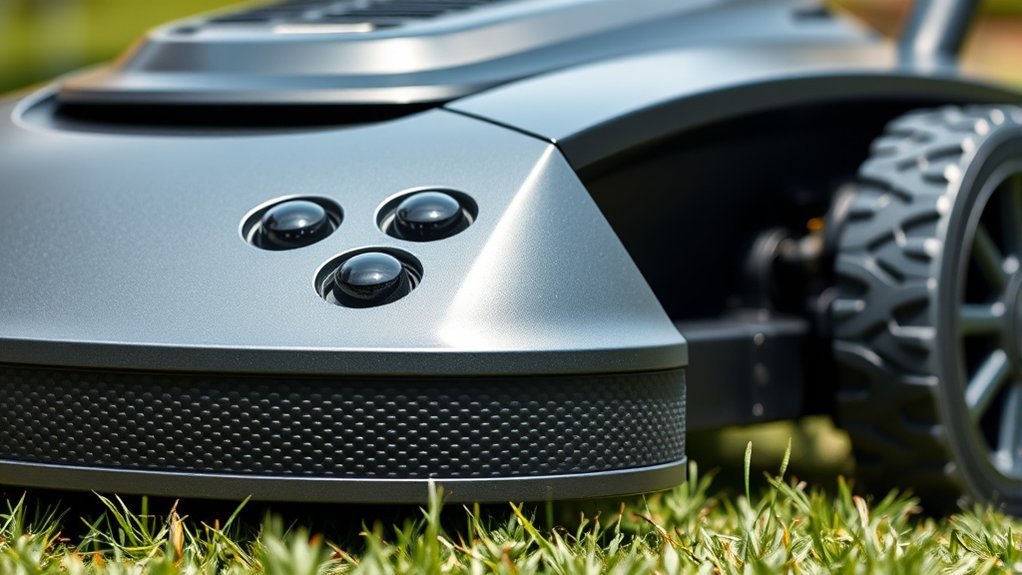
Robotic mowers incorporate various sensor technologies to detect obstacles effectively, ensuring a safe and efficient mowing process. Among these, bump sensors, contact sensors, and infrared or ultrasonic sensors are prevalent. Proper sensor calibration is critical for accurate obstacle detection, reducing false positives or negatives. Sensor placement also plays a crucial role; typically, sensors are positioned at the front, sides, or underneath the mower to maximize coverage and minimize blind spots. For instance, bump sensors are usually located on the mower’s bumper, requiring precise calibration to respond promptly. Ultrasonic sensors, placed strategically around the mower’s perimeter, provide thorough obstacle detection. Correct sensor placement and calibration are essential for ideal operation, directly impacting the mower’s ability to navigate complex terrains and avoid collisions efficiently.
Key Features to Look for in a Collision Sensor for Optimal Safety
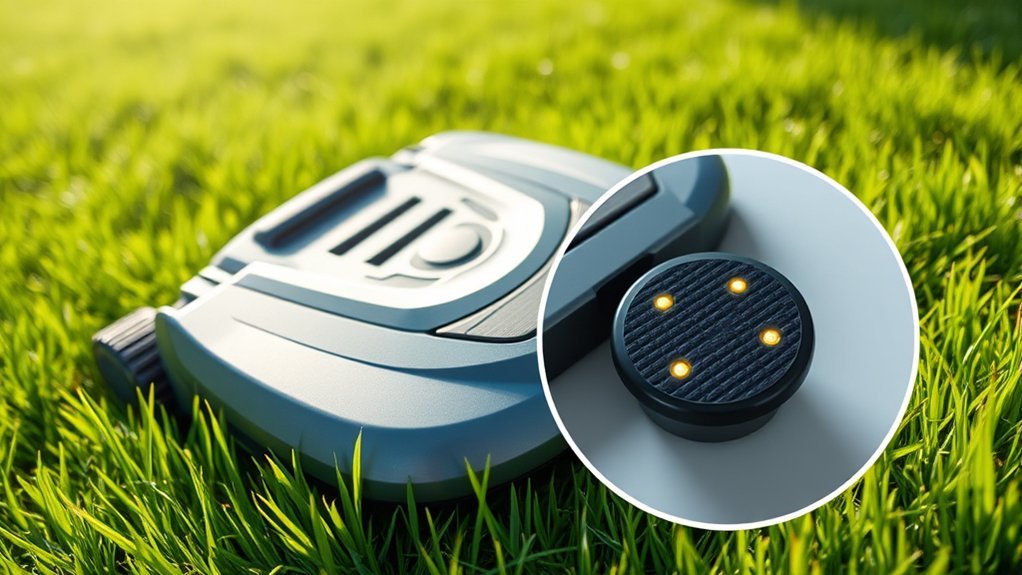
To guarantee ideal safety, selecting collision sensors with key features that enhance detection accuracy and response time is essential. Advanced AI integration allows sensors to distinguish between obstacles and false triggers, improving reliability in complex environments. Rapid response mechanisms are critical to prevent damage or accidents, so sensors must process data swiftly. Battery optimization is also crucial; energy-efficient sensors extend mower operation without frequent recharging, ensuring consistent safety monitoring. Features like high sensitivity, adaptive learning, and real-time alerts contribute to a more responsive system. By prioritizing these elements, we can ensure that collision sensors not only detect obstacles accurately but also respond promptly, maintaining optimal safety during operation.
Troubleshooting Common Collision Sensor Issues and Failures
When collision sensors fail to perform properly, identifying the root cause quickly becomes vital to maintaining safe and efficient mower operation. Common issues often stem from sensor calibration errors, which can cause false positives or missed detections. We also find that battery impact plays a significant role; a depleted or faulty battery can interrupt sensor signals, leading to inconsistent detection. Troubleshooting begins with verifying proper sensor calibration, ensuring alignment and responsiveness meet manufacturer specifications. Next, we examine the battery’s condition, replacing or recharging if necessary, to restore stable power supply. Additionally, debris or dirt buildup on sensors can impair their function, so cleaning is essential. Addressing calibration and battery issues systematically ensures reliable collision detection and minimizes operational failures.
Tips for Maintaining and Enhancing Collision Sensor Performance
How can we guarantee collision sensors operate at peak performance over time? Regular sensor calibration is essential to maintain accuracy, ensuring the sensors detect obstacles reliably. We also need to take into account the battery impact, as fluctuating power levels can impair sensor responsiveness. To optimize performance, consider these steps:
- Perform routine sensor calibration to correct misalignments.
- Check and replace batteries to prevent voltage drops that affect sensor function.
- Clean sensor surfaces to remove dirt or debris that may obstruct signals.
- Monitor sensor signals periodically with diagnostic tools to identify degradation early.
Frequently Asked Questions
Can Collision Sensors Distinguish Between Pets and Obstacles?
Collision sensors primarily detect obstacles through sensor accuracy, but pet detection varies, often limited by sensor technology. While some advanced models can differentiate pets from objects, many rely on general obstacle detection without specific pet recognition.
Are Collision Sensors Effective on Uneven or Sloped Terrain?
Collision sensors can be effective on uneven terrain if they have adjustable sensor sensitivity and strong terrain adaptability, allowing the mower to detect obstacles accurately despite slopes, but performance may vary depending on sensor quality and terrain complexity.
How Do Weather Conditions Affect Sensor Performance?
Weather conditions can impact sensor sensitivity and weather durability, causing false detections or reduced responsiveness. Rain, snow, or fog may interfere with sensor signals, so choosing weather-resistant models guarantees consistent performance regardless of environmental challenges.
Do Collision Sensors Require Regular Calibration?
Collision sensors generally need regular calibration to maintain sensor durability and accuracy. Visualize fine-tuning a delicate instrument; this calibration frequency guarantees consistent performance, preventing drift and guaranteeing reliable obstacle detection in varying environmental conditions.
Can Collision Sensors Be Upgraded in Older Robotic Mower Models?
Yes, collision sensors can often be upgraded in older models if compatibility is confirmed, focusing on sensor durability and integration. We analyze compatibility upgrades carefully, ensuring the new sensors enhance durability and performance without compromising the mower’s current system.
Conclusion
Certainly! Here’s the modified text with alternative words replacing “in conclusion”:
—
Ultimately, while collision sensors might seem like mere electronic gatekeepers, they’re actually the unsung heroes of your mower’s safety protocol—assuming they’re functioning properly, of course. Neglect these sensors, and your pristine lawn could become a battleground of dents and tears. So, let’s give credit where it’s due: vigilant sensors that tirelessly protect your investment, ensuring your mower’s survival in a world full of unpredictable obstacles—because even robots need a little human oversight.