Ad Blocker Detected
Our website is made possible by displaying online advertisements to our visitors. Please consider supporting us by disabling your ad blocker.
Robot mower geofencing security represents a critical advancement in automated lawn management, integrating GPS, RF, and AI to define precise operational boundaries. These systems are designed to prevent theft, accidental damage, and unauthorized access, while maintaining operational efficiency. As technology evolves, understanding how these boundaries are established and maintained becomes essential for best system performance. Exploring the mechanisms and future developments of geofencing can reveal how security and automation will continue to intersect in this field.
Key Takeaways
- Geofencing uses GPS or RF technology to establish virtual boundaries, ensuring precise boundary enforcement and operational security for robot mowers.
- Combining AI with geofencing enables real-time anomaly detection and adaptive responses to unauthorized access or tampering.
- Encrypted communication protocols and secure zones protect against hacking and unauthorized use of robot mowers.
- Regular firmware updates and calibration maintain boundary accuracy, system reliability, and security effectiveness.
- Supplementing geofencing with additional sensors and multilayer security strategies enhances overall mower security and intrusion resistance.
How Does Robot Mower Geofencing Work?
Although the concept of geofencing may seem complex, it fundamentally relies on the integration of GPS or RF technology to establish virtual boundaries around a designated area. Modern robot mowers utilize these signals combined with artificial intelligence to precisely detect their location within these boundaries. The AI algorithms process real-time data, ensuring accurate adherence to the geofence and optimizing mowing patterns. This system enhances operational efficiency while maintaining user privacy, as data processing often occurs locally or with anonymized data. However, it’s essential to evaluate how user privacy is protected, especially when location data is transmitted or stored. Overall, geofencing technology seamlessly integrates GPS, RF, and AI to create a secure, automated boundary system that respects user privacy while providing reliable boundary enforcement.
Benefits of Using Geofencing Security for Your Robot Mower
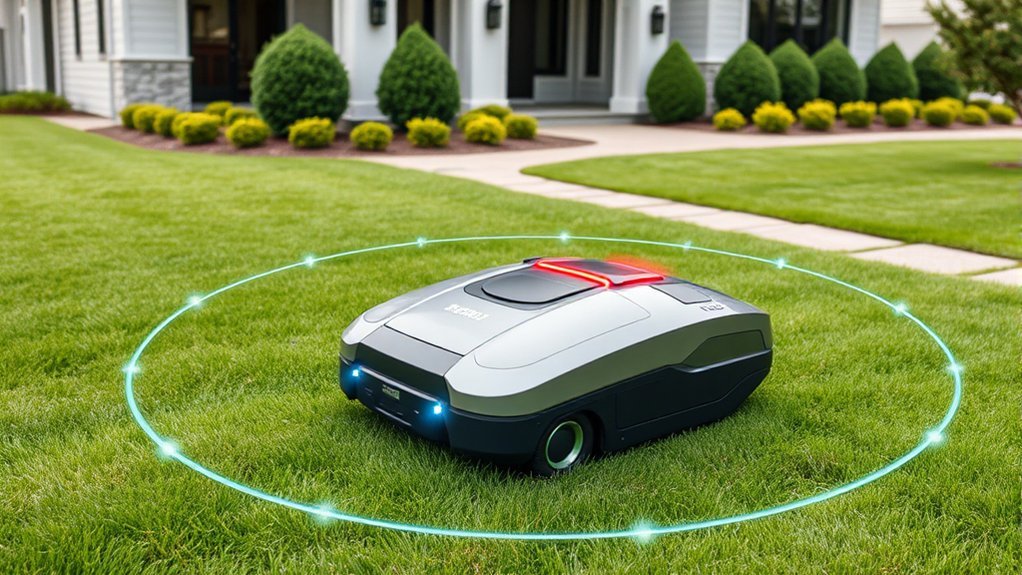
Implementing geofencing security for your robot mower offers significant operational advantages by guaranteeing precise boundary enforcement and reducing the risk of accidental damage or theft. This technology streamlines lawn mowing schedules, allowing for automated, consistent coverage without manual oversight. By maintaining clear boundaries, it minimizes interruptions, which can otherwise hinder robot mower maintenance routines and extend the time needed for upkeep. Additionally, geofencing reduces the likelihood of mower misplacement or unauthorized use, enhancing overall security. This targeted approach optimizes mower efficiency, preserves battery life, and ensures consistent mowing patterns. Consequently, integrating geofencing into your robot mower system delivers reliable boundary control, improves maintenance planning, and guarantees adherence to scheduled mowing, resulting in a more secure and efficient lawn care solution.
Key Features to Look for in a Geofencing System

When selecting a geofencing system for your robot mower, focusing on key features can greatly impact its effectiveness and reliability. Look for systems with precise boundary detection, guaranteeing minimal false alarms and consistent containment. Compatibility with various robot mower accessories enhances flexibility and security. Advanced communication protocols, like encrypted signals, prevent hacking or interference, maintaining safety. Real-time alerts and remote control capabilities allow quick responses to security breaches. Additionally, robust battery life and quick recharging support uninterrupted operation during lawn care tips, assuring consistent coverage. A user-friendly interface simplifies setup and monitoring, reducing errors. Ultimately, investing in a system with these critical features ensures your mower’s security, efficiency, and seamless integration into your lawn care routine.
Setting Up and Configuring Your Robot Mower’s Geofence
To effectively set up and configure your robot mower’s geofence, we start by precisely defining your boundaries to guarantee accurate containment. Next, selecting secure zones helps prevent unauthorized access and accidental entry into sensitive areas. Finally, fine-tuning geofence settings allows us to optimize performance and reliability through adjustments to parameters like boundary sensitivity and notification thresholds.
Defining Your Boundaries
Establishing clear boundaries for your robot mower is essential to guarantee safe and efficient operation. Boundary customization involves precise mapping of the designated mowing area, often utilizing GPS or boundary wires, to ensure accurate coverage. Properly configured geofences prevent the mower from encroaching on restricted zones, such as flower beds or patios, reducing potential damage. During setup, it’s crucial to consider privacy considerations, especially in residential settings, by limiting boundary visibility or access to sensitive areas. Accurate boundary definition enhances operational reliability and minimizes false triggers or boundary breaches. Regularly reviewing and adjusting these boundaries ensures they remain aligned with property changes and privacy needs, maintaining both security and efficiency in your automated lawn management system.
Selecting Secure Zones
Selecting secure zones involves strategically configuring your robot mower’s geofence to safeguard sensitive or restricted areas. Proper zone selection ensures that areas like flower beds or compost heaps remain untouched, preserving garden aesthetics. When defining these zones, we analyze spatial data to optimize coverage without encroaching on protected zones, which minimizes unnecessary battery drain. By restricting the mower’s access to certain sections, we also extend battery life, preventing excessive power use from frequent boundary crossings or re-entry. Accurate zone setup enhances operational efficiency and security, reducing the risk of accidental damage or theft in designated areas. This deliberate approach to safe zone selection balances maintaining your garden’s visual appeal with efficient, energy-conscious mowing, ensuring your robot mower operates reliably within the parameters you set.
Adjusting Geofence Settings
Adjusting the geofence settings is a critical step in customizing your robot mower’s operational boundaries, guaranteeing it functions within designated areas while avoiding restricted zones. Precise configuration enhances outdoor landscaping efficiency and minimizes the need for frequent robot mower maintenance.
To optimize settings:
- Define boundary points using the mower’s app or control panel, ensuring accurate mapping of your lawn’s perimeter.
- Set exclusion zones around delicate plant beds or obstacles, preventing accidental intrusion.
- Test and recalibrate the geofence periodically to accommodate landscape changes or new obstacles, maintaining operational accuracy.
Proper adjustment of these parameters ensures the mower operates safely within its designated area, reducing the risk of boundary breaches and environmental damage.
Troubleshooting Common Geofencing Issues
We often encounter geofencing issues caused by GPS signal loss, which can impair boundary accuracy and mower safety. Incorrect boundary settings may also lead to unintended mower behavior, highlighting the importance of precise configuration. Additionally, outdated device firmware can compromise geofence performance, requiring regular updates to maintain system integrity.
GPS Signal Loss
Why does GPS signal loss commonly disrupt geofencing in robotic mower systems? Signal loss hampers accurate boundary detection, leading to potential safety risks and operational inefficiencies. GPS signals can be obstructed by environmental factors like dense foliage or tall structures, which interfere with satellite communication. Additionally, poor signal quality can impair AI integration algorithms, reducing the mower’s ability to adapt to changing conditions. This results in increased power consumption, impacting battery longevity and overall system reliability. To mitigate these issues, we recommend:
- Installing external antennas or signal boosters to improve reception.
- Ensuring the GPS module is well-maintained and free of obstructions.
- Optimizing the mower’s software to handle intermittent signal loss effectively.
Addressing these factors enhances boundary accuracy and system resilience.
Incorrect Boundary Settings
Incorrect boundary settings are a common source of geofencing issues in robotic mower systems, as they directly influence the mower’s ability to navigate within designated areas accurately. Boundary misconfigurations, such as improperly set perimeter lines or incomplete boundary loops, can cause the mower to misinterpret its operational limits. Zone overlaps, where boundaries intersect or overlap, further complicate navigation, leading to unpredictable behavior or boundary breaches. These issues often stem from user error during initial setup or adjustments. Precise boundary calibration and careful mapping are essential to prevent misconfigurations. Regularly verifying boundary integrity and ensuring that zone overlaps are eliminated help maintain accurate geofence enforcement, safeguarding both the mower’s functionality and the surrounding environment.
Device Firmware Updates
Firmware updates are critical for maintaining the most effective performance and security of robotic mower systems, especially when addressing geofencing issues. They enhance indoor navigation accuracy, guarantee boundary compliance, and maximize battery management to prevent unexpected shutdowns.
To troubleshoot, we recommend:
- Regularly check for firmware updates that improve indoor navigation algorithms, reducing boundary misalignment.
- Implement updates that refine battery management protocols, extending operational periods and avoiding geofence breaches caused by power loss.
- Guarantee the firmware supports seamless communication between the mower and geofence boundaries, preventing false alarms or boundary errors.
Staying current with firmware updates ensures the system adapts to evolving security features, enhances geofence reliability, and maintains peak operational efficiency.
Enhancing Security: Combining Geofencing With Other Safeguards
While geofencing provides a foundational layer of security by restricting a robot mower’s operational area, deploying it in isolation leaves gaps that can be exploited by determined intruders. Combining geofencing with safeguards like artificial intelligence (AI) enhances security by enabling real-time anomaly detection and adaptive responses. For instance, AI can identify unusual movement patterns indicating tampering attempts. Additionally, integrating security with battery optimization algorithms ensures the mower can return to a designated zone before power depletion, reducing vulnerability during low-battery states. This synergy creates a multilayered defense, making unauthorized access significantly harder.
| Security Measure | Key Benefit |
|---|---|
| Artificial Intelligence | Detects intrusions, adapts responses |
| Battery Optimization | Ensures timely return, reduces risks |
Comparing Different Robot Mower Geofencing Technologies
Different robot mower geofencing technologies employ varied methods to define and enforce operational boundaries, each with distinct advantages and limitations. These methods influence automated navigation efficiency and battery optimization strategies.
- RFID-based Geofencing: Utilizes radio frequency signals for boundary detection, offering reliable control in complex terrains but limited flexibility for dynamic boundary adjustments.
- GPS-based Geofencing: Uses satellite signals for precise boundary mapping, enabling adaptive navigation and efficient battery use over large areas; however, signal accuracy can be compromised indoors or under dense foliage.
- Perimeter Wire Systems: Employ physical wires to establish boundaries, providing consistent enforcement but restricting mobility and requiring installation effort that impacts automated navigation and battery consumption.
Each technology’s effectiveness depends on terrain, area size, and the desired balance between security and operational efficiency.
Best Practices for Maintaining Accurate Geofences
Maintaining accurate geofences is crucial for guaranteeing the reliable operation and security of robot mower systems. Precise boundary definitions prevent unintended mowing and mitigate privacy concerns by safeguarding private property. Regularly updating geofence parameters accounts for environmental changes and prevents drift caused by GPS inaccuracies or physical alterations. User customization features should be leveraged to fine-tune boundary settings, balancing operational efficiency with privacy considerations. Implementing robust calibration protocols enhances positional accuracy, reducing false boundary breaches. Additionally, integrating supplemental sensors can reinforce GPS data, further minimizing errors. Consistent system audits, including reviewing boundary integrity and monitoring for anomalies, are essential for ongoing accuracy. By adhering to these practices, we can optimize geofence reliability, uphold privacy standards, and ensure the secure, efficient operation of robot mowers.
Future Trends in Robot Mower Security and Geofencing
Advancements in sensor technology, connectivity, and artificial intelligence are shaping the future landscape of robot mower security and geofencing. We anticipate AI integration will enable adaptive boundary recognition, enhancing accuracy and reducing false alarms. Improved sensor networks will facilitate real-time monitoring and swift threat detection, crucial for security. Additionally, battery optimization will play a critical role; smarter power management will extend operational time while maintaining security features.
- AI-driven anomaly detection will enable predictive threat responses, minimizing false positives.
- Enhanced connectivity will support seamless integration with smart home ecosystems, improving user control.
- Advanced battery management systems will ensure longer mowing sessions with minimal downtime, optimizing overall security.
Frequently Asked Questions
Can Geofencing Prevent All Types of Theft or Vandalism?
Geofencing enhances theft deterrence and vandalism prevention but doesn’t eliminate all risks. Its effectiveness depends on proper setup and additional security measures, as determined intruders or vandals may bypass or disable geofencing systems entirely.
How Does Weather Affect the Reliability of Geofence Alerts?
Weather interference can impact geofence alerts’ reliability by affecting sensor accuracy, especially during heavy rain, snow, or fog. These conditions may cause false triggers or missed alerts, reducing overall system dependability in adverse weather.
Are There Legal Restrictions on Using Geofencing for Security?
We guarantee legal compliance by understanding privacy concerns related to geofencing, adhering to regulations like GDPR and CCPA, and implementing transparent data practices to respect user privacy while maintaining effective security measures.
Can Geofencing Be Customized for Different Lawn Areas?
Certainly, boundary customization allows us to tailor lawn zones precisely, enhancing security and efficiency. By customizing geofencing for each lawn area, we optimize boundary control, ensuring the robot mower adheres strictly to designated zones, minimizing risks and maximizing performance.
What Is the Typical Battery Impact of Geofencing Features?
Geofencing features typically cause minimal battery drain, as they rely on low-power GPS or RF signals, resulting in negligible increases in overall power consumption. This efficient design minimizes impact on the mower’s battery life during operation.
Conclusion
In summary, geofencing acts as the vigilant guardian of our robotic mowers, drawing invisible borders that safeguard our landscapes like an unbreakable chain. As technology evolves, these digital fences become more sophisticated, symbolizing a steadfast commitment to security and environmental stewardship. Embracing these innovations guarantees we stay ahead of potential threats, much like a compass guiding us through complex terrain. Together, we can harness these tools to optimize safety, efficiency, and peace of mind.