Ad Blocker Detected
Our website is made possible by displaying online advertisements to our visitors. Please consider supporting us by disabling your ad blocker.
Much like steering through a complex landscape, choosing between a robot mower and a zero-turn mower involves analyzing their distinct operational architectures and performance metrics. Each offers unique advantages and limitations that can greatly impact your lawn care efficiency, depending on terrain, size, and user engagement. Understanding these differences is essential to making an informed decision that aligns with your specific needs—yet, the finer points of their functionality and suitability often remain underappreciated.
Key Takeaways
- Robot mowers operate autonomously with GPS and boundary wires, while zero-turn mowers are manually operated with steering controls.
- Zero-turn mowers are faster and better suited for large, complex, or rugged terrains; robot mowers excel on small, flat lawns.
- Robot mowers are quieter, low-maintenance, and cost less upfront, whereas zero-turn mowers are louder, more powerful, and require more upkeep.
- Zero-turn mowers provide precise, professional cuts but demand active user control; robot mowers deliver consistent, uniform mowing automatically.
- Choose a robot mower for low effort and quiet operation; opt for a zero-turn mower for speed, maneuverability, and handling tougher landscapes.
How Do Robot Mowers and Zero-Turn Mowers Work?
While both robot mowers and zero-turn mowers are designed for lawn maintenance, they operate through fundamentally different mechanisms. Robot mowers utilize automated navigation systems, often employing GPS and boundary wire detection to map and traverse lawns autonomously. Their movement algorithms optimize coverage, avoiding obstacles through sensors and real-time data processing. Battery technology plays a critical role, with lithium-ion batteries providing sufficient runtime and quick recharging to support continuous operation. In contrast, zero-turn mowers rely on human-operated steering mechanisms, with hydraulic or electric systems controlling wheel movement for sharp turns and rapid maneuvering. Zero-turns lack autonomous navigation, depending instead on operator inputs, but they benefit from advanced battery tech for cordless models, enhancing power efficiency and operational longevity.
Comparing Performance: Cutting Speed and Maneuverability
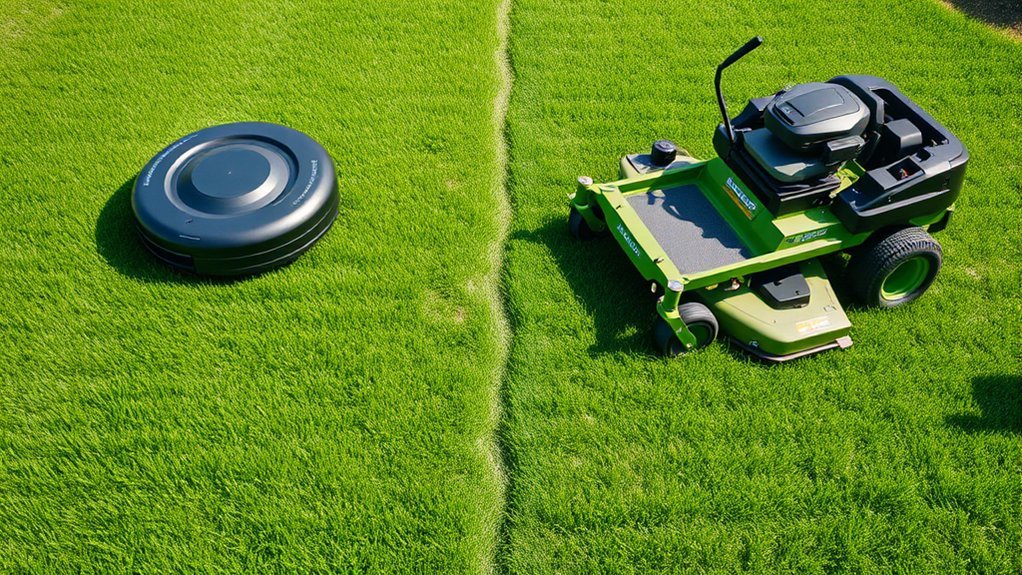
When comparing cutting speed efficiency, we find that robot mowers typically operate at a steady, lower pace optimized for battery life and consistent coverage, while zero-turn mowers achieve higher speeds suitable for large areas. Regarding maneuverability precision, zero-turn mowers excel with tight turning radii and responsive steering, whereas robot mowers rely on programmed algorithms for obstacle avoidance and path accuracy. Analyzing these performance metrics highlights the strengths and limitations inherent to each mower type in different terrain and task conditions.
Cutting Speed Efficiency
Considering their distinct designs, robot mowers and zero-turn mowers exhibit notable differences in cutting speed efficiency and maneuverability. Robot mowers typically operate at a steady, moderate pace optimized for battery life, often covering approximately 0.1 to 0.3 acres per hour, with continuous recharging cycles limiting overall speed. Zero-turn mowers, in contrast, achieve higher cutting speeds—up to 8-12 mph—delivering faster coverage on larger lawns. Noise levels also impact efficiency; robot mowers operate quietly, minimizing disruption but requiring more time, while zero-turn mowers produce significant noise, which can be a consideration during prolonged use. Battery life constrains robot mower speed but guarantees consistent operation, whereas zero-turn mowers rely on fuel-powered engines, emphasizing raw power over battery considerations.
Maneuverability Precision
Maneuverability precision plays a pivotal role in evaluating the overall performance of robot and zero-turn mowers, especially given their differing approaches to cutting speed and coverage. Robot mowers excel in navigation challenges through advanced obstacle detection systems, enabling accurate, autonomous maneuvering in complex yard layouts. Their ability to detect and avoid obstacles ensures consistent coverage without overlap or missed areas. In contrast, zero-turn mowers rely on skilled operator control, offering rapid directional changes and tight turns. While their maneuverability is exceptional in open spaces, their performance diminishes in cluttered areas where navigation challenges increase. Ultimately, robot mowers prioritize obstacle detection accuracy and autonomous precision, whereas zero-turn mowers emphasize operator-driven agility and quick responsiveness in varied terrain.
Cost and Maintenance: Which Is More Budget-Friendly?
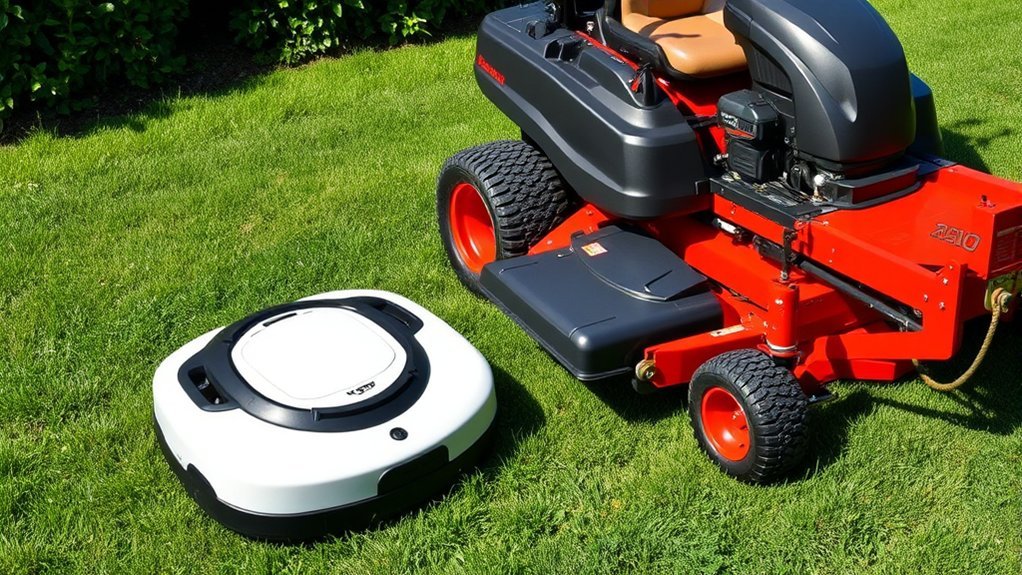
When evaluating costs, we compare the initial purchase prices of robot mowers and zero-turn mowers, noting that robot models generally have a higher upfront investment. We also analyze ongoing maintenance expenses, including parts, repairs, and software updates, which tend to be lower for robotic units due to fewer mechanical components. Understanding these financial factors helps determine which mowing solution aligns better with budget constraints over its lifespan.
Purchase Price Differences
Are we accurately evaluating which mower offers better value over time by comparing their initial purchase prices and ongoing maintenance costs? The upfront costs vary markedly. Robot mowers, often leveraging advanced battery technology, tend to have a higher initial investment, influenced heavily by brand reputation and battery longevity. Zero-turn mowers typically have a lower initial price but may incur higher maintenance expenses due to engine complexity. Consider the table below:
| Mower Type | Initial Purchase Price | Key Cost Factor |
|---|---|---|
| Robot Mower | $1,000 – $2,500 | Battery technology, brand reputation |
| Zero-Turn Mower | $2,500 – $5,000 | Engine durability, parts costs |
While robot mowers may cost more upfront, their efficient battery tech and reputable brands can justify the expense.
Ongoing Maintenance Costs
Over the lifespan of these mowing systems, ongoing maintenance costs play a critical role in determining overall affordability. Robot mowers generally require minimal maintenance, mainly involving battery replacements when battery life diminishes—typically after 2-3 years—and periodic blade sharpening. Warranty coverage for robot mowers often includes battery replacement, reducing unexpected expenses. In contrast, zero-turn mowers demand more extensive upkeep, such as engine oil changes, belt replacements, and hydraulic fluid top-offs, which can accumulate over time. While zero-turn mowers may have longer warranties covering major components, their higher frequency of parts replacement and routine servicing incur greater costs. Ultimately, robot mowers tend to be more budget-friendly in ongoing maintenance, especially when factoring in battery longevity and warranty support.
Ease of Use and Convenience for Homeowners
While both robot mowers and zero-turn mowers aim to simplify lawn maintenance, their ease of use and convenience for homeowners differ markedly. Robot mowers excel in automation, requiring minimal manual intervention once programmed, and operate quietly with low noise levels, contributing to an unobtrusive aesthetic appeal. They navigate the lawn independently, often equipped with boundary sensors and programmable mowing schedules, reducing user oversight. Conversely, zero-turn mowers demand more active operation, including steering, speed control, and routine adjustments, which can be complex for some users. While zero-turn mowers are less autonomous, they provide immediate control and customization. Overall, robot mowers offer higher convenience with less physical effort, whereas zero-turn mowers require more involvement but allow for real-time adjustments and direct control.
Suitability for Different Lawn Sizes and Types
When considering lawn size and terrain, the suitability of robot mowers versus zero-turn mowers varies substantially. Robot mowers excel on smaller to medium-sized lawns with relatively flat or gently sloped terrain, providing consistent cutting that enhances lawn aesthetics through uniform grass height. They are ideal for maintaining neatness without disrupting landscape features. However, their limited power and cutting width make them less effective on large or complex terrains. Zero-turn mowers are better suited for expansive, varied, and uneven lawns, offering high efficiency and maneuverability. Noise levels differ markedly; robot mowers operate quietly, minimizing disturbance, while zero-turn mowers generate substantial noise, which may impact residential environments. Selecting between these options depends on lawn size, terrain complexity, and desired lawn aesthetics.
Pros and Cons of Robot Mowers vs Zero-Turn Mowers
Both robot mowers and zero-turn mowers offer distinct advantages and limitations that impact their suitability for specific lawn care needs. Robot mowers excel in maintaining consistent cutting patterns with minimal noise, enhancing the aesthetic appeal of a well-kept lawn while operating quietly. Conversely, zero-turn mowers deliver high efficiency for large, complex terrains but tend to generate higher noise levels and may compromise aesthetic appeal if not operated carefully.
- Efficiency: Zero-turns provide faster coverage for large areas.
- Noise Levels: Robot mowers operate more quietly, reducing disturbance.
- Aesthetic Appeal: Zero-turns can produce more precise, professional cuts but may require skill to maintain visual consistency.
Understanding these pros and cons helps determine the best mower based on noise considerations, aesthetic priorities, and terrain complexity.
Which Mower Is Right for Your Lawn Care Needs?
Choosing the right mower depends on your specific lawn size, terrain complexity, and maintenance priorities. For maintaining lawn aesthetics with minimal effort, a robot mower offers precise, consistent trimming, especially on flat, well-defined areas. Its low noise levels make it suitable for noise-sensitive environments, though it may struggle on uneven or complex terrain. Conversely, a zero-turn mower excels in larger, irregularly shaped lawns, providing powerful performance and sharp turning capabilities to handle varied terrain efficiently. Zero-turns typically produce higher noise levels but are better suited for dense, tall grass and rugged conditions. If your focus is on a quiet, low-maintenance solution for small to medium lawns, a robot mower is ideal. For larger, more intricate landscapes requiring speed and maneuverability, a zero-turn mower is the more appropriate choice.
Frequently Asked Questions
How Energy-Efficient Are Robot Mowers Compared to Zero-Turn Mowers?
Robot mowers are more energy-efficient than zero-turn mowers, consuming less energy due to their smaller motors and autonomous operation, reducing environmental impact. Their optimized, low-power design minimizes energy consumption during regular, efficient turf maintenance.
Are Robot Mowers Suitable for Uneven or Hilly Terrain?
Robot mowers excel in terrain adaptability, maneuvering hills and uneven surfaces with cutting-edge sensors, ensuring precise mowing even on challenging terrain. Their advanced design maintains consistent grass height, delivering reliable, detailed mowing where traditional zero-turn mowers struggle.
What Safety Features Do Zero-Turn Mowers Have for Operator Protection?
Zero-turn mowers prioritize operator safety through safety protocols like seat sensors, blade shut-off systems, and rollover protection structures, actively preventing accidents and ensuring operator safety during use. These features make zero-turn mowers highly secure for operators.
Can Robot Mowers Handle Thick or Tall Grass Effectively?
Studies show robot mowers handle grass up to 8 inches tall, excelling in mowing precision. While thick or tall grass challenges them, advancements in blade technology and adaptive algorithms are improving their effectiveness on denser lawns.
How Long Does It Typically Take to Mow a Standard-Sized Lawn With Each Mower?
We find that robot mowers typically take 2-4 hours for standard lawns, optimizing lawn aesthetics through consistent, scheduled mowing, while zero-turn mowers usually complete the task in about 30-60 minutes, depending on size and terrain.
Conclusion
Ultimately, choosing between a robot mower and a zero-turn mower is like selecting the right tool for a specific craft. If we want silent, steady precision for a modest lawn, the robot mower is our diligent apprentice. But for rugged terrains and larger expanses, the zero-turn’s agility is unmatched—like a finely-tuned race car. Understanding their distinct mechanics and strengths helps us craft a tailored lawn care strategy, ensuring every blade of grass is attended to with expert finesse.