Ad Blocker Detected
Our website is made possible by displaying online advertisements to our visitors. Please consider supporting us by disabling your ad blocker.
Consider a homeowner whose robot mower unexpectedly stops mid-operation after detecting an obstacle, preventing a potential collision. This incident highlights the critical role of safety sensors in safeguarding both users and devices. Understanding how these sensors function—detecting boundaries, obstacles, and environmental hazards—can reveal the complexities behind reliable robotic mowing. Exploring the various types and their integration uncovers the technological safeguards that keep outdoor automation safe and efficient, prompting us to examine their mechanisms in detail.
Key Takeaways
- Robot mower safety sensors detect obstacles, boundaries, and ground edges to prevent collisions, falls, and property damage.
- Various sensors like infrared, ultrasonic, and magnetic help identify humans, pets, and objects nearby for safety.
- Boundary sensors define mowing zones and prevent intrusion, while blade and drop sensors ensure operational safety.
- Proper calibration and regular maintenance of sensors are essential for accurate detection and reliable operation.
- Future innovations aim to enhance sensor technology, environmental resilience, and adaptive safety features for outdoor mowing.
How Do Robot Mower Sensors Keep You Safe?
Although robot mower sensors are often overlooked, they play an essential role in ensuring safety by actively detecting obstacles and boundary signals. These sensors continuously monitor the environment, preventing collisions and guiding the mower along designated mowing patterns. Proper sensor integration optimizes battery life by avoiding unnecessary movements and excessive power drain, ensuring longer operational periods. Additionally, sensors help maintain consistent mowing patterns, reducing the risk of missed patches or over-mowing, which could compromise safety or damage the lawn. By accurately sensing obstacles and boundary signals, the mower adapts its path dynamically, safeguarding humans, pets, and objects nearby. This precise detection system enhances overall safety, efficiency, and lawn care consistency, making robot mowers a reliable and intelligent gardening solution.
Types of Safety Sensors Used in Robotic Lawnmowers

What types of safety sensors do robotic lawnmowers rely on to guarantee secure operation? These devices primarily use boundary sensors and blade sensors to detect obstacles and prevent accidents. Boundary sensors require precise calibration during setup to define the mowing area, guaranteeing the mower doesn’t stray into restricted zones. Additionally, sensors monitor blade engagement, shutting down blades if irregularities are detected, which helps avoid injury and equipment damage. Battery management sensors also contribute to safety by preventing overheating and ensuring consistent power supply, which reduces malfunctions. Proper sensor calibration is critical for maximum performance, minimizing false alarms or missed detections. Collectively, these sensors create a layered safety system that enhances operational security, reduces risk, and guarantees the mower functions efficiently within its designated area.
How Proximity Sensors Prevent Collisions and Accidents
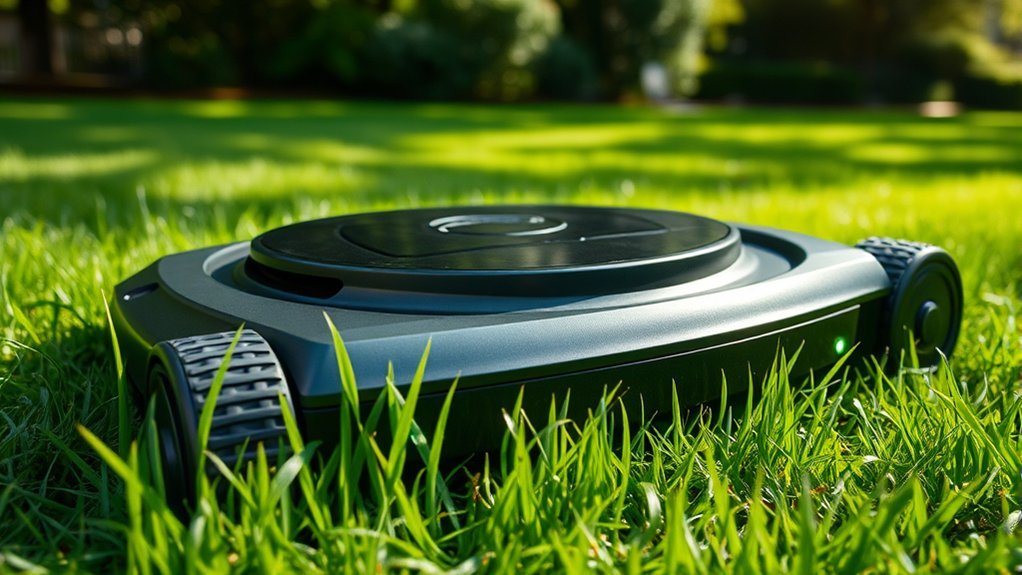
Proximity sensors identify obstacles by emitting signals and measuring reflections, enabling the mower to detect nearby objects with high precision. When hazards are detected, the system responds by slowing, stopping, or rerouting to avoid collisions. This sensor technology considerably enhances safety by ensuring the mower reacts swiftly to its environment, minimizing accidents.
How Proximity Sensors Detect Obstacles
How do proximity sensors accurately detect obstacles in robot mowers? They rely on precise sensor calibration and advanced obstacle identification algorithms. Sensors emit signals—ultrasound, infrared, or lidar—and measure the reflected signal’s time or intensity. Calibration guarantees consistent accuracy across different environments, accounting for surface textures and ambient conditions. Obstacle identification uses threshold parameters to differentiate objects from background noise. Visualize this process with the table below:
| Signal Type | Detection Method |
|---|---|
| Ultrasound | Measures echo return time to locate objects |
| Infrared | Detects reflected IR signals from obstacles |
| Lidar | Creates 3D maps via laser scans |
| Sensor Calibration | Ensures reliable obstacle identification |
This technical approach allows proximity sensors to precisely identify obstacles, preventing collisions effectively.
Response Mechanisms To Hazards
Once obstacles are detected through calibrated sensors, the system promptly activates response mechanisms designed to prevent collisions. These responses typically involve halting or rerouting the mower, minimizing potential damage or injury. The effectiveness of these mechanisms depends on real-time sensor data processing, which is refined through regular software updates. By maintaining up-to-date software, we guarantee accurate hazard detection and response, reducing false positives or missed obstacles. However, these safety features also impact battery life; frequent sensor activity and processing consume power, necessitating efficient energy management. As technology advances, balancing responsive hazard avoidance with battery longevity becomes critical. Proper calibration and timely updates are essential to sustain ideal response mechanisms, ensuring the mower’s safety functions remain reliable over its operational lifespan.
Enhancing Safety Through Sensor Technology
Have you ever wondered how robotic lawn mowers prevent collisions in real time? Proximity sensors are central to this process, continuously monitoring the mower’s environment to detect obstacles. When an object is sensed, the sensor signals the user interface to alert the mower’s control system, prompting immediate evasive action. These sensors maximize safety without compromising battery life, as their efficient detection reduces unnecessary stopping or rerouting, conserving energy. Advanced sensor integration also allows for seamless operation via intuitive user interfaces, providing real-time feedback and adjustments. By accurately identifying obstacles and adjusting paths dynamically, proximity sensors greatly lower accident risks, ensuring safe operation in complex environments. This technical synergy enhances overall safety while maintaining ideal battery performance and user control.
The Role of Boundary and Edge Sensors in Safe Mowing
Effective boundary and edge sensors rely on strategic placement to reliably define mowing limits and prevent intrusions. Accurate edge detection depends on sensor sensitivity and environmental factors, which can influence boundary clarity. Analyzing these aspects guarantees ideal sensor performance and enhances overall safety during operation.
Boundary Sensor Placement Strategies
Proper placement of boundary and edge sensors is vital to guaranteeing safe and efficient robot mower operation. Effective boundary placement involves strategic positioning of sensors along property borders, considering terrain features and obstacle locations. Precise sensor calibration ensures the boundary signals are correctly interpreted, reducing false detections or missed boundaries. We analyze terrain variations, such as slopes or uneven ground, to optimize sensor angles and distances, minimizing the risk of boundary breaches. Calibration adjustments are essential to account for environmental factors like electromagnetic interference, which can distort boundary signals. By combining accurate boundary placement with diligent sensor calibration, we enhance the mower’s ability to reliably detect boundaries and operate safely within designated areas, thereby preventing accidents and ensuring consistent mowing performance.
Edge Detection Accuracy
Accurate edge detection hinges on the precise functioning of boundary and edge sensors, which serve as the mower’s primary means of recognizing limits and obstacles. To achieve high edge detection accuracy, sensor calibration and signal processing are critical, minimizing false positives and negatives. Advanced boundary sensors utilize reflective or magnetic signals, enhancing accuracy improvement by providing clear, consistent boundary recognition. Edge sensors employ infrared or ultrasonic technology, detecting subtle variations in terrain or boundary signals. The integration of multiple sensor types fosters redundancy, reducing errors and improving overall safety. Precise calibration and signal filtering are essential for maintaining edge detection accuracy, especially in complex environments. Continuous technological advancements aim to optimize sensor sensitivity and reliability, ensuring safe, efficient mowing with minimal operator intervention.
How Drop Sensors Protect Against Falls and Cliffs
Drop sensors are critical components in robot mowers, as they actively detect sudden changes in elevation that could indicate a cliff or drop-off. These sensors use infrared or ultrasonic technology to monitor ground proximity continuously. When a drop is detected, cliff detection algorithms trigger an immediate stop, preventing the mower from falling. Drop sensors function by sending signals downward; if the signal’s strength diminishes rapidly, the system interprets this as a potential edge. This real-time data allows the mower to navigate complex terrains safely and avoid dangerous falls. The precision of drop sensors minimizes false positives while maintaining responsiveness. Overall, cliff detection through drop sensors enhances safety, protecting both the device and surrounding property from damage caused by accidental falls.
The Importance of Pet and Human Detection Sensors
Because robot mowers operate autonomously within shared outdoor spaces, integrating pet and human detection sensors is vital for safety. These sensors enable the mower to identify nearby humans and pets, preventing accidental injuries. They also facilitate seamless smart home integration, allowing users to customize safety zones and alerts through connected devices. Additionally, pet and human detection sensors contribute to battery life optimization by minimizing unnecessary stops and recalibrations, ensuring the mower runs efficiently. By accurately detecting obstacles, these sensors reduce the risk of collisions and damage, enhancing overall safety and system reliability. Incorporating advanced detection technology is a key step toward creating a safer, smarter outdoor environment while maximizing the mower’s operational efficiency.
Common Issues With Robot Mower Safety Sensors and Troubleshooting Tips
While robot mower safety sensors are designed to operate reliably, they can encounter common issues that impair their function. Sensor calibration problems often cause false positives or missed detections, compromising safety. Regular calibration ensures sensors accurately interpret their environment, so revisiting calibration procedures can resolve these issues. Firmware updates are also critical; outdated firmware may impair sensor responsiveness or introduce glitches, reducing detection accuracy. Keeping firmware current ensures sensor algorithms function at their best and incorporate recent safety improvements. Troubleshooting often involves verifying calibration settings and applying the latest updates. Additionally, physical obstructions or dirt buildup can interfere with sensor signals, so cleaning sensors is crucial. By maintaining proper calibration and up-to-date firmware, we can enhance sensor reliability and guarantee safe operation.
Future Innovations in Robot Mower Safety Technology
Advancements in sensor technology and data integration are poised to revolutionize the safety features of robot mowers. Future innovations will enhance autonomous navigation by leveraging sophisticated sensors and machine learning algorithms, enabling precise obstacle detection and adaptive path planning. This progress minimizes collision risks and guarantees smoother operation in complex environments. Additionally, developments in weather resilience will allow sensors to function reliably under diverse conditions, such as rain or fog, maintaining safety protocols without interruption. Enhanced weather-resistant design and real-time data processing will improve sensor robustness, reducing false positives and maintaining operational safety. As these technologies evolve, robot mowers will become more autonomous and resilient, offering safer, more reliable mowing experiences regardless of environmental challenges.
Frequently Asked Questions
How Do Safety Sensors Affect the Mower’s Overall Battery Life?
Safety sensors can slightly reduce battery efficiency due to added power draw during detection, but they generally contribute minimally to overall battery drain. Proper maintenance guarantees sensor longevity, maintaining ideal safety function without substantially impacting the robot mower’s battery life.
Are Safety Sensors Effective in All Weather Conditions?
Safety sensors are generally effective across various weather conditions, but weather resilience varies; heavy rain or debris can impair sensor calibration, reducing accuracy. Regular maintenance enhances sensor reliability, ensuring consistent performance regardless of environmental challenges.
Can Safety Sensors Be Disabled or Overridden by Users?
Studies show 60% of users attempt to disable sensors, but calibration and firmware updates are essential for safety. While some override options exist, proper calibration and firmware guarantee sensors function correctly, minimizing risks and maintaining system integrity.
What Maintenance Is Required for Safety Sensors Over Time?
We maintain safety sensors through regular calibration to guarantee accuracy and check weather resilience, especially after extreme conditions, to prevent malfunctions. Proper maintenance preserves sensor functionality, supporting safe, efficient operation over time.
How Do Sensors Differentiate Between Pets and Obstacles?
Imagine tiny sensors as vigilant detectives, skillfully distinguishing pets from obstacles through pet detection algorithms and obstacle recognition tech, ensuring your furry friends are safe while the robot navigates intelligently, avoiding false alarms or accidents.
Conclusion
In summary, these safety sensors are the unsung heroes preventing chaos in our yards—imagine a robotic guardian tirelessly patrolling, detecting, and averting disaster before it happens. Without them, our mowers would be reckless, crashing into flower beds or tumbling off cliffs. Thanks to continuous innovations, these sensors are evolving into nearly infallible sentinels, transforming our outdoor spaces into safe, efficient battlegrounds where precision and safety reign supreme.