Ad Blocker Detected
Our website is made possible by displaying online advertisements to our visitors. Please consider supporting us by disabling your ad blocker.
As we evaluate robot lawn mowers, it’s essential to weigh their advantages against potential limitations. While they offer automation and efficiency, questions about terrain suitability, safety, and long-term costs remain. Understanding these factors helps determine if they’re a practical choice for your yard. But to make an informed decision, it’s vital to analyze how these machines perform across different landscapes and user needs. Let’s explore the key aspects more closely.
Key Takeaways
- Robot lawn mowers save time and effort by automating lawn care with minimal noise and consistent cutting quality.
- They have safety features like obstacle sensors and emergency shutoffs, reducing injury risks.
- Higher initial costs and ongoing maintenance, such as blade replacements and software updates, are factors to consider.
- Performance may be limited on uneven terrain, steep slopes, or yards with many obstacles.
- Compared to traditional mowers, robots offer long-term savings but may require more frequent repairs and updates.
What Are the Benefits of Using a Robot Lawn Mower?
While traditional lawn care methods require significant time and manual effort, robot lawn mowers offer a compelling alternative by automating the mowing process. They contribute positively to garden aesthetics by maintaining an even, well-groomed lawn without the uneven patches caused by inconsistent manual mowing. Additionally, these devices operate with low noise levels, minimizing disruption to household activities and neighborhood peace. Their precise cutting mechanisms ensure consistent grass height, enhancing visual appeal and uniformity. The automation reduces the need for manual labor, freeing up time for other landscape improvements. Moreover, optimized mowing patterns prevent over-trimming and promote healthier turf growth. Overall, robot lawn mowers improve garden aesthetics through consistent, neat appearance while maintaining a quiet operation that complements the natural tranquility of outdoor spaces.
How Do Robot Lawn Mowers Work and What Features Should You Know?
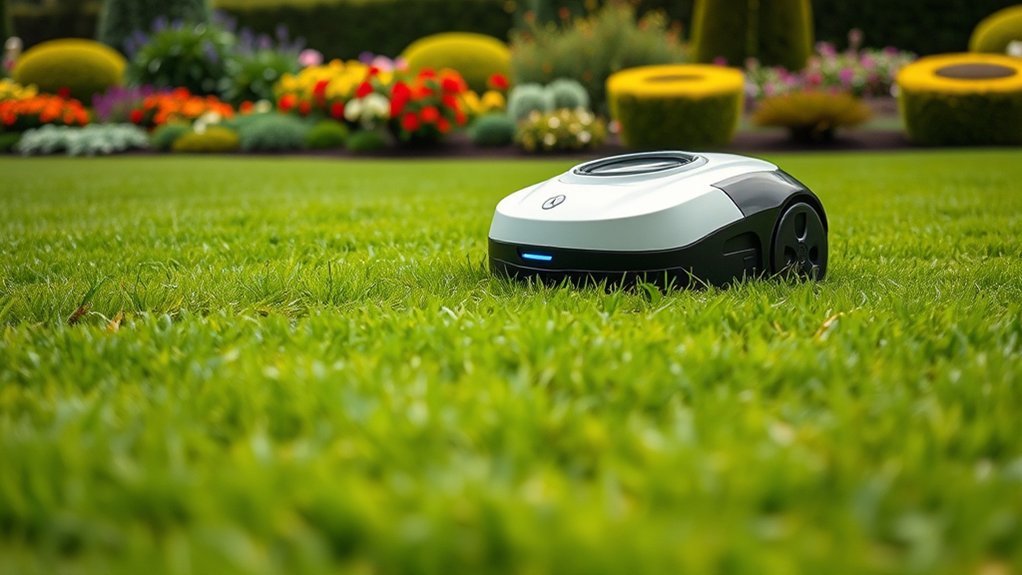
Robot lawn mowers utilize sophisticated navigation and boundary systems to precisely cover designated areas while avoiding obstacles. They feature cutting mechanisms optimized for efficiency and rely on automated charging stations to maintain operation without human intervention. Additionally, safety and security measures such as sensors and PIN codes guarantee secure use and prevent unauthorized access.
Navigation and Boundary Systems
Ever wondered how robot lawn mowers navigate complex outdoor terrains with minimal human intervention? They rely on sophisticated navigation and boundary systems designed for high navigation accuracy. Many models use GPS or inertial sensors to map your lawn precisely, guaranteeing efficient coverage while avoiding obstacles. Boundary detection is equally critical; perimeter wires or advanced sensors define the mowing area, preventing the mower from straying into flower beds or neighboring lawns. These systems work together to optimize route planning, reduce overlaps, and minimize missed spots. The effectiveness hinges on the quality of boundary detection and the precision of navigation algorithms. Ultimately, robust navigation and boundary systems ensure that robots operate safely, efficiently, and with minimal supervision, making them reliable tools for maintaining your lawn.
Cutting and Charging Features
Understanding how robot lawn mowers operate requires examining their cutting mechanisms and power management features. These devices utilize sharp, rotating blades for precise cutting, optimized by sensors that enhance cutting precision across uneven terrain. Battery longevity plays a critical role in maintaining consistent performance, as longer-lasting batteries ensure extended mowing sessions without frequent recharges. When the battery depletes, the mower autonomously returns to its charging station, using boundary signals for navigation. Charging features include rapid recharge capabilities and smart scheduling to minimize downtime. The efficiency of cutting and charging directly impacts operational reliability and lawn quality.
| Feature | Description |
|---|---|
| Cutting Mechanism | Rotating blades with sensor-guided precision |
| Battery Longevity | Extended use with durable, rechargeable batteries |
| Recharge Process | Automatic return to station when power is low |
| Charging Speed | Fast recharging for minimal downtime |
| Power Management | Smart scheduling to optimize battery use |
Safety and Security Measures
How do robot lawn mowers guarantee safety and security during operation? They incorporate multiple systems to prevent accidents and theft. An emergency shutoff feature immediately halts operation if a safety breach occurs, such as contact with obstacles or human interference, minimizing injury risks. Advanced sensors detect obstacles, drops, or irregularities, ensuring the mower avoids collisions. For theft prevention, GPS tracking and alarm systems are common, allowing owners to locate and immobilize the mower remotely. Some models also feature PIN codes or lock mechanisms to deter unauthorized use. These technical measures collectively enhance operational safety and security, providing peace of mind. By integrating emergency shutoff and theft prevention features, robot lawn mowers deliver a secure, reliable, and user-conscious mowing solution.
What Are the Common Drawbacks of Robot Lawn Mowers?
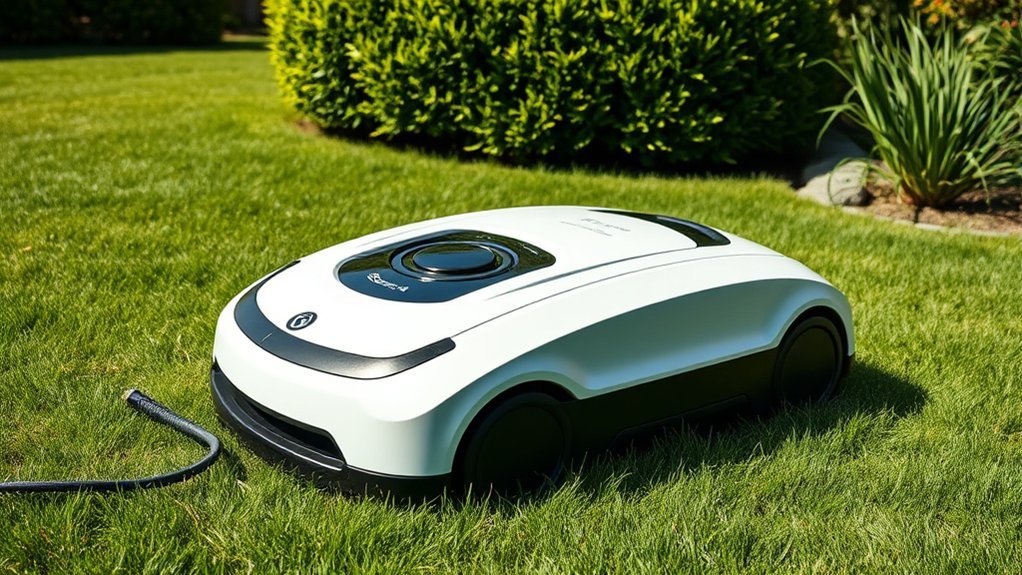
While robot lawn mowers offer many advantages, they also present several notable drawbacks that can impact their overall effectiveness and user satisfaction. One key issue is battery longevity, which diminishes over time, reducing operational runtime and increasing replacement costs. Additionally, noise pollution can be a concern, especially in quiet neighborhoods, as these machines often emit continuous noise during operation. Other common drawbacks include limited obstacle detection, which can lead to missed patches or damage, and susceptibility to weather conditions, such as rain, that can halt mowing. The following table summarizes these drawbacks:
| Drawback | Impact | Mitigation Challenges |
|---|---|---|
| Battery longevity | Reduced runtime, increased costs | Limited lifespan, frequent replacements |
| Noise pollution | Disturbs residents | Noise regulation compliance |
| Obstacle detection | Missed patches, damage risk | Sensor limitations |
| Weather susceptibility | Operational halts, damage risk | Weatherproofing, scheduling adjustments |
How Do Maintenance and Operating Costs Impact Your Budget?
Maintenance and operating costs considerably influence the overall affordability and long-term viability of robot lawn mowers. Conducting a thorough cost comparison helps identify potential expenses beyond the initial purchase, such as replacement blades, batteries, and software updates. Effective maintenance routines, including regular cleaning and timely part replacements, can extend the mower’s lifespan and optimize performance, reducing unforeseen costs. Conversely, neglecting routine upkeep may lead to increased energy consumption or component failure, escalating expenses. Understanding these costs allows us to evaluate whether the ongoing investment aligns with our budget constraints. While initial costs may appear appealing, analyzing the total cost of ownership—including maintenance and operating expenses—provides an all-encompassing view essential for making informed, financially sustainable decisions.
Is Your Yard Suitable for a Robot Lawn Mower?
Evaluating whether your yard suits a robot mower requires examining its size, terrain, and obstacle profile. Larger or irregularly shaped lawns may challenge navigation, while uneven terrain and complex landscaping can impede operation. Understanding these factors guarantees compatibility and ideal performance of the mower.
Yard Size Compatibility
Determining whether a robot lawn mower is suitable for your yard hinges on its size and layout. For peak performance, the mower’s cutting capacity must align with yard dimensions, ensuring coverage without excessive overlap or missed patches. Large or irregularly shaped yards may require models with extended battery life and larger cutting areas; otherwise, frequent recharging could disrupt seasonal adjustments to mowing schedules. Conversely, small or uniform lawns typically benefit from compact models that maintain garden aesthetics efficiently. The mower’s ability to adapt to seasonal changes—such as growth spurts or dormant periods—depends on its capacity to handle yard size consistently. Ultimately, matching a robot mower’s specifications with your yard’s size ensures consistent lawn quality and minimizes maintenance challenges.
Terrain and Obstacles
While robot lawn mowers are designed to navigate various yard conditions, their effectiveness heavily depends on the terrain and obstacles present. Terrain obstacles such as rocks, tree roots, or garden beds can impede movement and increase the risk of damage or malfunction. Uneven surfaces pose additional challenges, as the mower’s sensors and wheels may struggle with steep slopes or irregular ground, affecting cutting precision and stability. The mower’s ability to adapt relies on advanced navigation systems, but excessive obstacles or significant unevenness can limit coverage or require manual intervention. Consequently, evaluating the terrain’s complexity is essential to determine if a robot mower can operate efficiently without frequent adjustments or repairs. Properly assessing terrain and obstacles ensures peak performance and longevity of the mowing system.
Lawn Complexity Factors
The suitability of a yard for a robot lawn mower depends heavily on several key factors that influence its performance and efficiency. Lawn complexity factors such as terrain grade, obstacle density, and boundary definition directly impact mowing effectiveness. Additionally, the uniformity of lawn conditions, including consistent lawn irrigation and fertilization techniques, affects the mower’s ability to maintain an even cut. Variations in soil and grass health may require manual intervention or specialized equipment. A complex yard with uneven terrain or frequent obstacles can hinder navigation. Properly managed irrigation ensures consistent grass growth, while targeted fertilization techniques promote healthy turf, reducing the need for frequent adjustments.
- Terrain grade and slope stability
- Obstacle density and placement
- Boundary and fencing clarity
- Consistency of lawn irrigation
- Fertilization practices and turf health
How Safe Are Robot Lawn Mowers Around People and Pets?
Are robot lawn mowers safe to operate around people and pets? Generally, yes, due to advanced robot lawn mower safety features designed to minimize risks. Modern models incorporate obstacle detection sensors, which halt operation when detecting humans or animals, reducing injury potential. Pet friendly features, such as audible alerts and customizable boundary settings, further enhance safety by preventing accidental entry into sensitive areas. Additionally, many units include lift and tilt sensors that immediately stop blades if the mower is lifted or tilted, preventing injuries. While these safety mechanisms considerably reduce hazards, user vigilance remains essential, especially in environments with active children or pets. Overall, with proper setup and maintenance, robot lawn mowers can operate safely around people and pets, thanks to their sophisticated safety systems.
Should You Choose a Robot Lawn Mower or Stick With Traditional Mowing?
Choosing between a robot lawn mower and traditional mowing methods depends on several practical considerations. Robot lawn mower durability varies based on build quality and usage conditions, affecting long-term performance. Traditional mowing efficiency often exceeds robotic options in terms of speed and coverage, especially for larger or uneven terrains.
- Maintenance demands: Robots require regular updates and repairs; traditional mowers need more frequent physical upkeep.
- Operational environment: uneven or complex yards may challenge robot navigation, reducing durability.
- Cost-effectiveness: initial investment in robotic mowers may be higher, but operational costs are lower over time.
- Time investment: robotic mowers work autonomously, freeing up user time, whereas traditional mowing is labor-intensive.
- Long-term performance: lifespan of robot lawn mowers impacts their efficiency, making traditional mowing more reliable for certain landscapes.
Frequently Asked Questions
How Long Do Robot Lawn Mowers Typically Last Before Needing Replacement?
Typically, robot lawn mowers last about 5-8 years, depending on battery life and mowing efficiency. We observe that proper maintenance and battery replacements can extend their functional lifespan, ensuring consistent performance over time.
Can Robot Lawn Mowers Handle Steep Slopes or Uneven Terrain Effectively?
Back in the day, robot lawn mowers excel at slope navigation and terrain adaptability, but their effectiveness on steep slopes or uneven terrain varies. We find modern models increasingly capable, though some limitations still exist depending on terrain complexity.
Are There Specific Brands Known for Reliability and Durability?
We find that certain brands, like Husqvarna and Bosch, are known for reliability and durability due to strong brand reputation and all-encompassing warranty coverage, making them preferable choices for consistent performance and long-term investment in robot lawn mowers.
What Accessories or Upgrades Are Available for Robot Lawn Mowers?
We find smart navigation upgrades, like GPS modules, improve precision, while battery enhancements extend runtime. These accessories optimize performance, ensuring efficient mowing and longer operation, making our robotic lawn care more reliable and adaptable to varying yard sizes.
How Does Weather Affect the Performance and Safety of Robot Lawn Mowers?
Seventy-five percent of robot mower malfunctions relate to weather hazards, emphasizing the need for seasonal adjustments. Weather impacts performance and safety, requiring us to adapt mowing schedules, clear debris, and employ weather-resistant features for ideal operation.
Conclusion
Certainly! Here is the modified version with alternative words replacing the specified terms:
In summary, while over 80% of users report increased satisfaction with robotic lawn mowers’ efficiency and precision, their suitability depends heavily on yard complexity and landscape. For flat, manageable terrains, they offer a cost-effective, time-saving alternative to traditional mowing. However, understanding their limitations—such as navigation challenges and maintenance costs—is essential for informed decision-making. Evaluating your yard’s features and safety needs ensures that investing in a robotic mower aligns with your long-term landscaping goals.