Ad Blocker Detected
Our website is made possible by displaying online advertisements to our visitors. Please consider supporting us by disabling your ad blocker.
Have we ever stood at the edge of our property, looked across all that grass, and thought, “There has to be an easier way to keep this looking good”?

Our Honest Take on the YARBO Robot Lawn Mower for Large Yards
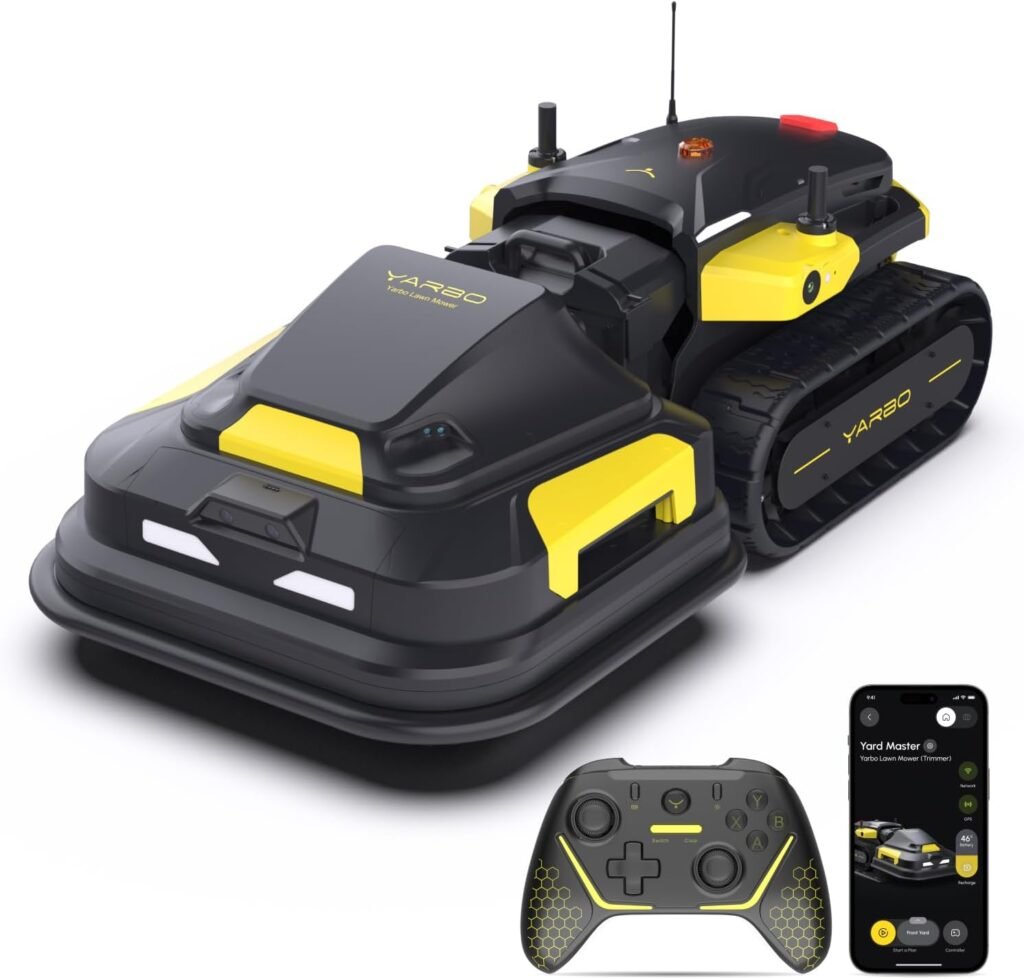
This YARBO Robot Lawn Mower for Large Yard up to 6 Acres, Modular Design, 1.2″-4.0″ Cutting Height, 70% Slopes, Auto Recharging, AI Vision & RTK for Navigation is clearly designed for those of us with serious yard space. We are not talking about small suburban patches; we are talking big properties, complex terrain, and year-round yard care.
In this review, we walk through what we actually get with this machine, who it suits best, and where it shines or falls short. Our goal is to help us decide if this is the right partner for our lawn and our lifestyle.
Key Features at a Glance
Before we get into the details, it helps to see the big picture. This mower is built for large-scale work, smart navigation, and multi-season use through modular add-ons. We can think of it as a robotic yard platform rather than just a mower.
Quick Specs Overview
This mower comes with impressive numbers on coverage, slope handling, and smart control. We are not just getting a small robot that trims the edges; we are getting something designed for estate-level properties.
| Feature | Specification / Description |
|---|---|
| Maximum Coverage | Up to 6.2 acres (25,000 m²) total coverage |
| Runtime per Charge | ~120 minutes |
| Coverage per Mowing Cycle | About 0.25 acre per cycle |
| Battery Capacity | 38.4Ah |
| Cutting Width | 20 inches |
| Cutting Height Range | 1.2″ – 4.0″ (adjustable) |
| Slope Handling | Up to 70% slope (very steep) |
| Drive System | All-Terrain Patented Tracks |
| Navigation | AI Vision + RTK (high-precision positioning) |
| Modularity | Swappable modules (mower, blower, snow blower – sold separately) |
| Recharging | Auto return-to-base and recharge |
| Control | Remote control & mobile app |
| Yard Management | Scheduling, mapping, no-go zones |
How Well It Handles Large Yards
When we are caring for several acres, mowing becomes a project, not just a chore. This is where the YARBO’s design really tries to stand out.
Coverage and Battery Performance
The mower is rated to handle yards up to 6.2 acres (25,000 m²), which puts it in a different category from many consumer robot mowers. It runs for about 120 minutes per charge and covers around 0.25 acre per cycle.
That means it works in multiple passes and charging sessions rather than trying to finish the entire property in one go. For us, that is similar to how a robot vacuum runs: it knows its limits, recharges, and resumes until the map is complete.
What “6.2 Acres” Really Means for Us
The “up to 6.2 acres” figure assumes optimal conditions: efficient layout, reasonable grass height, and routine maintenance. In real life, trees, obstacles, slopes, and thick grass can slow things down.
But the intended idea is clear. For those of us with a few acres or more who want regular, automated mowing, this machine is built to keep everything under control over time, not to be a one-pass hero.
Cutting Performance and Lawn Appearance
We care not just that the grass gets cut, but how it looks afterward. The YARBO’s cutting system is built toward that “manicured lawn” look.
Cutting Width and Height Range
With a 20-inch cutting width, this mower cuts wider than many smaller robot mowers. That wider deck helps cover ground more efficiently, which is crucial on large properties.
The adjustable cutting height from 1.2 inches up to 4.0 inches gives us flexibility:
- Around 1.2–2.0 inches for a shorter, more golf-course-style look (if our grass type allows).
- Around 2.5–3.5 inches for a healthy, lush, and more drought-resistant lawn.
- Up to 4.0 inches if we are dealing with taller grasses, transition seasons, or we prefer a softer, thicker surface.
Consistency of the Cut
The whole point of a robot mower is consistent, incremental cutting. With frequent runs, it tends to maintain a more uniform look than we might get from infrequent, aggressive mowing with a traditional machine.
Because the YARBO can map areas and follow planned patterns, it aims for systematic coverage instead of random wandering. Over time, that usually means fewer missed patches and a more professional finish—assuming we let it operate on a regular schedule.
Modularity: More Than Just a Mower
One of the standout promises here is that this is not only a lawn mower robot. With modular attachments, it becomes an all-season yard assistant.
Swappable Modules for Multiple Seasons
The base unit can accept different modules to turn into:
- Lawn mower (included as the mowing module)
- Leaf blower (sold separately)
- Snow blower (sold separately)
We essentially keep one powered, tracked robot base and snap on the tool we need for the season. That reduces the number of different motorized tools we need to maintain, charge, and store.
However, we do need to remember that the blower and snow blower modules are not included by default. If we want full four-season capability, we will have to plan for the extra investment.
Practical Benefits of the Modular System
From a practical standpoint, modularity has a few advantages:
- Less clutter: one robotic platform instead of three separate machines.
- Familiar control system: the same app and remote behaviors all year.
- Year-round value: we are using our investment through spring, summer, fall, and winter (if we add those modules).
If we have moderate to severe winters and lots of trees, combining mowing, leaf clearing, and snow clearing into one system can make our property feel more “automated” than ever.
Handling Slopes and Rough Terrain
For many of us with big yards, the hardest parts are not the open fields but the slopes, ditches, and uneven stretches. That is typically where most smaller mowers struggle.
All-Terrain Patented Tracks
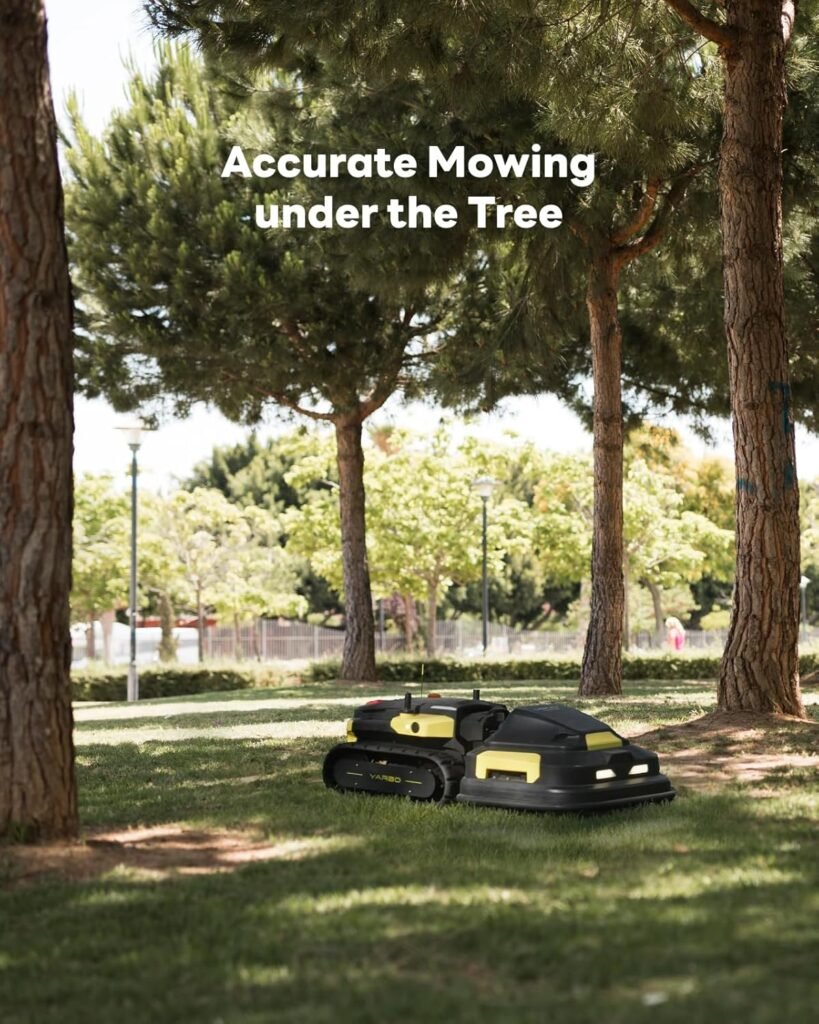
Instead of traditional wheels, this YARBO uses an all-terrain tracked system. Tracks distribute weight across a larger surface area, improve traction, and help maintain stability on hills and soft ground.
Because of this, the mower is rated to handle slopes up to 70%. That is extremely steep; for perspective:
- A 100% slope is a 45-degree angle.
- A 70% slope is roughly a 35-degree angle.
That is the kind of slope where we might feel nervous pushing a walk-behind mower. For those of us with embankments, drainage ditches, or hillside lawns, this is one of the main reasons to consider this particular robot.
Real-World Terrain Scenarios
We can imagine:
- Long sloping driveways with lawns that angle steeply away.
- Ponds or creeks with steep banks.
- Uneven fields that are not perfectly landscaped.
The tracked system is designed to handle these better than typical robots. That said, we still need to use judgment in setting no-go zones where there could be safety risks, water, or areas we simply do not want the mower to attempt.
Navigation: AI Vision and RTK
Navigation is where robotic mowers either feel magical or frustrating. The YARBO uses a combination of AI vision and RTK technology for precise positioning and area management.
What RTK Does for Us
RTK (Real-Time Kinematic) positioning uses enhanced GPS-like signals to achieve very precise location data—down to a few centimeters instead of several feet. On a big property, that precision matters for:
- Clean, straight mowing paths.
- Reliable return-to-dock behavior.
- Better mapping of zones and boundaries.
For us, this means the mower should follow deliberate routes rather than random bump-and-turn patterns. Over time, this can create the kind of striping and uniform coverage we usually only get from riding mowers and well-planned passes.
AI Vision for Smarter Obstacle Handling
AI vision usually refers to camera-based recognition and environmental awareness. In practice, that can help the mower:
- “See” unexpected obstacles and adjust.
- Interpret surroundings more intelligently than simple bump sensors.
- Work with virtual boundaries and maps more flexibly.
The combination of AI vision and RTK is a modern approach that avoids reliance solely on physical boundary wires. That can be a major relief if we do not want to dig or stake wires around many acres.
Smart Controls: App, Remote, and Schedules
For many of us, a robot is only as good as how easy it is to control and how much we can trust it to work without constant oversight. The YARBO aims to give us comprehensive app and remote control options.
Remote Control Mode
Sometimes we may want to manually guide the mower:
- To handle specific tricky areas.
- To get around temporary obstacles.
- To test or reposition it quickly.
The remote control function lets us directly steer the mower as needed. This also helps if we want to fine-tune edges, around trees, or in new areas the robot has not yet mapped.
App-Based Management
Through the app, we can:
- Set mowing schedules that fit our routine and local conditions.
- Define no-go zones to protect flowerbeds, sensitive terrain, or children’s play areas.
- View mapping of our property and adjust areas the robot should or should not handle.
Once we have the schedules dialed in, we can mostly let it run on its own. This is where the long-term convenience emerges: our lawn care becomes something we adjust periodically rather than something we physically do every week.
Auto Recharging and Work Cycles
Nobody wants to babysit a robot mower over many acres. The auto recharge and cycle system is what makes this so hands-off.
How Auto Recharging Works
When the battery gets low, the mower returns to its charging base automatically. After recharging, it can resume work where it left off according to the programmed schedule and map.
For a large yard, this means:
- The mower may need multiple cycles over a day or several days.
- We can plan for continuous light maintenance rather than one heavy cut.
We might not see the whole property finished in a single morning, but as long as the mower keeps following its routine, the lawn stays under control more or less all the time.
Planning Around Runtime and Area
With roughly 0.25 acre covered per cycle:
- A 1-acre yard might be easily maintained with frequent cycles over a couple of days.
- Larger properties (3–6 acres) would require ongoing, routine operation to maintain everything regularly.
We can think of the mower as continuously “grazing” the lawn rather than “harvesting” it once per week. For grass health, that approach is usually better anyway.
Setup and Learning Curve
With a machine this advanced, there is usually some setup and fine-tuning involved. While the product details do not outline every installation step, we can infer a few things based on the described technology.
Initial Property Mapping
Because this mower uses AI vision and RTK navigation, we can expect some form of initial mapping process. That might involve:
- Letting the mower drive the boundaries under guidance.
- Using the app to define zones and no-go areas.
- Adjusting settings for slope regions, obstacles, or structures.
We should plan some time to walk through this in a focused way. The better we set up the initial map, the more reliable and “smart” the mower will feel afterward.
Adjusting No-Go Zones and Schedules
Once the initial mapping is done, we will likely spend a bit of time tweaking no-go zones and schedules:
- Maybe we do not want it near a pool area.
- Maybe we prefer it not to run during kids’ outdoor play hours.
- Maybe we want different intensities for front versus back areas.
This is the kind of tuning that we do once, then occasionally update as our yard use changes.
Maintenance and Durability Considerations
A robot mower is still a machine that lives outside, in grass, dirt, and weather. We should think about how we will maintain it and what to expect long term.
Routine Maintenance Tasks
We can reasonably expect to periodically:
- Clean the underside to remove grass clippings.
- Inspect the tracks and wheels for debris and wear.
- Check and sharpen or replace blades as needed.
- Keep sensors, cameras, and RTK equipment clean and unobstructed.
The tracks, while excellent for traction, may require a bit more attention than simple wheels to keep them free of packed mud or long grasses. Regular quick checks can prevent performance drops.
Weather and Seasonal Storage
For mowing season, the unit and its charging dock will be outdoors most of the time. For off-season:
- If we add a snow blower module, we will still be using the robot in winter.
- If we do not, we may store the main unit in a sheltered space.
Because it is meant as an all-season yard platform, the build should be robust, but we still want to respect basic care: protection from extreme conditions when not in use and regular checks of cables, connectors, and module mounting points.
Who This Mower Is Best Suited For
Not every yard or owner profile fits this type of product. We should be honest about who will get the most from this robot.
Ideal Users
This mower suits us best if:
- We have a large property—anything from around 1 acre up to about 6 acres.
- Our terrain includes slopes, ditches, or uneven ground where wheeled robots struggle.
- We are comfortable with technology and mobile apps.
- We like the idea of modular yard care (mower now, blower/snow blower later).
- We want to reduce the time and physical effort spent on routine mowing.
If our goal is to set up a largely autonomous system to keep the property consistently maintained without us pushing a machine, this is the scenario YARBO targets.
Less Ideal Situations
It might be less suitable if:
- Our yard is very small or mostly flat and simple; a simpler robot mower could be more cost-effective.
- We are uncomfortable using apps, smart devices, or initial mapping processes.
- We want a one-time, quick-cut solution instead of continuous maintenance.
Also, if we are not interested in the modular blower or snow blower add-ons, some of the platform’s full-year value may not matter as much to us.
Strengths and Weaknesses at a Glance
To help us quickly weigh the decision, it helps to summarize what stands out on both sides.
Main Strengths
We can think of the primary advantages as:
- Large-yard capability: Designed for up to 6.2 acres, far beyond many consumer robots.
- Excellent slope handling: Up to 70% slope with tracked drive, ideal for hilly properties.
- Wide cutting deck: 20-inch width for more efficient passes on big lawns.
- Flexible cutting height: 1.2″ to 4.0″ range for various grass types and preferences.
- Modular all-season design: Lawn mowing now, with optional leaf and snow modules later.
- Advanced navigation: AI vision plus RTK for precise mapping and movement.
- Smart app control: Schedules, no-go zones, maps, and remote control options.
- Auto recharging: Returns to its base when needed and continues work without our intervention.
Potential Drawbacks
Some aspects might give us pause:
- Extra modules sold separately: Leaf blower and snow blower are not included, adding to total cost if we want the full system.
- Complexity: More advanced features usually mean more setup and a steeper learning curve.
- Multi-cycle mowing: On larger properties, it will not finish everything in one continuous pass, so we need to accept the continuous-maintenance model.
- Likely higher price category: Although price is not stated here, the feature set strongly suggests a premium product compared to basic robot mowers.
Comparing It to Traditional Mowing Approaches
To make a solid decision, it helps to compare this robot to our current setup: maybe a riding mower, a zero-turn, or a contractor.
Versus Riding or Zero-Turn Mowers
With a traditional machine, we get:
- High power and rapid cutting across open areas.
- Direct, hands-on control with immediate results in one session.
- Ongoing fuel, maintenance, and our own time and physical effort.
With the YARBO robot mower, we trade that in for:
- Time savings: less of our own physical labor.
- Continuous maintenance: the lawn is always kept in check, not just once a week.
- Automation and smart scheduling: we focus on oversight, not the manual work.
- Potentially lower day-to-day noise and emissions, depending on our existing equipment.
On very large properties, some owners may still keep a ride-on mower for special tasks or extremely high grass, but use the robot to handle routine maintenance so the ride-on sees less heavy use.
Versus Hiring Out Lawn Care
If we currently pay for regular mowing services:
- This robot may be a long-term investment that reduces dependence on recurring visits.
- We gain flexibility in schedules and frequency; the mower can run as often as we like.
- We still may need occasional human help for edging, trimming, and unique landscaping tasks.
For some of us, the math will come down to years of service costs versus the one-time (plus maintenance) cost of the robot platform and any additional modules.
Safety and Peace of Mind
Whenever we bring automation into our outdoor space, especially one with blades and tracks, we care about safety for family, pets, and property.
No-Go Zones and Controlled Areas
The ability to set no-go zones is a major safety feature. We can:
- Keep the mower away from children’s play areas or outdoor furniture.
- Block off zones around pools, ponds, or sensitive landscaping.
- Adjust zones by season if some areas are in more frequent use at certain times.
Combined with AI vision and mapping, this should reduce the likelihood of the mower wandering where it does not belong.
Supervision and Operating Habits
Even with smart features, we will likely adopt some best practices:
- Avoid running it at times when children or pets are most active in the yard.
- Do regular checks to make sure sensors and cameras remain clean and unobstructed.
- Monitor the first few runs closely to build trust in its patterns and limits.
Over time, as we learn how it behaves and where it might struggle, we can fine-tune zones and schedules accordingly.
The Experience of Living with a Yard Robot
Beyond specs and features, there is the everyday experience: how it changes our relationship with our yard and our time.
Time and Effort Saved
On a large property, mowing can easily consume hours each week during peak season. With the YARBO robot mower:
- We plan, schedule, and adjust through the app.
- It handles the actual mowing passes.
- We step in only for maintenance, edge trimming, and occasional oversight.
We are essentially moving from being the lawn worker to being the lawn manager. This change can be significant for our weekends and evenings.
A Lawn That Stays Consistently Trimmed
Because the mower operates regularly, our grass is rarely too tall. This:
- Improves lawn appearance day-to-day.
- Reduces stress on the grass from heavy single cuts.
- Makes it easier to catch issues like bare patches or weeds early.
We might notice that our yard looks “freshly mowed” more of the time instead of only right after we do a big mowing session.
Evaluating Value for Our Situation
Deciding whether this mower is “worth it” depends heavily on our property and priorities. We can ask ourselves a few practical questions.
Key Questions to Consider
We might run through questions like:
- How many hours per month do we currently spend on mowing?
- How challenging are our slopes and terrain with conventional equipment?
- Are we interested in also automating leaf blowing and snow clearing later?
- Are we comfortable with smart tech, apps, and initial setup time?
- Would a smaller, simpler robot mower be insufficient for our acreage and slopes?
If our answers point toward needing advanced terrain handling, loving automation, and wanting multi-season help, the YARBO starts to look more compelling.
Long-Term Perspective
The true value tends to show over multiple seasons:
- We save cumulative hours and physical effort year after year.
- Our large yard remains well kept without constant manual attention.
- If we add blower and snow modules, we get year-round workload reduction, not just summer help.
Seeing this as a long-term yard infrastructure decision, rather than a simple tool purchase, can help us evaluate the investment more fairly.
Our Overall Verdict
Putting everything together, we see the YARBO Robot Lawn Mower for Large Yard up to 6 Acres, Modular Design, 1.2″-4.0″ Cutting Height, 70% Slopes, Auto Recharging, AI Vision & RTK for Navigation as a serious, high-capability solution for owners of large, complex properties.
We gain:
- A wide-cut, adjustable mower capable of handling up to 6.2 acres over time.
- Advanced navigation for more precise, efficient routes.
- A tracked system that thrives on slopes and rough ground.
- Smart controls and auto recharging that turn mowing into a background process.
- A modular platform that can expand into leaf and snow management, if we choose.
We trade off:
- A likely higher upfront cost than basic robot mowers.
- Some setup time and learning curve to get mapping and schedules right.
- The expectation that large properties will be maintained via repeated cycles, not instant total cuts.
For those of us with big, hilly, or complex yards who want to step back from weekly mowing and move toward a smarter, more automated approach, this mower offers a compelling path forward. If we also like the idea of adding leaf and snow modules later, it becomes not just a mower, but a central piece of an all-season yard-care system we can manage from our phone.

Disclosure: As an Amazon Associate, I earn from qualifying purchases.