Ad Blocker Detected
Our website is made possible by displaying online advertisements to our visitors. Please consider supporting us by disabling your ad blocker.
Have we ever wished our lawn could take care of itself while we sit back and actually enjoy our yard instead of working in it?

What Is the eufy E18 Robot Lawn Mower?
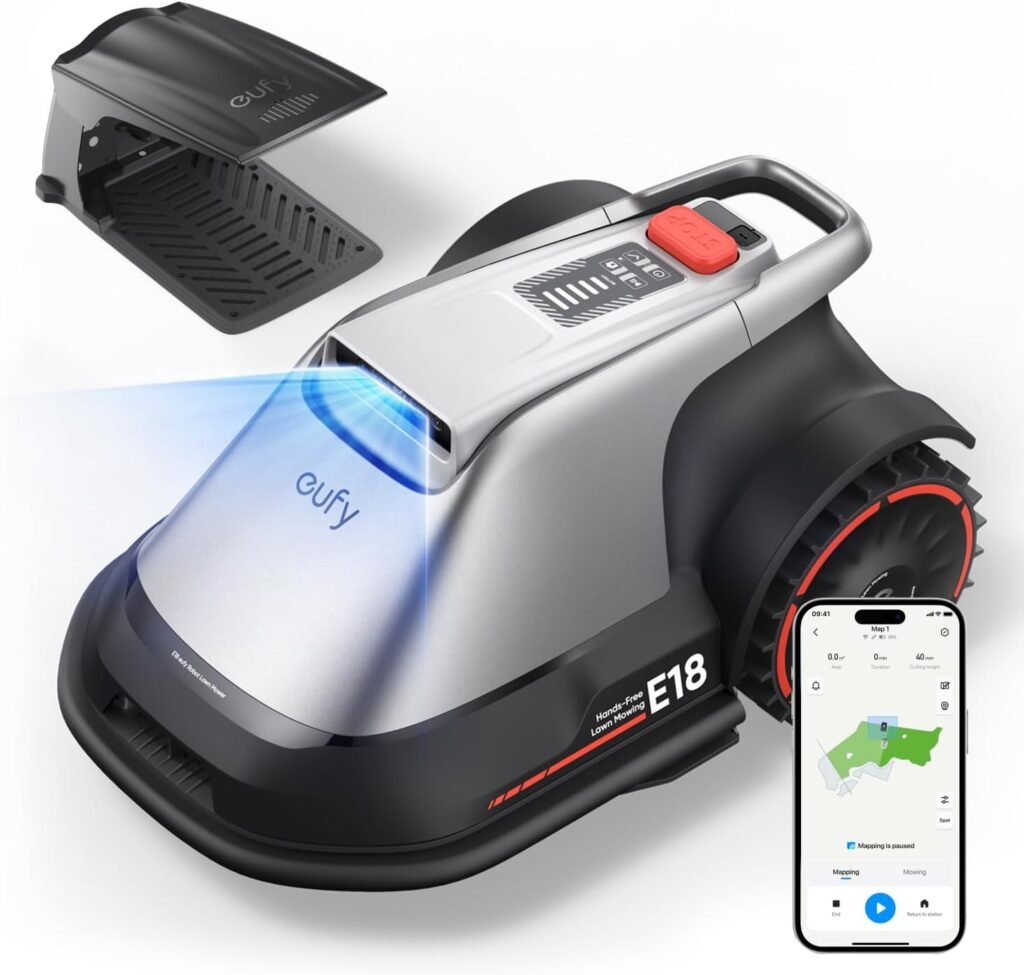
The eufy E18 Robot Lawn Mower is a wireless, self-guided mower designed to automatically maintain lawns up to 0.3 acres (about 13,000 sq ft). It combines camera-based vision navigation, auto mapping, and app control so we can manage lawn care from our phone instead of pushing a heavy mower every week.
In simple terms, this is a “set-it-and-let-it-work” lawn mowing solution: no boundary wires, no RTK stations, and no constant babysitting. It is built for flat, medium-sized lawns and aims for consistent, parallel cuts that keep grass looking neat and uniform.
Key Features at a Glance
Before we get into the details, it helps to see the main features side by side. This gives us a quick overview of what the eufy E18 is designed to offer.
| Feature | What It Means for Us |
|---|---|
| Max area 0.3 acres (13,000 sq ft) | Suitable for small to medium-sized yards |
| Wireless, no boundary wires | No need to install perimeter wires in the ground |
| Auto mapping | Automatically scans and maps the lawn’s layout |
| Vision navigation (Pure Vision FSD) | Uses cameras and algorithms to guide movement without RTK or wires |
| AI obstacle avoidance | Detects and moves around objects to reduce collisions |
| App control | We control schedules, zones, and see the map from our smartphone |
| Multi-zone management | Handles separate sections of the yard in one system |
| GPS tracking | Helps locate the mower and deters theft |
| Max slope 18° | Can handle gentle slopes, but not steep hills |
| Adjustable cut height 1″–3″ | Lets us choose how short or long the grass should be |
| Smart coverage detection | Helps ensure there are no missed patches |
| Auto recall in rain or low light | Returns to base when conditions aren’t ideal |
This combination of features aims to give us a more automated and stress-free lawn care routine, especially if our yard fits within the mower’s operating limits.
Yard Suitability and Limitations
Not every yard is a good fit, and understanding that early helps us avoid frustration. The eufy E18 is specifically tuned for certain conditions.
Lawn Size and Layout
E18 supports a maximum mapping area of 0.3 acres, or about 13,000 square feet. That’s roughly the size of many suburban front-and-back yard combinations.
If our yard is:
- Much larger than 13,000 sq ft, we might need multiple units or a different model.
- Around or under that size, and not heavily fragmented by fences and walls, the E18 can usually manage it.
We should also think about:
- Narrow passages: The mower can handle reasonably narrow parts of the yard, but very tight spaces or lots of obstacles can slow things down.
- Separate areas: The multi-zone feature lets us manage different sections (front yard, back yard, side yard) as long as the mower can physically reach them or we can move it between zones.
Grass Type and Height
The E18 has clear grass compatibility guidelines:
- Works for grass under 3.5 inches in height when it starts mowing.
- Not recommended for St. Augustine or dense Zoysia grass.
St. Augustine and dense Zoysia are typically thicker, coarser, and sometimes more demanding on mowers, especially robotic ones. The E18 is better suited to:
- Finer to medium-blade grasses.
- Lawns that are reasonably well-maintained already.
If our grass has been neglected and is very tall or thick, we would likely need to:
- Mow it down to below 3.5″ manually first.
- Then let the E18 maintain it regularly to keep it in shape.
Terrain and Slopes
This mower is made for relatively flat lawns:
- Maximum slope: 18°
- Height difference across the lawn: should be under 1.2 inches for best mapping and navigation.
That means:
- Gentle slopes are okay.
- Steep hills, terraces, or yards with sharp drop-offs or uneven patches might not be ideal.
If we have a mostly flat lawn with some mild slopes, we are in the target zone. If we have a hilly property, we may want to reconsider.
No Wires, No RTK: How the E18 Navigates
One of the biggest selling points is that we do not need to bury or lay boundary wires, and we do not need a separate RTK base station.
Pure Vision FSD Technology
The E18 uses high-precision cameras plus intelligent algorithms (what eufy calls “Pure Vision FSD” technology) to:
- See the environment in front of it.
- Understand edges and obstacles.
- Navigate and map the yard autonomously.
Instead of relying on wires under the ground or precise satellite correction data, it relies on:
- Visual cues.
- Internal mapping.
- Intelligent path planning.
This approach means:
- Setup is faster and simpler since we do not have to wire the perimeter.
- If we change the layout of our yard (new flower beds, moved furniture), the mower can adapt without re-laying wires.
Mapping Without Boundary Wires
The auto mapping process uses:
- Precise positioning and distance measurement.
- Cameras to recognize edges, obstacles, and lawn boundaries.
During initial runs, the mower systematically travels the yard to:
- Build a virtual map.
- Identify zones and boundaries.
- Learn where it should and should not cut.
We can view this map in the app, which provides a visual representation of how our yard is divided and where the mower has worked.
Hands-Free Auto Mapping and Smart Path Planning
Mapping and path planning are central to how the E18 maintains a uniform lawn.
How Auto Mapping Helps Us
Auto mapping means we do not need to:
- Manually trace boundaries in the app for every edge.
- Constantly correct where the mower should or should not go.
The mower:
- Moves around the yard to detect boundaries and obstacles.
- Saves that information as a digital map.
- Uses that map to plan efficient mowing routes in future sessions.
Over time, the map becomes the basis for:
- Multi-zone management.
- Scheduling.
- Coverage optimization.
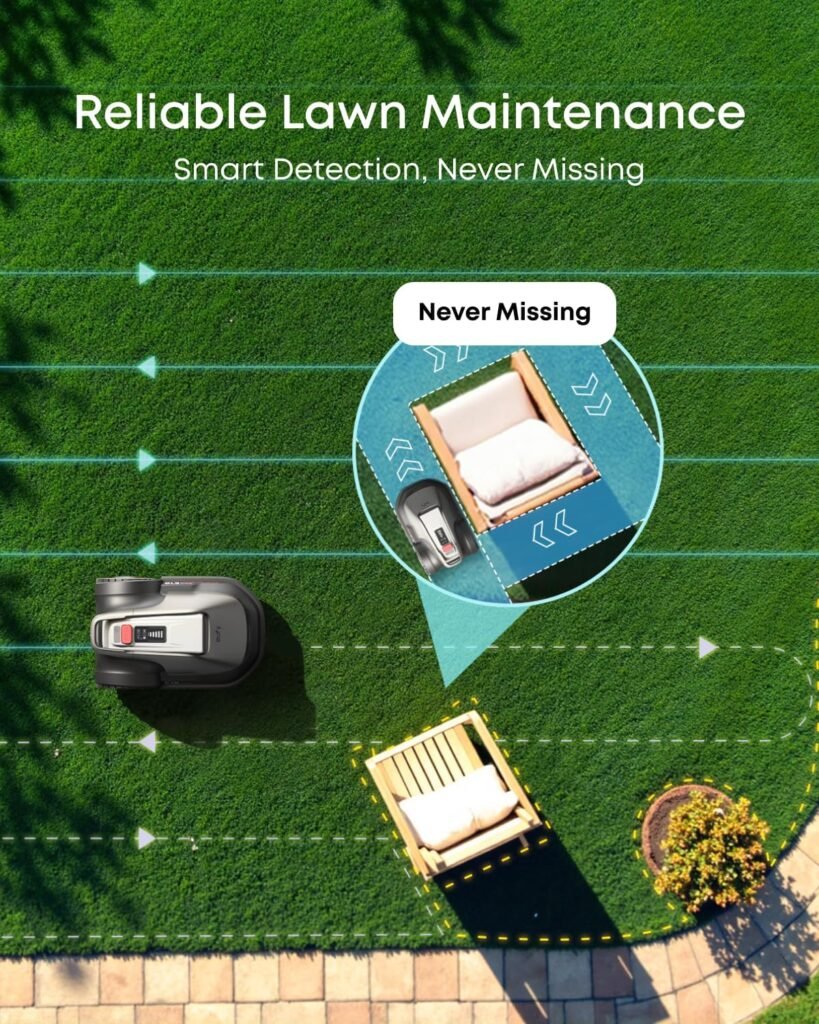
Parallel Cutting and Coverage
One of the notable promises is “beautiful and uniform parallel cutting.”
In practice, that means:
- Instead of random patterns, the mower follows organized, parallel paths.
- The lawn ends up with a more professional-looking finish, similar to what we see with traditional mowing in straight lines.
Paired with the smart coverage detection system, the E18 attempts to:
- Identify areas it hasn’t reached yet.
- Avoid leaving uncut patches.
- Optimize the route to cover the entire lawn efficiently.
If we are used to older robot mowers that wander in seemingly random directions, this more systematic pattern is a noticeable improvement in both appearance and efficiency.
Obstacle Detection and Safety
Having an autonomous machine moving around the yard means safety and collision control matter a lot.
AI-Powered 3D Perception
The E18 uses a 3D perception system for obstacle detection. That means:
- It doesn’t just rely on basic bump sensors.
- It uses visual information to identify objects before it reaches them.
This system helps it:
- Detect toys, tools, garden decorations, and similar objects.
- Recognize and avoid collisions.
- Maneuver around obstacles instead of constantly bumping and turning.
For complex gardens with furniture, flower pots, or kids’ play equipment, this matters a lot. It can reduce:
- Wear and tear on both the mower and our belongings.
- The likelihood of accidents or stuck situations.
Safety Around People and Pets
While we still need to use common sense (supervise children, avoid intentional interference, etc.), the obstacle avoidance and perception system contribute to safer operation.
We should expect:
- The mower to slow or redirect if something appears in its path.
- Less chance of hard collisions with legs, paws, or toys left in the grass.
We still should not rely on any robotic mower to babysit children or pets, but the extra intelligence does help reduce risk.
App Control and Connectivity
Being able to manage our lawn from the couch is a big part of the appeal. The E18’s app functionality is central to that experience.
What We Can Do in the App
Using the smartphone app, we can:
- View the mapped layout of our yard.
- Set mowing schedules (days, times, duration).
- Create and manage different zones.
- Adjust mowing parameters, like cutting height.
- Monitor the mower’s location and status in real time.
- Receive alerts or notifications.
The app turns our phone into a remote control plus information center for the mower.
Wi-Fi and Optional 4G Data
For connectivity, the mower relies on:
- Our home Wi-Fi when available.
- An optional 4G data subscription via the app for yards where Wi-Fi coverage is spotty or non-existent.
If our yard extends beyond reliable Wi-Fi coverage:
- Relying solely on Wi-Fi could result in lost connections.
- eufy suggests subscribing to 4G data through the app to maintain stable communication.
This matters for:
- Tracking the mower’s location when it is far from the house.
- Receiving consistent updates and alerts.
- Issuing commands without interruption.
We should consider our Wi-Fi coverage outdoors before deciding on the data option.
Multi-Zone Management
Many of us have yards that are split into distinct areas. The E18 is built to handle that with multi-zone management.
Managing Separate Lawn Areas
With multi-zone management, we can:
- Define different sections of the yard in the app.
- Assign unique settings or schedules to each zone.
- Have the mower work one zone at a time or alternate between them.
For example:
- Zone 1: Front yard, shorter cut, more frequent schedule.
- Zone 2: Back yard, slightly higher cut, less frequent.
- Zone 3: Side lawn, custom schedule or occasional maintenance.
This flexibility is useful if different areas have different sun exposure, traffic levels, or aesthetic priorities.
Physical Access Between Zones
While the app can define zones, the mower still needs physical access:
- Open gates or passages between areas help the mower move on its own.
- If areas are fully fenced or separated, we may need to manually move the mower between zones.
The multi-zone feature makes management easier but does not bypass physical barriers, so we should plan accordingly.
GPS Tracking and Anti-Theft Peace of Mind
Leaving an expensive robot outside might make us nervous, especially if the yard is visible from the street.
Built-In GPS Tracking
The E18 includes GPS tracking, which helps us:
- Locate the mower’s position in real time via the app.
- Follow its movement pattern.
- Track it in case of suspicious movement or theft.
This acts as both:
- A deterrent, since the mower is trackable.
- A recovery aid, helping us find it if someone tries to walk off with it.
We gain extra reassurance that the device isn’t simply gone if it leaves its normal operating area.
Rain, Low Light, and Automatic Recall
Weather and lighting affect how well any vision-based mower can operate, and the E18 has built-in behaviors to handle that.
Automatic Return in Bad Conditions
The E18 is designed to automatically return to its base station when:
- It detects rain.
- Light levels are too low to operate safely and accurately.
This helps in several ways:
- Protects the mower from unnecessary exposure to harsh conditions.
- Prevents it from making navigation errors in poor visibility.
- Keeps our lawn from being damaged by mowing wet or muddy grass.
We do not need to run outside to rescue it when a storm suddenly rolls in; it is built to look after itself.
Scheduling Around Local Weather
Even with auto recall, we can fine-tune our schedules to:
- Avoid early morning dew-heavy periods if we prefer.
- Skip extremely hot midday hours.
- Target specific time windows when children or pets are less likely to be outside.
The mower’s intelligence reduces manual intervention, but schedules are still ours to control.
Cutting Performance and Height Adjustment
Performance on the grass itself is ultimately what matters most. The E18 aims for both appearance and consistency.
Uniform Parallel Cutting
The mower’s navigation and mapping tie directly into its cutting pattern:
- It follows parallel paths to deliver a clean, neat finish.
- The end result is a lawn that looks professionally maintained.
By running regularly, the mower:
- Trims small amounts often, instead of hacking off large chunks at long intervals.
- Encourages a healthier lawn due to more frequent, gentler cutting.
- Reduces visible clippings, since smaller pieces decompose more quickly.
Adjustable Cutting Height: 1″–3″
The cutting height range is:
- Minimum: 1 inch
- Maximum: 3 inches
We can adjust the height according to:
- Grass type and health.
- Local climate (for hotter regions, slightly higher grass can protect soil).
- Personal aesthetic preference.
The limitation here is that 3 inches may be shorter than what some lawn-care pros recommend for very hot, dry regions or certain grass types. If we prefer a longer cut for drought tolerance, this is worth considering.
Setup and Daily Use Experience
Using a wire-free robot mower still requires some initial setup, but much less than traditional wired models.
Initial Setup Steps
We can expect to:
- Place and connect the charging base
- Choose a flat, accessible spot near power and within Wi-Fi range (if possible).
- Charge the mower fully
- Let it reach full charge before the first mapping run.
- Install the app and connect the mower
- Pair it to Wi-Fi and, if needed, set up the 4G data subscription.
- Start the first mapping run
- Let it move around the yard to build its virtual map.
- Review and adjust zones in the app
- Fine-tune boundaries and settings if needed.
Compared to running boundary wires around the entire perimeter and around every obstacle, this is significantly simpler and faster.
Daily and Weekly Operation
Once everything is set up:
- The mower runs according to our schedule.
- It returns to its dock to recharge when needed.
- We receive alerts via the app if something interrupts its work.
Our typical involvement becomes:
- Occasionally checking the app for status.
- Making tweaks to schedules or zones.
- Clearing unexpected obstacles from the yard when needed.
The whole point is to give us consistent lawn care with minimal ongoing effort.
Connectivity, Firmware, and Long-Term Reliability
Since this is a smart device, software and connectivity influence long-term satisfaction.
Importance of Updates
Because the E18 depends heavily on:
- Vision algorithms
- Mapping logic
- Obstacle avoidance
We should expect:
- Regular firmware updates that refine navigation and improve reliability.
- Occasional app updates with new features or performance improvements.
Keeping both the app and the mower firmware updated ensures we benefit from the latest optimizations and fixes.
Reliability Considerations
As with any vision-based system, real-world performance can depend on:
- Lighting conditions (too dark may reduce accuracy).
- Very reflective or unusual surfaces near the lawn.
- Extremely cluttered yards.
Still, the combination of smart mapping, 3D perception, and GPS tracking aims to make the E18 a consistent and dependable part of our routine.
Pros and Cons of the eufy E18 Robot Lawn Mower
To help us evaluate, it is useful to summarize the strengths and limitations.
Advantages
-
No boundary wires needed
We avoid the hassle, time, and potential maintenance of buried or staked wires. -
Auto mapping with visual navigation
The mower builds its own map and follows efficient paths, resulting in a tidy, uniform finish. -
AI obstacle avoidance with 3D perception
Better at avoiding collisions and navigating complex gardens than basic bump-only systems. -
Multi-zone management
Lets us customize different parts of the yard and tailor schedules or settings per zone. -
GPS tracking
Adds anti-theft peace of mind and makes it easier to find the mower’s location. -
Smart coverage detection
Focuses on complete coverage, reducing the chance of random missed patches. -
Automatic recall in rain or low-light
Helps protect the mower and prevents poor-quality mowing in bad conditions. -
App control with optional 4G data
Good flexibility for different yard Wi-Fi setups.
Limitations
-
Maximum area of 0.3 acres (13,000 sq ft)
Not suitable for larger properties without adding more units. -
Not recommended for St. Augustine or dense Zoysia
Those grass types may not perform well with this mower. -
Requires relatively flat lawns
Slopes over 18° or significant height differences may cause problems. -
Cut height limited to 3 inches
Some homeowners prefer longer cuts for specific grass types or climates. -
Dependent on camera vision
Very dark conditions, heavy shade, or certain environmental quirks may challenge navigation.
Understanding these trade-offs helps us decide whether the E18 matches our specific yard and expectations.
Who Is the eufy E18 Ideal For?
This mower is not for every lawn situation, but for the right user, it can be a major upgrade in convenience.
Best Fit Scenarios
The eufy E18 is likely a strong match for us if:
- Our yard is under 0.3 acres and mostly flat.
- Our grass is not St. Augustine or dense Zoysia.
- We value wire-free installation and want to avoid boundary wires.
- We like smart-home style control via an app.
- We want clean, parallel cuts and a professional-looking result with minimal effort.
- We appreciate anti-theft GPS tracking for peace of mind.
If this sounds like our situation, the E18’s strengths line up well with our needs.
Less Ideal Use Cases
We might want to look at alternatives if:
- Our lawn is large, hilly, or has steep slopes over 18°.
- We grow St. Augustine or dense Zoysia and expect heavy-duty mowing.
- We insist on mowing higher than 3 inches for specific lawn-care reasons.
- We prefer a very simple, non-connected mower with no reliance on apps.
In those cases, a different model or even a more traditional mower might serve us better.
Practical Tips for Getting the Most Out of the E18
To make sure we get maximum value and smooth operation, a few practical strategies can help.
Prepare the Lawn Before First Use
Before we start:
- Mow the grass manually if it is taller than 3.5 inches.
- Clear major obstacles: branches, loose stones, and clutter that could block or confuse the mower.
- Check terrain: fill large holes or fix sharply uneven patches that might trap the mower.
This initial preparation helps the auto mapping and navigation perform better and reduces early hiccups.
Fine-Tune Zones and Schedules
Once the first map is created:
- Adjust zone boundaries in the app to match our real layout.
- Assign different schedules to each zone based on growth rates and personal preference.
- Start with conservative schedules and then tweak frequency and duration after seeing initial results.
We gain more control and better results by tailoring the system to our actual yard conditions.
Maintain the Mower Periodically
Even fully autonomous devices benefit from a little care:
- Clean the underside occasionally to prevent grass buildup.
- Check blades and replace or sharpen when needed.
- Inspect the camera area for dirt or obstructions that might affect vision.
- Ensure the charging base is stable and not blocked.
These small routine checks help maintain cutting performance and navigation accuracy.
How the eufy E18 Compares Conceptually to Traditional Robot Mowers
While we are focusing on this specific product, it helps to place it conceptually in the broader world of robotic mowers.
Traditional Wire-Based Systems
Traditional robot mowers typically require:
- Boundary wires around the entire perimeter.
- Separate guide wires or markers.
Compared to them, the E18:
- Removes the wire installation step, which can be time-consuming and hard to adjust later.
- Uses computer vision for mapping, which is more flexible when the yard layout changes.
Wire-based systems are well-tested and can be very robust, but they are more work to set up and modify.
RTK-Based Mowers
Some newer premium mowers use RTK (real-time kinematic) GPS:
- They need an RTK base station in the yard.
- They achieve very high positioning accuracy.
In contrast, the E18:
- Does not require RTK hardware or complex antenna setups.
- Relies on cameras and algorithms instead.
This simplifies installation and equipment, especially for users who are not comfortable dealing with RTK technology.
Our Overall Impression of the eufy E18 Robot Lawn Mower
Putting all of this together, we see the E18 as a modern, vision-driven solution aimed at simplifying lawn care for smaller, relatively flat yards.
We appreciate that:
- Setup is much easier than wired systems.
- Auto mapping and app control give us both convenience and good visibility into what the mower is doing.
- 3D perception and AI obstacle avoidance reduce collisions and make it more suitable for complex garden layouts.
- GPS tracking adds a much-needed security layer.
We also recognize that:
- The lawn size, grass type, and terrain limitations are real and important.
- The 3-inch maximum cut height and incompatibility with St. Augustine and dense Zoysia exclude some homeowners.
- Vision-based navigation, while flexible, depends on favorable conditions and proper maintenance of the mower’s sensors.
For those of us whose yards fit the recommended profile—medium size, mostly flat, non-St. Augustine grass—and who want a wire-free, smart, and user-friendly robot mower, the eufy E18 Robot Lawn Mower, Max 0.3 Acres, Wireless Robot Mower with Auto Mapping, Vision Navigation, Multi-Zone Management, AI Obstacle Avoidance, APP Control, 18° Slope, Cut Height 1–3″ stands out as a compelling option.
If we are tired of spending our weekends pushing a mower and our lawn meets the E18’s operating requirements, this robot can realistically turn lawn mowing from a recurring chore into something that quietly happens in the background—while we use our yard for what we actually want: relaxing, playing, and enjoying the outdoors.

Disclosure: As an Amazon Associate, I earn from qualifying purchases.