Ad Blocker Detected
Our website is made possible by displaying online advertisements to our visitors. Please consider supporting us by disabling your ad blocker.
Have we ever watched our robot mower sit out in a storm and wondered how long it can really last like that?
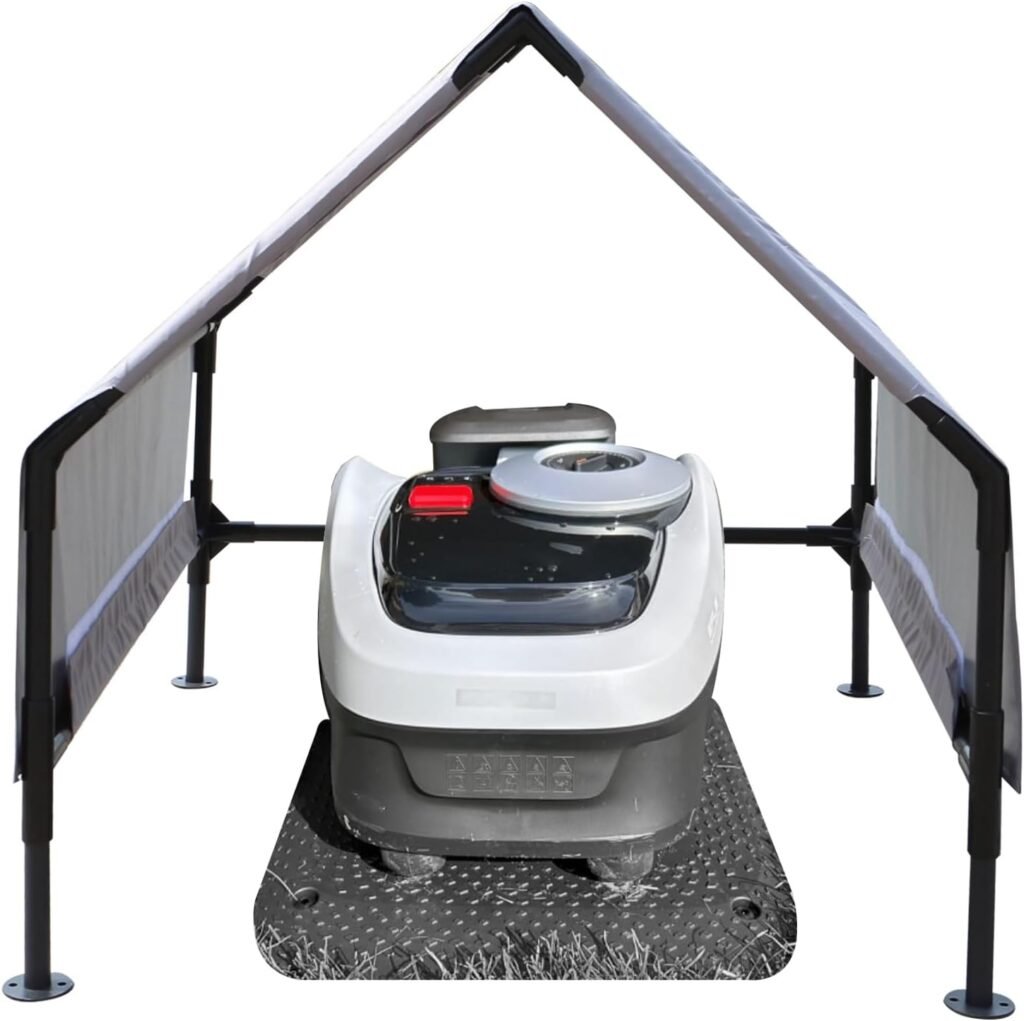

What Is the CNAINFC Robot Mower Garage?
This garage is essentially a weatherproof “home base” for our robot mower and its charging station. It is a wire‑free, stand‑alone cover made from durable, waterproof, and UV‑resistant polyester Oxford fabric, sized at 32″ x 28″ x 24″.
We use it to shield our mower from rain, snow, hail, falling branches, bird droppings, and harsh sunlight. In practice, it becomes a small, protective shelter that helps our mower last longer and keeps it looking and working like new.
Key Features at a Glance
Sometimes it helps to see everything in one quick overview. Below is a breakdown of the main features and what they mean for us.
| Feature | Description | Why It Matters to Us |
|---|---|---|
| Product Name | CNAINFC Robot Mower Garage, Wire Free Robot Lawn Mower Cover | A universal shelter for most robot mowers and their charging stations |
| Dimensions | 32″ x 28″ x 24″ | Large enough to cover about 92% of consumer robot mowers |
| Material | Polyester Oxford, waterproof and UV‑resistant | Protects from rain, snow, and sun damage |
| Weather Protection | Shields from rain, hail, snow, branches, bird droppings, UV radiation | Extends the life of our mower and its electronics |
| Installation Surface | Works on lawn and hard ground | Flexible placement options in our garden |
| Anchoring System | 12 x 7″ stainless steel lawn anchors + 8 extra bolts for hard surfaces | Keeps the garage stable in wind and bad weather |
| Compatibility | Ecovacs GOAT, LUBA 2, Anthbot, Navimow, YUKA2000, Husqvarna, Worx Landroid | Fits most popular brands and models |
| Design | Simple structure, white roof, side entrance | Integrates neatly into our garden, looks like a little mower “tent” |
| Maintenance | Easy to disassemble, recommended winter storage in a frost‑free place | Simple long‑term care and seasonal use |
Design and Build Quality
The first thing we notice about this garage is how minimalist the design is. It is not a bulky plastic shed or a complicated enclosure. Instead, it is a simple, arched cover with a white roof that resembles a small camping tent for our mower.
The structure balances visual simplicity with practical durability. It is neutral and unobtrusive in the yard while still feeling solid enough to trust in different weather conditions.
Materials: Waterproof and UV‑Resistant
The garage uses polyester Oxford fabric that is both waterproof and ultraviolet‑proof. This combination is crucial because our mower’s most serious enemies are moisture and UV exposure.
We often underestimate how quickly UV radiation can damage plastic and rubber components. Over time, sunlight can fade paint, crack plastic housings, and harden rubber seals and tires. By blocking UV rays, this cover helps protect the mower’s body and sensitive parts, including sensors and displays.
On the moisture side, the waterproof fabric keeps rain and snow from sitting directly on the mower or its charging station. That reduces the risk of corrosion, moisture seeping into connectors, and micro‑damage to circuit boards caused by repeated wet‑dry cycles.
Construction and Structural Stability
The garage is assembled using hardware that locks each piece into place with screws. That makes the frame rigid enough to stand up to wind, mild impacts, and the daily use of the mower going in and out.
We also appreciate that the kit includes twelve 7‑inch stainless steel anchors. These stakes hold the structure down firmly in grass or soil. Stainless steel is an important detail: it resists rust, which is especially important for something that lives outdoors in wet conditions.
For hard surfaces like concrete, stone, or pavers, we have eight extra bolts. With those, we can fix the base to a solid substrate so the garage does not shift or tip when gusts or storms hit.
Size and Compatibility
One of the most reassuring aspects of this garage is the generous size. At 32″ long, 28″ wide, and 24″ high, it is designed to cover not just the mower itself but also its charging station.
That means we do not have to wedge the mower in or worry about the roof brushing against control panels or displays. There is enough volume for the mower to park naturally as it would without a shelter.
Brands and Models It Supports
The manufacturer states that this garage covers about 92% of robot lawn mowers on the market along with their stations. Specifically, it is suitable for:
- Ecovacs GOAT
- LUBA 2
- Anthbot
- Navimow
- YUKA2000
- Husqvarna robotic mowers
- Worx Landroid series
If we own one of these brands, we can feel fairly confident it will fit. Even if we do not, the dimensions give us enough information to measure our own mower plus station and compare.
Large Opening and Side Access
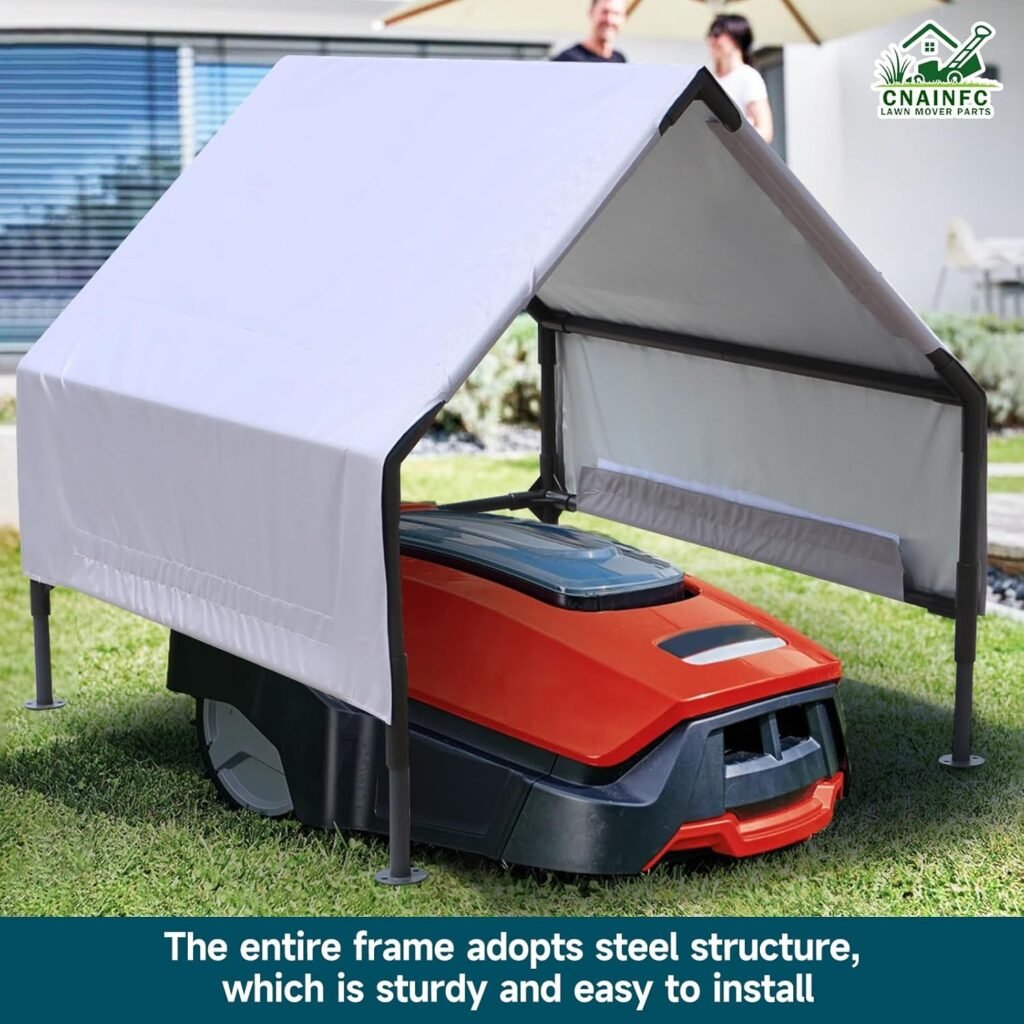
The wide front opening and low, open sides make entry and exit very straightforward. The mower does not need to navigate through a narrow tunnel or steep threshold.
Instead, it moves in from the side naturally to reach the charger. That also helps in rainy conditions: the mower can tuck itself under the cover as part of its usual return‑to‑base routine, without us needing to intervene or reposition it.
This larger opening is also handy for us when we want to clean or adjust the mower, check settings, or inspect the charging station. We can reach in easily without removing the whole structure.

Weather Protection and Environmental Shielding
The core purpose of this garage is to protect our robot mower from environmental factors. Leaving a sensitive, battery‑powered machine outdoors 24/7, season after season, can shorten its life significantly. This shelter helps reduce that risk.
Protection from Rain, Snow, and Hail
Continuous exposure to water is one of the biggest threats to a robot mower and its charging station. Even if our mower is designed with weather resistance in mind, the reality is that gaskets age, housings can warp slightly, and tiny leaks may develop over time.
By covering our mower and its dock, this garage:
- Reduces direct water contact during heavy rain
- Prevents snow accumulation directly on top of electronics
- Adds an extra layer of defense against hail impacts
In practical terms, that means fewer opportunities for water to seep into seams, charging contacts, or small cracks in the housing. It also means we are less likely to find our mower half‑buried in snow or sitting under a sheet of ice after a winter storm.
Blocking UV and Heat from Strong Sunlight
Sunlight and heat are slow, silent destroyers of outdoor equipment. Over time, UV light breaks down plastics, fades paint, and embrittles housings. Battery performance can also degrade faster when a device is frequently overheated.
The UV‑proof roof of this garage acts like a shade canopy. Our mower and its charger sit in the shade, which helps:
- Keep surface temperatures lower during hot days
- Reduce UV exposure to plastic housings and decals
- Protect rubber seals, bumpers, and tires from drying and cracking
We are not just shielding the exterior; we are also indirectly protecting the internal electronics and batteries from extreme temperature swings.
Guarding Against Branches, Bird Droppings, and Debris
Branches blowing in the wind, nuts falling from trees, and even bird droppings can all create small but cumulative damage or dirt buildup on our mower.
This garage reduces those risks in a few ways:
- The roof intercepts falling twigs and small branches
- The mower is less likely to be hit by bird droppings when parked
- Dust and debris settle on the roof instead of directly on the mower
It might sound minor, but all those little contaminants can affect sensors, interfere with charging contacts, and make cleaning more time‑consuming. A simple roof keeps a lot of that mess off the machine.
Installation Process
Setting up the CNAINFC garage is designed to be straightforward, even if we are not particularly handy. The process is more like assembling a simple frame and attaching a cover than building a full shed.
We follow the included installation instructions, and each component connects using screw joints. This ensures that once it is assembled, the structure will not wobble loosely or collapse easily.
Step‑by‑Step Setup Experience
In practical terms, installation typically looks like this:
-
Unpack all parts
We lay out the frame pieces, screws, anchors, bolts, and the fabric cover. Taking a moment to verify all components are there makes the rest easier. -
Assemble the frame
We connect the structural pieces with screws as described in the instructions. This step is where the “interesting installation process” comment comes in—there is a bit of satisfaction in watching it take shape. -
Attach the cover
Once the skeleton is solid, we stretch and fix the polyester Oxford cover over the frame. We make sure it is snug and correctly aligned, with openings where we need them. -
Position the garage
We place the assembled garage over or around our charging station in the yard, adjusting so the mower can approach naturally along its usual path. -
Anchor it in place
Here, we choose between lawn anchors or bolts depending on our surface. This last step gives us stability against wind and bumps.
It is an uncomplicated process overall, and we can likely complete it with basic tools and a bit of patience.
Mounting on Lawn vs. Hard Ground
Being able to install the garage either on the lawn or on a hard surface makes it adaptable to almost any garden design.
-
On lawn or soil:
We use the twelve 7‑inch stainless steel anchors. We push or hammer them through the base points into the ground. The longer length and rust‑resistant material help keep the garage secure for a long time. -
On hard ground (concrete, stone, pavers):
We switch to the eight included bolts. After aligning the garage where we want it, we drill holes if needed and anchor it firmly to the surface.
This flexibility is particularly helpful if we have a dedicated equipment area or patio where we prefer to keep the charging base.
Everyday Use and User Experience
Once the garage is in place, the daily interaction becomes almost completely hands‑off. Our robot mower continues to operate as usual, but now its “home” is sheltered.
We notice that the mower returns to a shaded, dry space after each run. That not only protects it but can also help keep charging connections cleaner and more reliable.
How the Mower Uses the Garage
The design allows the mower to slip underneath the roof from the side and settle into charging position. Since the overall front and sides are open enough, the mower does not struggle to align itself.
This arrangement respects the actual path the mower’s navigation system uses. We are not asking the robot to steer around obstacles or navigate a narrow tunnel; we are simply putting a canopy over its usual parking spot.
During rain or strong sun, the mower can end a mowing cycle and immediately take shelter, reducing the time it spends exposed to harsh conditions unnecessarily.
Aesthetics and Integration into the Garden
Many of us care about how our yard looks, not just how it functions. The CNAINFC garage has a modest, clean appearance that blends into most garden styles.
- The white roof offers a neutral, light look that can feel like a small tent.
- The simple shape avoids drawing too much attention.
- The low profile keeps the focus on our lawn and landscaping rather than on equipment.
Because the design is understated, we can place it in a visible part of the yard without feeling like we have added an industrial structure. It becomes more of a subtle accessory than a focal point.
Protection Benefits for the Mower and Charging Station
One of the strongest reasons to choose a garage like this is the long‑term protection it offers. Robot mowers are not cheap; investing a little more to shield them from the elements can save us from earlier repairs or replacements.
Extending Service Life
By reducing exposure to water, sun, and debris, we lower the chance of:
- Cracked or faded housings
- Brittle rubber parts
- Corroded connectors
- Faulty sensors from dirt buildup
- Warped plastic parts from heat
Over several seasons, those avoided issues add up. Our mower and charger can continue working reliably, rather than slowly degrading and needing parts replaced ahead of schedule.
This is especially beneficial if we live in areas with:
- Strong summer sun
- Heavy rainfall
- Snowy winters
- Frequent hail or falling debris
The more extreme the environment, the more valuable the shelter becomes.
Improved Charging Stability and Safety
Charging stations are somewhat vulnerable components. Exposed contacts and electronics are not thrilled to be in constant rain or under snow.
By placing the charging station inside this garage, we help:
- Keep charging contacts drier and cleaner
- Reduce risk of short circuits from water pooling
- Maintain more stable temperatures during charging
In everyday terms, that can mean fewer charging errors, less need to wipe away moisture or debris, and a more consistent performance from the charging system overall.
Seasonal Use and Maintenance
Although this garage is built for outdoor conditions, a bit of smart seasonal use and care can make it last even longer.
The manufacturer recommends a specific approach to wintertime, especially when temperatures drop below freezing.
Winter Storage Recommendations
When the temperature falls below freezing, we are advised to store the robot mower in a frost‑free indoor area such as:
- A garage
- A workshop
- A tool shed
- A basement or utility room (if safe and appropriate)
At the same time, we can:
- Disassemble the mower garage if needed
- Store it indoors to prevent unnecessary wear from harsh winter storms
The disassembly process is relatively easy because the joints are screw‑based. This makes it practical to break down and put away during the off‑season. When spring returns, we reassemble it and set it up again.
Routine Cleaning and Care
To keep the garage in good condition, we can occasionally:
- Brush off leaves, dust, or bird droppings from the roof
- Check that all screws and anchors are still tight
- Inspect the fabric for any tears or signs of wear
- Wipe down the cover with mild soap and water if it gets dirty
These small tasks help ensure the fabric remains waterproof and that the structure stays stable and safe in the garden.
Advantages and Possible Limitations
Every product has strengths and some trade‑offs. Understanding both helps us decide whether this garage fits our needs and expectations.
Benefits We Gain
Some of the clearest advantages of the CNAINFC robot mower garage include:
-
Broad compatibility
It is designed for a wide range of robot lawn mowers and charging stations, including several major brands. -
Strong weather protection
It shields against rain, snow, hail, sun, branches, and bird droppings, all of which can damage electronics over time. -
Flexible installation
We can mount it on either grass or hard ground, which works well with many different yard layouts. -
Stability and durability
Stainless steel anchors and bolts help keep it firmly in place, even in windy conditions. -
Simple, neutral aesthetics
The low‑key design and white roof integrate nicely into garden spaces without dominating the view. -
Ease of maintenance
Lightweight fabric and screw‑based construction make it straightforward to clean, dismantle, and store.
Things to Consider Before Buying
We also want to be aware of a few considerations:
-
It is not a fully enclosed shed
This garage provides a roof and partial side coverage, but not a locked, fully sealed structure. If we need theft protection or a complete enclosure, we might require an additional solution. -
Indoor winter storage is still recommended
For areas with freezing winters, we are still advised to bring the mower indoors. The garage does not remove the need for smart seasonal care. -
Dependence on correct placement
To work smoothly, we must position it so the mower’s navigation and docking behavior remain unaffected. That usually is simple, but it does require a bit of attention. -
Fabric can still age over time
Even durable, UV‑resistant material eventually shows wear if left out year‑round under harsh conditions. Occasional inspection is wise.
None of these are deal‑breakers, but they help set realistic expectations. It is a protective canopy, not a full replacement for a garage building.
Who Is This Garage Best For?
We can think about the ideal user by looking at how and where we use our robot mower.
This product is especially suitable for us if:
- We leave our robot mower and charging station outdoors year‑round.
- We live in a region with strong sun, frequent rain, or occasional hail.
- Our yard has trees that drop branches, nuts, or a lot of debris.
- We want to protect our investment without building a permanent structure.
- We care about keeping the garden looking tidy and coordinated.
On the other hand, if we already have a covered porch, carport, or built‑in shelter for the mower, this standalone garage might be less necessary. It mainly shines in open yards where equipment is otherwise fully exposed.
Practical Tips for Getting the Most Out of It
Once we decide to use this mower garage, a few simple practices can help us get the maximum benefit from it over many seasons.
Positioning for Best Performance
We can:
- Place the garage so the mower’s path to the charger remains straight and unobstructed.
- Avoid setting it at the very bottom of a slope where water may pool.
- Ensure enough clearance around the sides so blades of grass or borders do not interfere with docking.
If our mower uses a specific boundary wire or virtual maps, we might need to run a test cycle after installation to confirm everything still aligns well.
Coordinating with Our Maintenance Routine
We can build the garage into our ongoing mowing and yard routines:
- When we clean the mower, we also give the cover a quick wipe.
- When we inspect the charging contacts, we check the anchor stability.
- When we prepare the mower for winter storage, we decide whether to disassemble and store the garage too.
This way, the garage becomes part of a simple, integrated system of care rather than a separate chore.
Comparison to Leaving the Mower Uncovered
To really understand the value, it helps to compare two scenarios over a few years: using the mower with no cover at all, versus using this type of garage.
Without a Garage
Over time, without any shelter, we often see:
- Faded, brittle plastic housings
- Stiff or cracked rubber parts
- More frequent cleaning needed on sensors and contacts
- Higher risk of moisture‑related issues after storms
- Potential for small impact damage from falling debris or hail
We might not notice the damage overnight, but after several seasons it often becomes clear that the mower has aged quickly.
With the CNAINFC Garage
Using this cover regularly, we can expect:
- Less weathering on visible plastic and rubber components
- Reduced exposure to direct rain and snow
- Fewer contaminants reaching delicate sensors and charging contacts
- More stable temperatures during charging
- Overall longer usable life for both mower and charger
In financial terms, if this shelter helps us get one or two extra seasons out of our mower before needing major work or replacement, it can easily pay for itself.
Summary of What We Get
When we put everything together, the CNAINFC Robot Mower Garage offers us:
- A wire‑free, standalone canopy that fits the majority of consumer robot mowers and their docks
- Durable, waterproof, UV‑resistant polyester Oxford fabric to shield against rain, snow, sun, and debris
- Flexible installation on either lawn or hard surfaces, supported by stainless steel anchors and bolts
- A simple, neutral design that blends into our garden and looks like a neat little tent for our mower
- A practical way to extend the service life of our mower and protect our investment in automation
If we rely on a robot mower to keep our lawn in good shape, it makes sense to give that machine its own safe, weather‑protected spot. This garage does exactly that with a straightforward design, sturdy anchoring, and materials meant for the outdoors.
We end up with less worry about storms and sun, a cleaner charging area, and a mower that is better protected day after day.
Disclosure: As an Amazon Associate, I earn from qualifying purchases.