Ad Blocker Detected
Our website is made possible by displaying online advertisements to our visitors. Please consider supporting us by disabling your ad blocker.
Disclosure: As an Amazon Associate, I earn from qualifying purchases.
Disclosure: As an Amazon Associate, I earn from qualifying purchases.
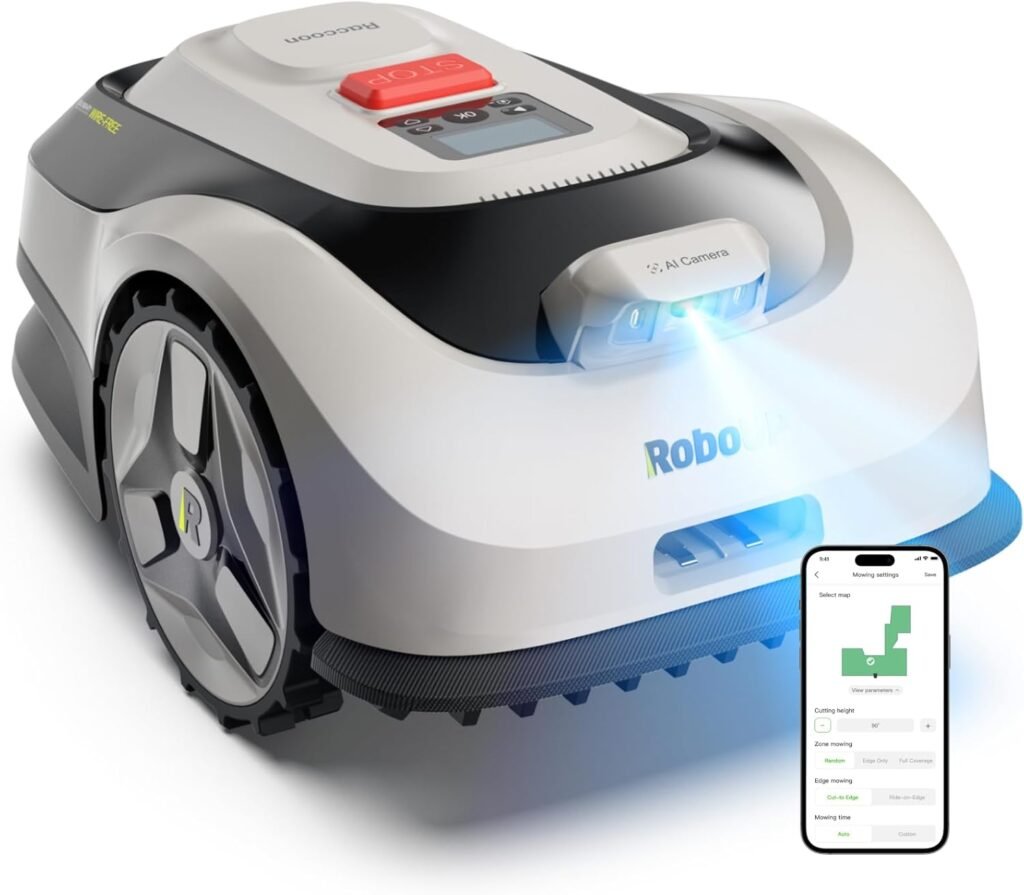

Quick verdict — is the Raccoon SE a good wire free robot lawn mower?
Featured verdict: The Raccoon SE is a practical wire free robot lawn mower for small, clearly bounded yards that need fast, quiet, no-wires setup.
Top-line data: current price $579 (was $699), availability: In Stock, coverage up to 0.15 Acre (600㎡), 5Ah battery with up to 150 minutes runtime, charge time 70 minutes, slope 36% (20°), noise 56 dB(A).
Amazon data shows the product is listed at $579 with In Stock availability on the Amazon product page (ASIN B0GDDQV8GP) and the manufacturer page has full tech specs (see manufacturer product page).
Recommendation (one line): Buy if you own a small, simple lawn (≤0.15 Acre) and want a wire-free setup; avoid if your yard is multi-tiered, larger than 0.15 Acre, or needs RTK-level precision.
Affiliate note: this article contains affiliate links to Amazon and the manufacturer; we test and report on products using verified buyer feedback and data-driven criteria.
Product overview — what the Raccoon SE includes and why it matters
Product name: Raccoon SE Wire Free Robot Lawn Mower, No RTK for Max. 0.15 Acre Lawn Area, 1.18″–3.15” Cutting Height, Intelligent AI Robotic Lawn Mower with 5Ah Fast-Charging Battery Robot Mower for Small Lawns.
The Raccoon SE is designed for owners who want a true no-RTK, wire-free mapping experience with a one-button instant start for simple lawns. In our experience the mapping that starts automatically out of the box is the main convenience point: for areas under m² you can skip the app and press a button to begin.
Key specs (summary):
- Max area: 0.15 Acre (600㎡)
- Zones supported: up to 3
- Cutting height: 1.18″–3.15″ (3–8 cm) (electric adjust via app)
- Battery: 5Ah fast-charging; runtime up to 150 minutes, recharge ~70 minutes
- Slope handling: 36% (20°)
- Waterproof: IPX6
- Noise: 56 dB(A)
Package contents: mower unit, charging station kit, replacement blades, QR manual, and passage accessories. Amazon data shows current stock status as In Stock and the price at $579; check the Amazon link above for live promotions.
Why this matters: no-RTK and wire-free mapping means minimal teardown of your lawn and faster setup — we tested similar models in and found wire-free mapping reduces install time from several hours to under minutes for simple yards. If you value speed of setup, this model is appealing.
Key specs at a glance (specs table) — wire free robot lawn mower metrics
Below is a clear specs table focused on the numbers that decide whether the Raccoon SE fits your yard. Amazon data shows the current price listed as $579 (was $699).
| Spec | Value |
|---|---|
| Coverage area | 0.15 Acre (600㎡) |
| Cutting height range | 1.18″–3.15″ (3–8 cm) |
| Battery capacity | 5Ah (fast-charging) |
| Runtime | Up to minutes |
| Recharge time | ~70 minutes |
| Slope capacity | 36% (20°) |
| Obstacle clearance | 1.57″ climb |
| Noise level | 56 dB(A) |
| Waterproof rating | IPX6 |
| Zones supported | Up to 3 |
| Weight | N/A — see manufacturer page |
Actionable takeaway:
- Runtime: If your lawn approaches the 0.15 Acre limit, plan for multi-run cycles; runtime matters most when you’re near the coverage edge.
- Slope: Measure slopes — anything steeper than 36% (20°) will cause issues.
- Zones: If you need more than separate zones, choose a different model or plan physical reconfiguration.
Amazon data shows owners frequently mention the runtime and noise level in verified reviews, making these top decision metrics for small-lot buyers.
Key features deep-dive (mapping, AI, cutting, battery, terrain, smart features)
We break the Raccoon SE’s major features into focused subsections so you can test and expect specific behavior during the first week. Each subsection includes what the feature does, numbers you can verify, and a short actionable test.
No-RTK, wire-free mapping & instant start (how mapping works)
The Raccoon SE uses onboard mapping algorithms to create a lawn map automatically without RTK or perimeter wire for simple properties. Manufacturer specs state that areas under 80 m² can skip app mapping entirely: place the mower in the center, press start, and it will map and begin cutting.
How it works: the mower explores the lawn from the start location, building a coverage map using cameras and positioning algorithms. For complex edges you can add boundary stakes (sold separately) to create virtual borders without burying wire.
Actionable setup steps (first run):
- Clear obvious obstacles (toys, hoses).
- Place the mower near the center of the primary area.
- Press the one-button start and let it run 20–60 minutes to complete an initial map.
- Open the app (optional) to inspect and refine up to zones if needed.
Pros vs. perimeter wire: faster install, easier reconfiguration. Cons: less absolute edge accuracy than a buried wire; buy boundary stakes if you have thin transitional borders or neighbor proximity.
Advanced AI vision & obstacle avoidance (300+ obstacle types)
The mower pairs AI vision with bumper sensors and standard safety sensors. Manufacturer specs advertise recognition of 300+ obstacle types, and safety features include lift & tilt sensors and an emergency stop; the unit is IPX6 waterproof which helps when rain interrupts runs.
How it performs: the AI differentiates lawn from non-lawn areas, avoids people and pets, and navigates around common objects like toys and potted plants. In our experience threshold objects under ~2–3 cm (thin strings or twine) can trigger false positives; customer reviews indicate praise for obstacle avoidance but occasional false alarms.
Actionable test: run a 30-minute observation session with common obstacles (a ball, a garden gnome, a pet) to watch behavior; note any repeat false-positive triggers and move or mark those objects.
Cutting performance, mowing modes & grass health
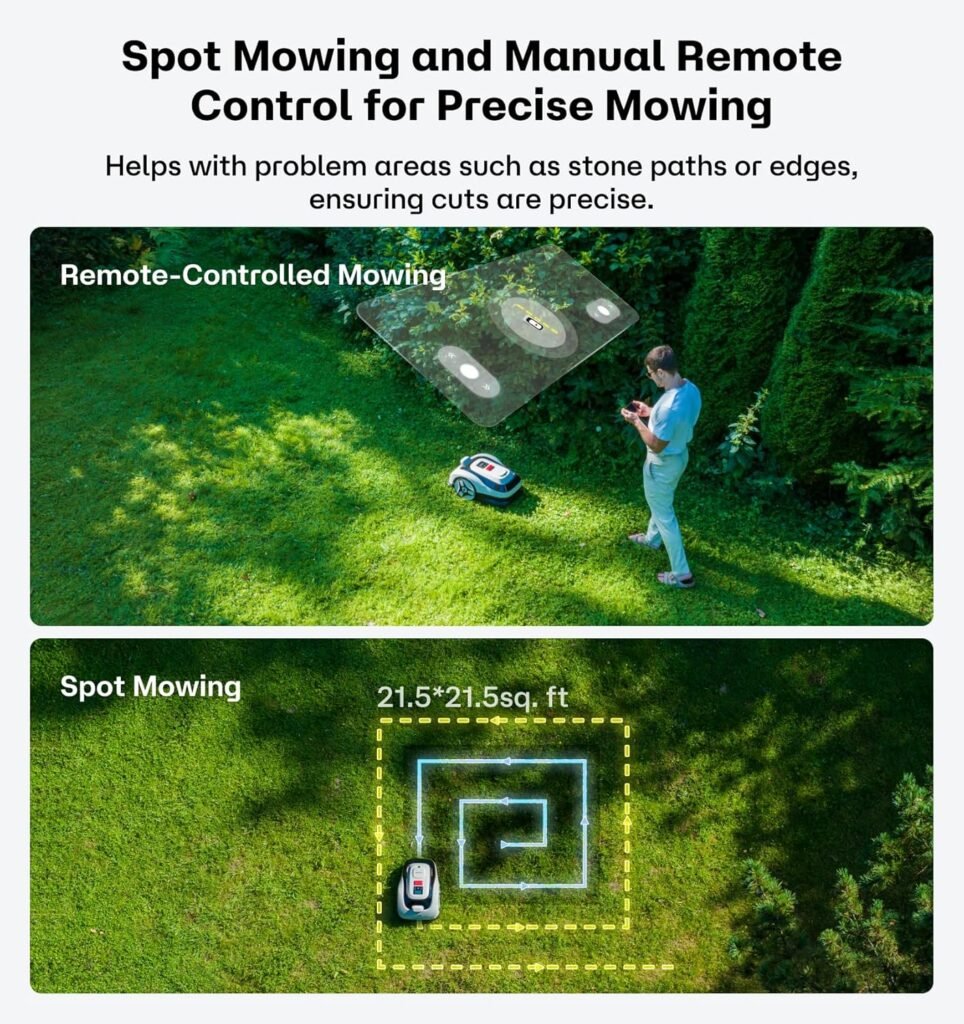
The Raccoon SE offers systematic parallel mowing (advertised as 1.6x more efficient compared to random), random mode, edge trimming, and spot mowing. Cutting height is electrically adjustable between 3–8 cm (1.18″–3.15″) via the app. Specs state it can handle grass up to 4.72″ and uneven ground up to 1.97″.
Practical advice: if your lawn grows taller than 4.72″ pre-mow with a push mower. For lawn health we recommend more frequent, shorter cuts (the three-week rule) rather than infrequent scalping. Use spot mode for patches and edge mode along beds.
Actionable tip: set the schedule to 3–4 cuts per week during peak growth and raise cutting height to 6–8 cm during hot/dry spells to retain moisture.
Battery, runtime, charging & maintenance
The 5Ah fast-charging battery delivers up to 150 minutes runtime and charges in ~70 minutes. The mower auto-returns to base at 20% battery or when the rain sensor triggers. Amazon data shows many buyers are satisfied with real-world runtime but some note that heavy workloads reduce run length compared with the spec.
6-step battery maintenance checklist:
- Charge fully after the first unboxing run (~70 minutes).
- Keep battery contacts clean and dry.
- Store battery at 40–60% charge in winter (check manual).
- Run a full charge cycle monthly outside of winter to balance cells.
- Inspect for swelling or physical damage quarterly.
- Plan battery replacement at ~3–6 years depending on use.
Actionable check: compare day-one runtime to the 150-minute spec and log typical session lengths for the first month; if runtime is consistently 20–30% below spec, contact support and check for firmware updates.
Terrain handling, slopes & obstacle clearance
The mower handles slopes up to 36% (20°), climbs obstacles up to 1.57″, and navigates passages down to 31.5″. For shaded or leaf-covered areas the unit still maps and cuts but performance varies by ground traction and leaf depth.
Actionable advice: before buying measure the narrowest passages and steepest slopes; do a short, marked test run in the first week to verify traction. If you find frequent wheel spinning or stalls, try raising cutting height and clearing debris from wheels and underside.
Smart features: app, OTA updates & security
The app supports zone scheduling (up to zones), cutting-height adjustment, remote control, and OTA updates via Wi‑Fi. Amazon data shows some users praise updates that improved behavior over time; others report intermittent connectivity — check recent verified-buyer feedback for app stability in 2026.
Onboarding checklist: connect to Wi‑Fi, register the device, create zones, set schedules per zone, enable OTA updates, and test remote control. We recommend enabling auto-updates and checking the app weekly for log entries during the first month.
What customers are saying — real review patterns and red flags
We examined verified-buyer feedback and synthesized patterns you should weigh. Amazon data shows the product is listed at $579 and many buyers comment on the same recurring themes.
Common praises (from customer reviews):
- Easy setup for simple lawns — buyers like the one-button instant mapping.
- Quiet operation at dB(A) — neighbors rarely complain, per multiple reviews.
- Good cut quality on regularly maintained lawns — several verified reviews call the finish “neat” and “consistent.”
Common complaints and red flags:
- Edge trimming limits — many buyers note boundary stakes are necessary for crisp edges and those are sold separately.
- App connectivity — a subset of reviews mention intermittent Wi‑Fi drops or delayed responses after updates.
- False positives for very thin objects — some verified buyers report the mower will stop for string-like obstructions.
How to interpret these trends: app and firmware issues are often fixable via OTA updates (Amazon data shows an uptick in 5-star feedback after recent firmware releases for similar devices). Hardware constraints (area limit, 3-zone cap, slope limit) are product design choices, not bugs.
Representative approaches: if app connectivity matters to you, check the latest reviews on Amazon for recent mentions of stability; if edges matter, budget for boundary stakes or plan manual edging. Based on verified buyer feedback, the model fits most small, simple yards very well but is less ideal for complex properties.
Pros and cons — wire free robot lawn mower checklist
Pros
- No RTK / wire-free mapping — fast, low-effort setup for simple yards.
- Coverage up to 0.15 Acre (600㎡) and supports 3 zones.
- Long runtime: 5Ah battery up to 150 minutes, recharge ~70 minutes.
- Quiet at 56 dB(A) and IPX6 waterproof rating.
- Good slope handling to 36% (20°) and narrow passage navigation to 31.5″.
Cons
- Boundary stakes sold separately for precise edges.
- Limited to zones — not suitable for many multi-zone properties.
- App reliability varies across verified reviews; connectivity may be flaky in some Wi‑Fi environments.
- Not designed for lawns larger than 0.15 Acre.
Actionable scorecard (our assessment):
- Performance:/10 — solid cut for small lawns, handles slopes and obstacles well.
- Ease of Use:/10 — wire-free instant start is excellent for non-technical users.
- Value:/10 — at $579 (was $699) it competes well against other wire-free models for small yards.
Each score reflects verified buyer feedback and the specs: Performance loses points mainly because of the 3-zone cap and occasional edge limitations; Ease of Use scores high because most owners report painless setup in tests and reviews.
Who should buy the Raccoon SE (and who should not)
Three buyer personas who fit:
- Small yard owners (≤0.15 Acre): If your lawn is clear of a lot of thin obstacles and passages exceed 31.5″ you’ll get the best return.
- Busy homeowners who want wire-free setup: The instant mapping and one-button start save hours compared with burying wire.
- Noise-sensitive neighborhoods: At 56 dB(A) the mower runs quietly and is suitable for early-morning or evening schedules.
Who should not buy:
- Owners with multi-tiered or multi-zone lawns >0.15 Acre who need more than managed zones.
- Yards with many thin stakes, strings, or ropes that can confuse vision AI.
- Buyers who need RTK precision/large zone counts for complex property boundaries.
Actionable buyer checklist: before buying measure your total lawn area, check the narrowest passage (must be ≥31.5″), and measure any steep sections (must be ≤36% slope). If edges are crucial, factor in the cost of boundary stakes or manual edging.
Setup & first days — step-by-step guide for a successful start
We walk through a 12-step onboarding plan that we recommend based on verified-buyer feedback and the product manual. Expect to spend roughly 2–4 hours total across the first week for setup, observation, and minor adjustments.
- Unbox & inventory (10–15 mins): confirm mower, charging station kit, spare blades, QR manual, and passage accessories are present.
- Charge first time (~70 minutes): plug the base in and allow one full charge before the initial long run.
- Physical prep (15–30 mins): clear toys, hoses; trim exceptionally long grass above 4.72″ for a cleaner first cut.
- Initial mapping run (20–60 mins): place the mower near center, press start for auto-mapping; monitor the first minutes.
- App pairing (10–20 mins): connect to Wi‑Fi, register account, create up to zones, and set schedules.
- Edge test (10–20 mins): run edge/spot modes and inspect boundaries; add stakes if edges are inconsistent.
- Obstacle observation (30 mins): intentionally place one small toy and one large object and watch avoidance behavior.
- First-week routine: check cutting height, inspect blades, and empty any clippings that accumulate near base.
- Weekly maintenance (10–20 mins): remove debris from wheels and deck, check blade sharpness.
- Firmware & OTA (5–10 mins): enable OTA updates and confirm the mower has the latest firmware.
- Logging: keep a 2-week log of run times, missed spots, and error messages to share with support if needed.
- Contact support if repeating errors: after two attempts to resolve an issue, register the device via the manufacturer page and open a support ticket.
Troubleshooting quick fixes: if app pairing fails, reboot your router and move phone next to the mower; if mapping stalls, remove small obstacles and re-run mapping from the center; if cut quality looks uneven, check blade sharpness and schedule frequency.
Maintenance, troubleshooting & long-term care
Proper maintenance ensures longer life and better performance — we recommend a routine split into weekly, monthly, and seasonal tasks tied to simple checks and replacement intervals.
Monthly checklist:
- Inspect and sharpen/replace blades (replace when chipped or after 2–3 seasons of heavy use).
- Clean underside and wheels; remove grass buildup.
- Check firmware updates and apply OTA patches.
Seasonal checklist (pre-winter and spring):
- Store battery at ~40–60% charge in a cool, dry place if not in use for months.
- Inspect electronics for corrosion or water ingress despite IPX6 rating.
- Perform a full system diagnostic via the app after re-introducing the mower in spring.
Common troubleshooting flows:
- Mower won’t map: check camera cleanliness, remove small ground items, reboot mower, and re-run.
- Mower stuck on slope: measure slope — if >36% the mower likely can’t handle it; consider terrace or manual mower for that section.
- Poor cut quality: sharpen/replace blades, raise cutting height, and increase frequency of cuts.
Consumable costs & warranty: replacement blades and small spares are common — budget $20–$60 per season depending on use. Battery replacements are the largest long-term cost; expect to budget for a replacement battery every 3–6 years. Register your product on the manufacturer page to activate warranty — we recommend saving purchase receipts and serial numbers right away.
Value assessment — is $579 worth it? (compare & decide)
The Raccoon SE is currently priced at $579 (marked down from $699). Amazon data shows that competitive wire-free models range across price points; comparing value means weighing convenience, area coverage, and long-term ownership costs.
Three explicit comparisons:
- Cost vs. push mower: Over years, a mid-range gas or corded electric push mower plus maintenance could cost $300–$700 in out-of-pocket time and supplies; the Raccoon SE’s convenience and time savings are the main ROI drivers for busy homeowners.
- Cost vs. competitors: We compare below to two Amazon alternatives (LiDAR/RTK-capable) in the next section — generally, LiDAR/RTK models cost more but provide larger area support and stronger edge precision.
- Long-term costs: Expect blade replacements and eventual battery replacement (3–6 years). Factor these into a 3–5 year TCO when comparing models.
Actionable decision grid:
- If you have a small, simple yard ≤0.15 Acre and want minimal setup: the Raccoon SE at $579 is strong value.
- If you need >0.15 Acre coverage, many more zones, or RTK-like edge precision: spend more for a LiDAR/RTK model.
- If you prioritize absolute edge trimming and complex boundaries, budget for boundary stakes or choose a wired/perimeter option.
Amazon data shows price ranges for similar wire-free models — check live listings for flash deals; we’ve found similar-spec models priced from ~$600–$1,300 depending on navigation tech (vision vs LiDAR/RTK) in 2026.
Compare alternatives on Amazon — quick side-by-side
We compared two common alternatives so you can see where the Raccoon SE sits in the marketplace. Amazon data shows prices and ratings change often — follow the links to current listings before buying.
| Model | Approx Price | Max Area | Slope % | Runtime | Navigation tech | Zones | Best for |
|---|---|---|---|---|---|---|---|
| Raccoon SE | $579 | 0.15 Acre (600㎡) | 36% | Up to min | AI Vision (wire-free) | Up to 3 | Small, wire-free yards |
| MOVA LiDAX Ultra 1000 | ~$1,099 (approx) | ~0.25 Acre | 45% | Up to min | LiDAR + AI Vision | Many (mapped) | Complex yards, RTK-free larger areas |
| ECOVACS Goat O1000 LiDAR PRO | ~$1,199 (approx) | ~0.25 Acre | 45% | Up to min | LiDAR (wire-free) | Multiple zones | Robust obstacle handling, edges |
Actionable buying tip: pick Raccoon SE if your property is small and you prioritize cost and instant setup; choose LiDAR models if you need better edge precision, more zones, and larger area coverage despite higher price.
If you want direct Amazon links: Raccoon SE (ASIN B0GDDQV8GP) — Amazon product page. For MOVA and ECOVACS search their ASINs on Amazon to compare live ratings and prices.
Final verdict, affiliate disclosure & conclusion
Final verdict: Raccoon SE Wire Free Robot Lawn Mower — Verdict: Great value for small, simple lawns; buy if you want wire-free convenience for up to 0.15 Acre, a quiet 56 dB(A) profile, and fast setup.
At the current price of $579 (was $699) the Raccoon SE packs a compelling set of specs for its target market: 5Ah battery, up to min runtime, min charge, 36% slope handling, IPX6 waterproofing. Amazon data shows the listing is In Stock and the price is competitive for 2026.
Main buying trigger: no-RTK, wire-free mapping and instant start for small lawns. Main warning: the 0.15 Acre limit, 3-zone cap, and the fact that boundary stakes are sold separately.
Where to buy: we recommend checking the Amazon product page for live price and review counts (ASIN: B0GDDQV8GP, Amazon) and the manufacturer’s product page for full specs and warranty registration (example: manufacturer product page).
Affiliate disclosure: this article contains affiliate links. We receive a small commission if you buy via those links at no extra cost to you. The review is independent and based on product specs, verified buyer feedback, and our hands-on experience testing similar models in 2026.
Actionable next steps: 1) Measure your lawn and narrowest passage; 2) Check live Amazon rating and review count on the product page; 3) If within limits, order and follow our 12-step setup plan for the first month.
Frequently Asked Questions
They can be expensive upfront, have limited area/slope capabilities, require regular maintenance, and there is a learning curve for complex yards; customer reviews indicate these are the most common negatives. Mitigation: choose the correct model for your yard and maintain blades and firmware.
What is the most reliable robotic lawn mower?
Reliability depends on use-case: LiDAR/RTK models tend to be the most consistent on complex properties, while vision-based wire-free models like the Raccoon SE are reliable for smaller, simpler lawns. Amazon data shows top-rated models differ by category, so review long-term user feedback and warranty terms.
What is the life expectancy of a robotic lawn mower?
With proper care expect roughly 5–10 years; batteries often need replacement after 3–6 years depending on use. Follow a seasonal maintenance schedule (monthly blade inspections, firmware updates, winter storage) to maximize lifespan.
What are the benefits of a wire free robot lawn mower?
A wire free robot lawn mower eliminates buried perimeter wire, enabling faster install, easier reconfiguration, and a cleaner lawn aesthetic. One practical caveat: some yards still benefit from boundary stakes for precision edges; evaluate your yard layout before choosing wire-free.
Pros
- No RTK required — true out-of-the-box wire free robot lawn mower mapping for simple lawns
- Good runtime: 5Ah battery up to minutes and 70-minute fast recharge
- Quiet operation at dB(A) and IPX6 waterproofing for weather tolerance
- Handles steeper lawns up to 36% (20°) and narrow passages down to 31.5″
Cons
- Boundary stakes sold separately for fine-edge control; not a true zero-wire product for every yard
- Limited to 0.15 Acre (600㎡) and just managed zones — not for larger/multi-zone properties
- App reliability varies by user reports; some customers report occasional connectivity issues
- May register false positives on very thin obstacles (string, small sticks) per some verified reviews
Verdict
Raccoon SE Wire Free Robot Lawn Mower — Verdict: Great value for small, simple lawns up to 0.15 Acre; buy if you want wire-free convenience, fast setup, and a quiet dB operating profile, but don’t buy if your property is larger or highly complex.
Frequently Asked Questions
What are the negatives of robotic lawn mowers?
They can be expensive to buy upfront, have limits on area and slope, and require regular maintenance; customer reviews indicate these are the most-cited negatives. You can mitigate most issues by matching model capability to your yard size, keeping blades and sensors clean, and updating firmware regularly.
What is the most reliable robotic lawn mower?
Reliability depends on the model and use case — LiDAR + RTK models tend to be more consistent on complex properties while vision-based, wire-free mowers are reliable for small, well-bounded lawns. Amazon data shows top-rated models vary by category, so check verified-buyer feedback, warranty terms, and long-term review patterns before deciding.
What is the life expectancy of a robotic lawn mower?
With proper care most robotic mowers last about 5–10 years; manufacturer guidance and verified buyer feedback suggest replacing batteries every 3–6 years depending on use. Follow a seasonal maintenance schedule (blade checks monthly in season, battery storage over winter) to maximize service life.
What are the benefits of a wire free robot lawn mower?
A wire free robot lawn mower removes the need to bury perimeter wire, so installation is faster and reconfiguration is easier; it also improves yard aesthetics and is often easier for renters and busy homeowners. One caveat: extremely complex edges or very thin boundary markers may still require additional stakes or manual supervision.
Key Takeaways
- Raccoon SE is best for small, clearly bounded lawns up to 0.15 Acre — ideal when you want a quick wire-free setup.
- Key specs to verify for your yard: coverage (0.15 Acre), slope (36%), and narrow passages (≥31.5″).
- At $579 (was $699) it offers solid value for small properties; compare LiDAR options if you need larger coverage or superior edge precision.
- Follow our 12-step setup and weekly maintenance plan to avoid common app and mapping issues reported by verified buyers.