Ad Blocker Detected
Our website is made possible by displaying online advertisements to our visitors. Please consider supporting us by disabling your ad blocker.
Looking for a self-propelled mower that actually makes yard work easier?
We know how frustrating it can be to push a heavy mower around, fight with a pull cord that will not start, and then still end up with clumps of grass all over the lawn. That is exactly the sort of situation where a machine like the PowerSmart Self Propelled Gas Lawn Mower, 21-Inch with 170cc 4-Cycle OHV Engine 2-in-1 Rear-Wheel Drive Lawnmower with Bagging really matters. In this review, we walk through what it actually feels like to use this mower, what it does well, where it has limitations, and who we think will be happiest owning it.

Overall Impressions of the PowerSmart Self-Propelled Mower
Our first impression of this mower is that it focuses on practicality: strong engine, self-propelled rear-wheel drive, and a 21-inch cutting deck that suits typical suburban yards. Nothing feels overly complicated, and we appreciate that it is designed for users who just want to get the lawn cut efficiently without tinkering.
In use, we find that the mower hits a good balance between power, cut quality, and convenience. It is not a premium, feature-packed machine with lots of bells and whistles, but it offers dependable performance for most residential lawns up to about half an acre. The self-propel feature, bagging option, and simple height adjustment combine to make regular mowing much less of a chore.
Key Features at a Glance
To understand what we are getting with this mower, we find it helpful to break the product down into its core components: engine, drive system, cutting deck, clippings management, and ease-of-use features.
| Feature Category | Specification / Detail |
|---|---|
| Engine | 170cc 4-cycle OHV engine with recoil starter and auto choke |
| Propulsion | Rear-wheel-drive, single-speed self-propel (approx. 3.5–4.1 km/h) |
| Cutting Width | 21-inch steel deck with heavy-duty blade |
| Cutting System | Fine cutting system for small clippings |
| Clipping Options | 2-in-1: mulching or rear bagging |
| Grass Bag Capacity | 1.4-bushel, easy-to-empty rear bag |
| Height Adjustment | 6-position, single-lever deck height adjustment |
| Assembly | Fully assembled in the box; no tools required, just unfold the handle |
| Recommended Yard Size | Up to 1/2 acre |
| Deck Material | Durable steel |
This quick snapshot makes it clear that the mower aims at users who want reliable gas power, easy starting, and straightforward controls rather than advanced electronics or complex multi-function systems.
Engine Power and Performance
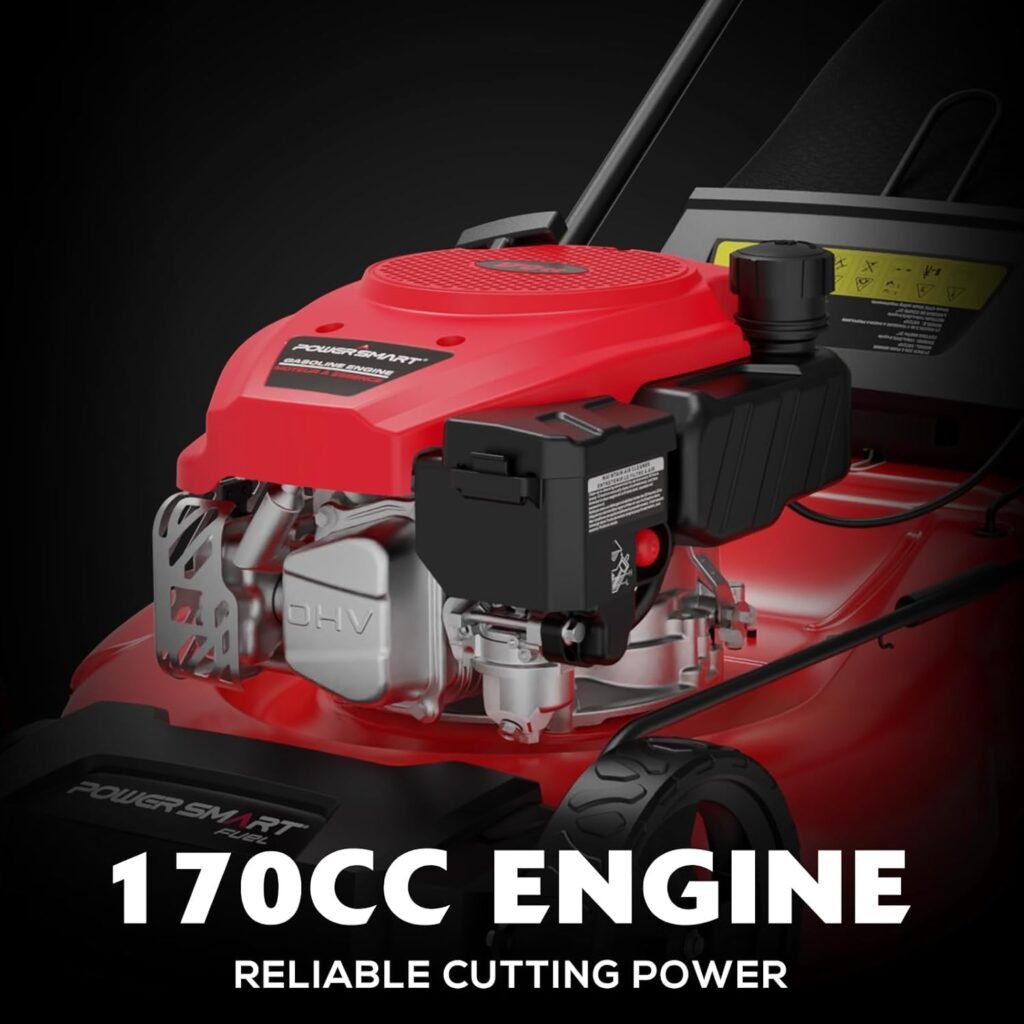
The heart of this mower is its 170cc 4‑cycle OHV engine, and we consider that a strong point. A 170cc engine is more than adequate for a 21-inch deck, and it provides enough torque to handle moderately thick or slightly overgrown grass without bogging down too much.
Because it is a 4-cycle (4-stroke) engine, we do not have to mix gas and oil. We just fill the fuel tank with regular gasoline and maintain engine oil separately, which simplifies regular use and maintenance. The overhead valve (OHV) design is fairly standard on modern small engines, and it generally improves efficiency and durability compared to older flathead designs.
In practice, we notice that the engine provides:
- Consistent power across most typical mowing conditions
- Balanced fuel economy for a gas mower in this size class
- Steady speed through normal lawn density, with only mild slowdown in very tall or wet grass
For a typical suburban yard mowed once a week, the power output feels well-suited. We do not feel like the mower is struggling, and we can maintain a comfortable pace without constant stopping or re-starting.
Starting System: Recoil With Auto Choke
We know that starting can be a major frustration with gas mowers. This mower uses a recoil starter (pull cord) combined with an auto choke system. That combination is meant to simplify cold starts by automatically adjusting the air-fuel mixture, so we do not have to manually set a choke lever.
In real-world use, this translates into:
- No need to fuss with a choke or primer bulb
- Typically starting in one to three pulls when properly maintained
- Quicker restarts during the same mowing session
We still need to use a consistent pull motion and maintain the engine with fresh fuel and clean spark plug, but the auto choke reduces the guesswork, especially at the start of the season. We find that for most users, this will feel much less finicky than older mowers with manual choke settings.
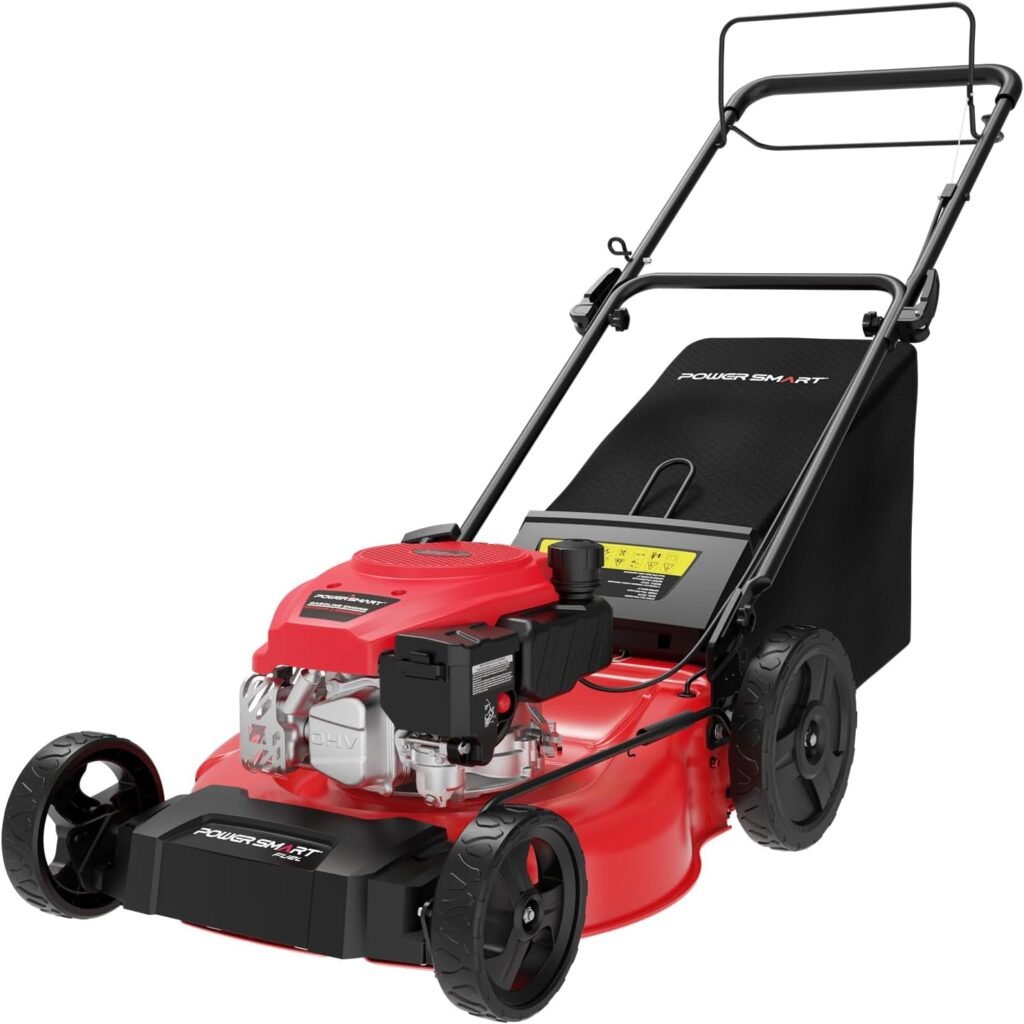

Self-Propelled Rear-Wheel Drive
One of the main reasons we choose a mower like this is the self-propelled rear-wheel-drive system. Rear-wheel drive offers better traction than front-wheel systems, especially on slopes, because the driving wheels are behind the center of gravity and stay more firmly planted on the ground.
The mower runs at a single speed of about 3.5–4.1 km/h, which is roughly a comfortable walking pace. We do not have speed adjustability here, but the pre-set pace should feel natural for most people. We simply squeeze the drive bar to engage the self-propel and walk behind it.
We notice several benefits:
- Reduced physical effort: We are guiding the mower rather than pushing the full weight.
- Better hill performance: On inclines, the rear-wheel drive helps pull the mower up without slipping as easily.
- More consistent lines: Because the mower is moving itself, it is easier to keep straight rows.
The trade-off is the lack of variable speed. If we prefer a very slow walking pace or we mow around many tight obstacles, the fixed speed might occasionally feel a bit fast. However, for large, open sections of lawn, that steady pace makes the job feel quicker.
Rear-Wheel Drive on Hills and Slopes
We appreciate that this mower is explicitly described as suitable for hills and larger yards up to 1/2 acre. The rear-wheel-drive power helps us maintain control and traction going uphill, and it feels more stable than a front-wheel-drive mower when pushing over uneven ground.
In practice, on moderate slopes:
- The mower climbs with less effort from us.
- We feel the tires grip better when the bag starts filling and weight shifts slightly backward.
- We do not need to lean forward as much to keep the front wheels down.
That said, we still need to follow safe mowing practices on steep slopes, such as mowing across the slope instead of straight up and down, and avoiding extremely steep areas that might pose a tipping risk for any walk-behind mower.
Cutting Deck and Blade Design
The mower uses a 21-inch wide steel deck fitted with a heavy-duty blade. A 21-inch deck is a practical middle ground: wide enough to keep passes to a reasonable number, but still maneuverable around landscaping, trees, or flowerbeds.
We like that the fine cutting system is designed to produce small clippings. This benefits us in two ways:
- Mulching quality improves, since smaller pieces break down faster.
- Bag capacity is used more efficiently because tiny clippings pack more densely.
The steel deck adds durability compared to lighter plastic decks, though it also means the mower has some weight to it. Fortunately, the self-propel feature offsets that when mowing. We do want to keep the underside of the deck clean to prevent rust over time, but the sturdiness of steel gives us confidence for the long term.
Cutting Width and Mowing Efficiency
With a 21-inch cutting width, we can cover ground at a reasonably quick rate. While larger decks (22–23 inches) exist, the difference in productivity is small, and the 21-inch size often feels more manageable in tighter yards or those with landscaping.
We find that:
- For yards up to 1/2 acre, this width is efficient without becoming cumbersome.
- For smaller yards, we still appreciate the wide cuts because we finish quicker.
- The deck size strikes a balance between productivity and maneuverability, especially around corners and near fences.
When we combine the cutting width with the single-speed self-propel drive, the mower feels like it keeps us moving at a consistent, productive pace across the lawn.
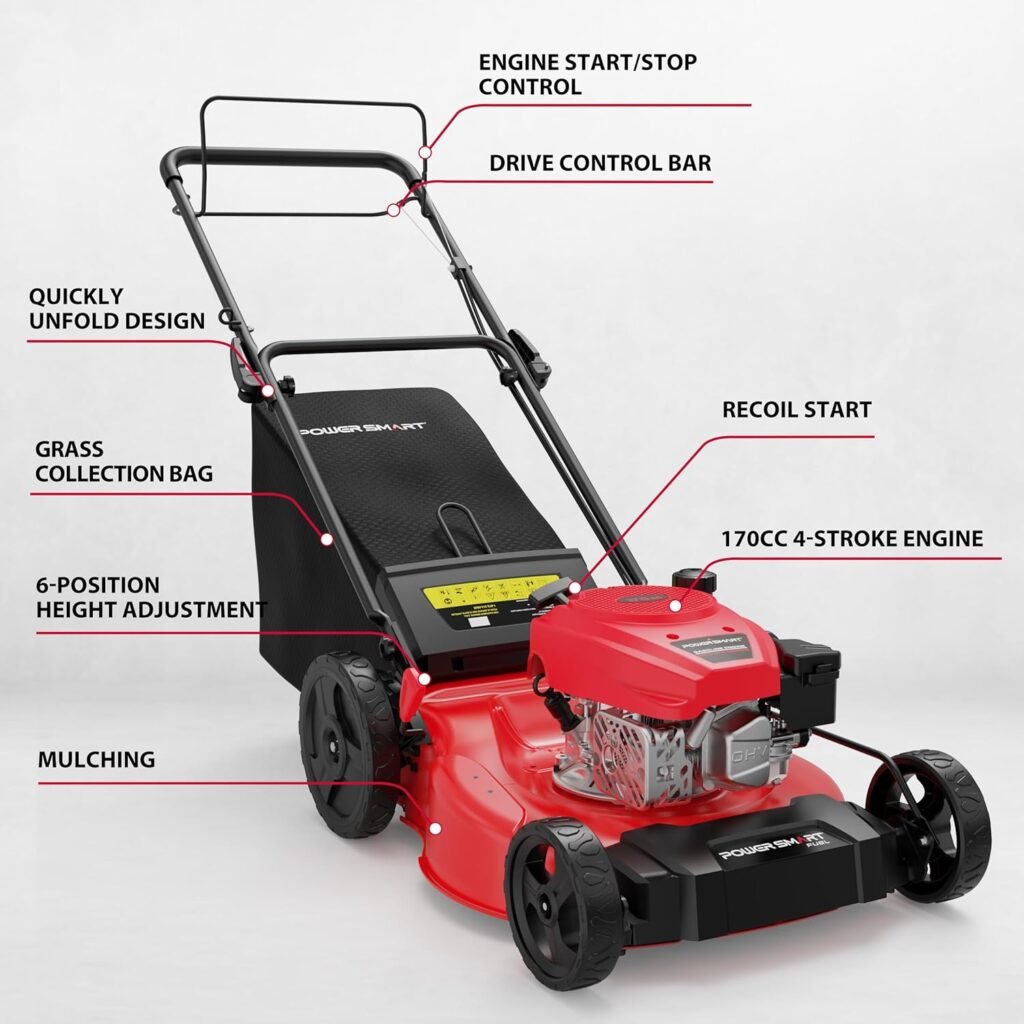
Mowing Quality and Grass Appearance
We all want that clean, even look after we finish the job. This mower’s fine cutting system and heavy-duty blade work together to leave a tidy finish, especially when we keep the blade sharp and mow at appropriate intervals.
We notice:
- Evenness of cut across the deck width, as long as the ground is relatively level.
- Minimal scalping when we adjust the height properly.
- Cleaner edges along borders when we line up the deck carefully.
On most regular lawns, the mower leaves a neat, uniform appearance with small clippings that blend quickly into the turf when mulching. If we prefer a manicured look, we may still go around with a trimmer for edges, but the main field of grass looks tidy and evenly cut.
2-in-1 System: Mulching and Bagging Options
One of the big conveniences here is the 2-in-1 clipping management system: we can choose between mulching and bagging depending on our lawn conditions and personal preference. We like having the flexibility to switch modes as seasons or grass growth patterns change.
Mulching Mode
In mulching mode, the mower recirculates clippings under the deck, chopping them into small particles that fall back into the turf. We appreciate mulching for several reasons:
- It returns nutrients to the soil, acting as a natural fertilizer.
- It reduces the volume of waste we need to haul away.
- It saves time because we are not stopping to empty the bag.
The fine cutting system really helps here, since smaller clippings decompose faster and are less likely to sit visibly on the surface. We find mulching works best when:
- The grass is not too tall or wet.
- We mow regularly.
- We are not dealing with heavy leaf fall or thick thatch.
Bagging Mode
The mower ships with a 1.4-bushel, easy-to-empty grass bag, and we can switch to bagging when we want maximum cleanliness. We prefer bagging when:
- The grass has grown taller than usual.
- We are cleaning up leaves or other debris along with grass.
- We want that pristine, no-clippings look, especially in front yards.
The bag is sized so that it holds a decent amount of small clippings before we need to empty it. The small clipping size also means we can mow a bit longer before the bag gets full. The design focuses on reducing blowout, so fewer clippings escape around the sides or back, keeping our shoes and legs a bit cleaner.
Grass Bag Capacity and Handling
The 1.4-bushel bag strikes a middle ground between capacity and portability. It is not huge, but we find that:
- It fills at a steady rate when mowing average growth.
- It remains light enough that most users can lift and empty it without strain.
- The attachment and removal process feels straightforward once we get used to the hooks and frame.
We also appreciate that the bag is described as easy-to-empty, which in practice means we can detach it, carry it by the handle, and empty it into a compost pile, yard waste bin, or collection area without wrestling with it.
For larger lawns, we will still be making multiple trips to empty the bag if we choose to bag everything, but that is typical for a mower in this size category.
Adjustable Cutting Height: Six Positions
A crucial part of good lawn care is cutting the grass at the right height for the season and grass type. This mower gives us a 6-position single-level height adjustment, which means we can raise or lower the deck with one lever instead of adjusting each wheel individually.
We find that:
- It is quicker to adjust height mid-mow if we hit a patch of uneven ground.
- We can adapt easily to seasonal needs—higher during hot, dry months and slightly lower during cooler growth spurts.
- Single-lever systems reduce the chance of accidentally setting one wheel different from the others.
While the exact height range is not specified, six positions typically span from around low (for short, manicured lawns) to fairly high (suitable for first cuts of slightly taller grass). Being able to change settings in a few seconds lets us experiment and find the sweet spot for our particular yard.
Ease of Use and Assembly
We really value that this mower is fully assembled in the box. Instead of spending time bolting on handles or adjusting cables, all we have to do is unfold the handle and lock it into place. No tools required.
This has several advantages:
- Less intimidation for those of us who are not mechanically inclined.
- Faster setup so we can get to mowing sooner.
- Reduced chance of incorrect assembly affecting performance.
Once set up, the control layout is straightforward: standard engine bail bar, self-propel bar, and simple levers for height adjustment. There is nothing overly complicated to learn, so even users who are new to gas mowers can become comfortable fairly quickly.
Handling, Maneuverability, and Weight
The combination of a steel deck, 21-inch width, and self-propel system creates a mower that has some heft, but we find it manageable due to the drive system. On flat ground with the self-propel engaged, we mainly guide and steer; the mower does most of the moving.
We notice:
- Turning at the end of rows is reasonably easy, especially if we release the drive bar just before turning.
- Tight spaces still require some muscle, particularly if we are maneuvering without drive power.
- Over bumpy or uneven areas, the rear-wheel drive keeps the mower pushing forward rather than bouncing and losing traction.
Overall, we feel that the handling is well suited to medium-sized residential yards. Very tight, obstacle-heavy spaces might benefit from a smaller deck, but for typical suburban layouts, this mower feels like the right balance.
Build Quality and Durability
From a durability standpoint, we appreciate:
- The steel deck, which resists impacts from small debris better than plastic.
- The heavy-duty blade, which stands up to regular sharpening and occasional rough patches.
- The simple mechanical controls, which limit potential electronic failure points.
Of course, as with any gas mower, long-term reliability also depends heavily on maintenance. Regular oil changes, keeping the air filter clean, inspecting the spark plug, and avoiding stale fuel all have a direct impact on how long the engine and drive components last.
With routine care, we expect the combination of a sturdy deck and a decent-sized engine to serve well for multiple seasons, especially for those of us mowing around once a week during the growing season.
Noise Level and Vibration
Being a gas mower with a 170cc engine, this machine does generate a typical level of noise and vibration. It will not be as quiet as a cordless electric mower, but that is the trade-off we accept for greater power and run time.
We generally observe:
- A standard gas mower noise profile; hearing protection is a good idea.
- Manageable vibration through the handle, though prolonged use will still feel like a workout for our hands and arms.
- A steady engine tone without excessive rattling when components are properly tightened.
If neighbors are very close or noise ordinances are strict, we may want to time our mowing to respectful hours, but in most residential environments, this mower’s sound level is typical and expected.
Fuel Efficiency and Maintenance Needs
The mower’s 4-cycle OHV engine is built with efficiency in mind, so we get a reasonable balance of fuel use and power output. For average lawns, we can usually mow a good portion—or even an entire medium-sized yard—on a single tank, depending on grass height and mowing pace.
Maintenance expectations include:
- Regular oil checks and changes according to the manufacturer’s schedule.
- Periodic air filter cleaning or replacement to maintain airflow.
- Blade sharpening to preserve cut quality and reduce engine strain.
- Spark plug inspections to ensure easy starting and consistent combustion.
- Deck cleaning to prevent buildup and corrosion underneath.
We like that there are no overly complex systems here; routine mower care is straightforward and well within the abilities of most homeowners who are willing to spend a little time each season.
Pros and Cons Summary
To help us assess whether this mower fits our needs, we find it useful to summarize the main advantages and trade-offs.
Advantages
- Strong 170cc 4-cycle OHV engine for efficient power in this class.
- Auto choke with recoil start, making starting simpler with no manual choke adjustment.
- Rear-wheel-drive self-propel system that makes mowing hills and larger yards easier.
- 21-inch steel deck with heavy-duty blade, providing durable construction and wide cuts.
- Fine cutting system that produces small clippings for clean mulching and efficient bagging.
- 2-in-1 mulching and bagging capability for flexible clipping management.
- 1.4-bushel easy-to-empty grass bag, designed to minimize blowout and keep the lawn clean.
- 6-position single-lever height adjustment, allowing quick and consistent deck changes.
- Fully assembled in the box, with only handle unfolding required—no tools needed.
Trade-Offs
- Single-speed self-propel may feel fast for those who prefer a slower walking pace or more control.
- Gas engine noise and emissions are higher compared with electric mowers.
- Steel deck adds weight, relying on the drive system to counterbalance it.
- Limited advanced features (no variable speed, no side discharge mentioned, no electric start).
- Regular maintenance is necessary to keep performance and starting reliability high.
Best Use Cases and Ideal Yard Types
We see this mower as being best suited for:
- Yards up to 1/2 acre, particularly those with moderate open spaces and some slopes.
- Homeowners who want self-propelled convenience without a steep learning curve.
- Users who prefer gas power for unlimited run time and strong performance.
- Lawns that benefit from mulching most of the time but occasionally need bagging for cleanup.
We might choose this mower if:
- Our yard has a combination of flat and slightly hilly areas.
- We want a straightforward, functional mower rather than a complex, feature-packed machine.
- We value a strong engine and durable deck but still want an easy assembly and user-friendly controls.
We might look elsewhere if:
- We need variable speed control for very intricate mowing patterns or very slow walking.
- We prefer ultra-quiet operation and absolutely minimal maintenance (where an electric mower may shine).
- Our yard is very small and cramped, where a narrower deck might be more practical.
Tips for Getting the Most Out of This Mower
To make sure we are getting the best performance and longest life from this mower, we can keep a few habits in mind:
1. Maintain a Regular Mowing Schedule
We aim to mow before the grass becomes too tall. This helps:
- Keep the engine from working too hard.
- Improve mulching performance.
- Maintain a cleaner finished appearance.
2. Adjust Cutting Height Seasonally
We can use the 6-position height adjustment strategically:
- Set it higher in hot, dry summers to shade soil and reduce stress on the grass.
- Set it slightly lower in cooler, wetter seasons to keep growth manageable.
- Avoid cutting more than about one-third of the grass blade in a single pass.
3. Keep the Blade Sharp
We get a better cut and less engine strain when the blade is sharp. We can:
- Inspect the blade at least once or twice per season.
- Sharpen or replace it if we notice tearing instead of clean slicing.
- Avoid hitting rocks or large debris that can chip the blade.
4. Clean the Deck and Bag
After mowing, especially in wet or sticky conditions:
- We can brush or hose off the underside of the deck (with the engine off and spark plug disconnected for safety).
- We can knock clippings out of the bag to maintain good airflow and collection performance.
- We can store the mower in a dry area to reduce rust risk.
5. Use Fresh Fuel and Check Oil
We protect the engine by:
- Using fresh gasoline and avoiding fuel that has sat for many months.
- Checking the oil regularly and changing it at the intervals recommended in the manual.
- Storing the mower with stable fuel practices at the end of the season.
How This Mower Compares Conceptually to Alternatives
Without naming specific competing models, we can think about how this mower’s general design stacks up against typical alternatives.
Compared to non-self-propelled mowers:
- We save physical effort, especially on larger yards and slopes.
- We gain easier, more consistent pacing across the lawn.
- We accept slightly more mechanical complexity due to the drive system.
Compared to front-wheel-drive self-propelled mowers:
- We gain better traction on hills and uneven ground.
- We may notice more stable forward motion when the bag is full.
- We might have slightly more weight over the drive wheels, improving grip.
Compared to electric or battery mowers:
- We gain stronger, more sustained cutting power in dense or tall grass.
- We do not need to worry about battery run time.
- We accept more noise, emissions, and maintenance responsibilities.
This mental comparison helps us decide whether a gas-powered, rear-wheel-drive, 21-inch mower is truly aligned with our yard and our personal preferences.
Longevity and Value Over Time
When we think about value, we consider both the purchase price and the years of service we can reasonably expect. The PowerSmart self-propelled mower focuses on:
- A solid engine size for its class.
- A steel deck that resists impact and wear.
- Simple mechanical systems that are relatively easy to maintain.
If we follow normal home-owner maintenance routines, we can expect this mower to remain a reliable tool for multiple mowing seasons. Over time, the ability to mulch rather than bag every cut can also reduce time spent dealing with yard waste and potentially support healthier turf, which adds to the mower’s overall value.
While it does not bring high-end features like variable speed or electric start, we see it as a practical, work-focused machine that aims to get the fundamentals right.
Our Final Thoughts on the PowerSmart Self-Propelled Gas Lawn Mower
When we step back and look at the PowerSmart Self Propelled Gas Lawn Mower, 21-Inch with 170cc 4-Cycle OHV Engine 2-in-1 Rear-Wheel Drive Lawnmower with Bagging as a whole, we see a mower built for homeowners who want straightforward, effective performance without unnecessary complication.
We get:
- A powerful and efficient 170cc engine that starts more easily thanks to auto choke.
- Rear-wheel-drive self-propel assistance that makes mowing hills and up to half-acre yards substantially easier.
- A 21-inch steel deck and fine cutting system for clean, consistent results.
- Flexible 2-in-1 mulching and bagging options with a practical, easy-to-empty 1.4-bushel bag.
- Quick, single-lever height adjustments and tool-free assembly, keeping setup and operation user-friendly.
We give up variable speed and some advanced features, but in return we receive a focused, reliable gas mower that addresses the core needs of many residential lawns. For those of us who want to reduce the strain of mowing, maintain a neat yard, and rely on a sturdy machine that emphasizes function over frills, this PowerSmart self-propelled mower presents itself as a strong, sensible choice.
Disclosure: As an Amazon Associate, I earn from qualifying purchases.