Ad Blocker Detected
Our website is made possible by displaying online advertisements to our visitors. Please consider supporting us by disabling your ad blocker.
Did you know that not all robot lawn mowers on the market meet strict safety standards, even if they appear similar? Many devices lack thorough testing for obstacle detection, electrical safety, or emergency shutdown features, which can pose significant risks. Understanding the certification process is vital to guarantee your mower operates safely and reliably. As we explore the key standards and certification procedures, you’ll see how these measures protect both users and property—making it imperative to choose certified models.
Key Takeaways
- Safety certification verifies compliance with standards like IEC 60335-2-107 and UL 802, ensuring safe operation and obstacle detection.
- Certified robot mowers undergo rigorous testing of electrical, mechanical, and sensor systems to meet safety and performance benchmarks.
- Look for certification labels, logos, and manuals to confirm mower compliance with safety standards before use.
- Key safety features include emergency stop buttons, boundary sensors, obstacle avoidance, and automatic shutdown mechanisms.
- Using uncertified or failed devices poses increased risks of accidents, electrical faults, and operational hazards.
What Is Robot Lawn Mower Safety Certification and Why Does It Matter?
Robot lawn mower safety certification is a formal process that verifies whether these devices meet established safety standards before they reach consumers. This certification assures that the mower’s battery life aligns with safety requirements, minimizing risks of overheating or fire during operation. It also assesses mowing efficiency, confirming that the device performs reliably without posing hazards to users or bystanders. Precise testing evaluates electrical components, sensors, and mechanical parts for compliance with safety protocols. Certification guarantees that the robot’s power management optimizes battery use while maintaining consistent mowing performance. By adhering to rigorous safety standards, manufacturers demonstrate that their devices are both effective and safe, providing reassurance that the mower’s battery life and mowing efficiency meet strict safety and operational benchmarks.
Key Safety Standards and Certifications for Autonomous Lawn Mowers
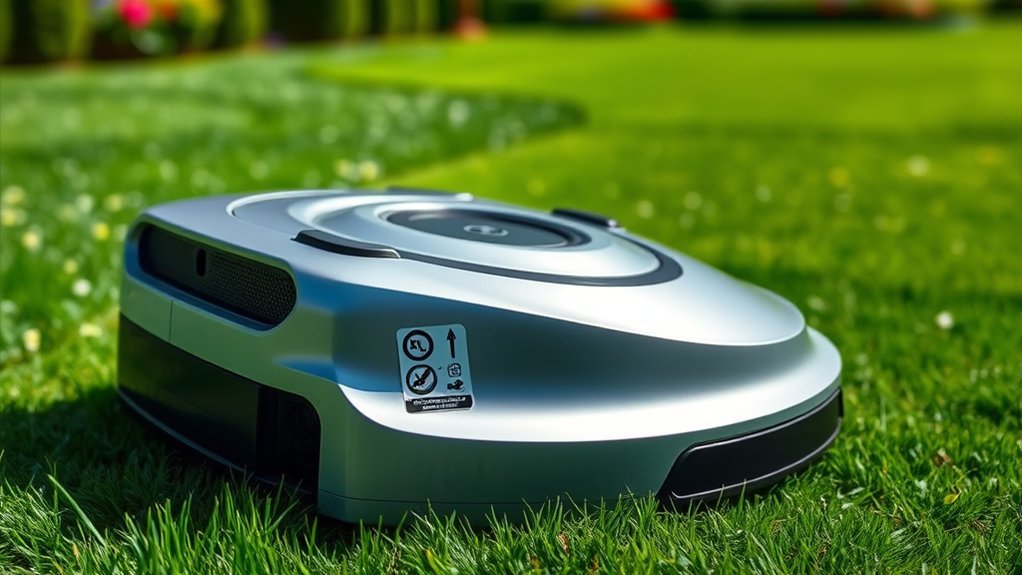
We focus on essential safety standards such as IEC 60335-2-107 and UL 802, which specify rigorous testing protocols for autonomous lawn mowers. Understanding the certification processes guarantees compliance with these benchmarks, verifying that devices meet safety and performance criteria. Recognizing these standards highlights the tangible benefits of certification, including enhanced reliability, user safety, and market acceptance.
Essential Safety Standards
Ensuring safety in autonomous lawn mowers requires adherence to specific standards and certifications that verify their compliance with established safety protocols. Key safety standards focus on multiple facets, including battery technology, which must meet rigorous thermal and electrical safety criteria to prevent fire hazards during lawn maintenance. These standards also address the mechanical and electrical integrity of the mower, ensuring robust construction and reliable shutdown mechanisms in emergencies. Certifications such as IEC 60335-2-107 specify safety requirements for robotic lawnmowers, emphasizing obstacle detection, safe power management, and safe battery operation. By complying with these standards, manufacturers guarantee that the autonomous mower minimizes risks to users and bystanders while maintaining ideal performance in routine lawn maintenance tasks.
Certification Processes and Benefits
Obtaining certification for autonomous lawn mowers involves a rigorous process that verifies compliance with established safety standards, guaranteeing their safe operation in diverse environments. Certification assesses critical aspects such as artificial intelligence algorithms, battery technology, and sensor reliability. These standards confirm that the mower’s AI can accurately detect obstacles, while battery safety protocols prevent overheating or failure. The certification process also evaluates electromagnetic compatibility and fail-safe mechanisms.
| Certification Aspect | Purpose |
|---|---|
| AI Safety Standards | Ensures reliable obstacle detection and decision-making |
| Battery Safety Protocols | Prevents overheating, fires, and power failures |
| Sensor Reliability | Confirms consistent environmental awareness |
| Electromagnetic Compatibility | Avoids interference with other devices |
| Fail-Safe Systems | Guarantees safe shutdown during malfunctions |
How Safety Certifications Are Tested and Approved
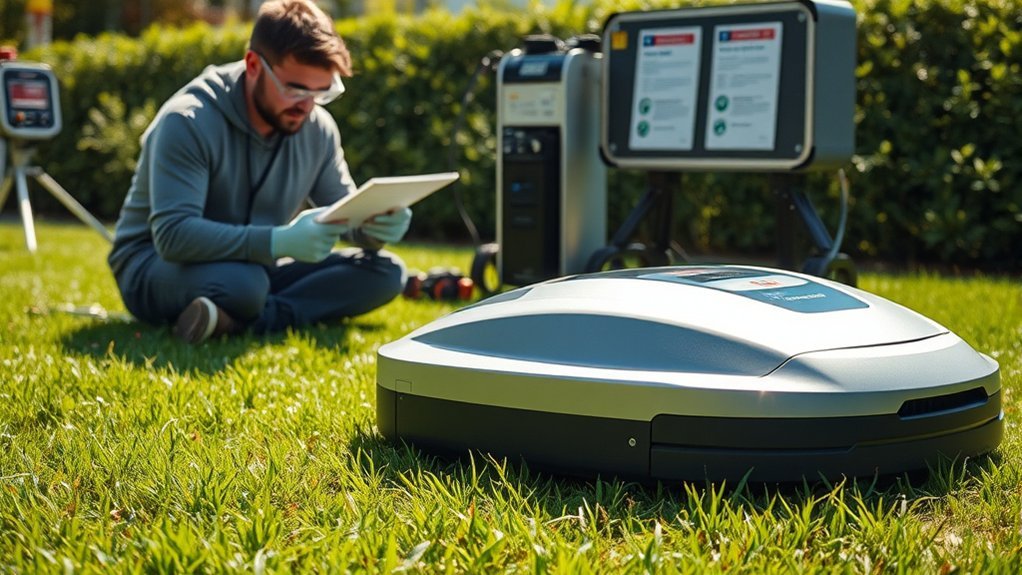
To verify that a robot lawn mower meets safety standards, rigorous testing processes are employed by certification bodies. These tests evaluate various safety aspects critical to garden landscaping and lawn maintenance. Safety certifications involve evaluating electrical safety, ensuring proper insulation, grounding, and fault protection. Mechanical safety is scrutinized through obstacle detection, blade guard integrity, and stability during operation. Additionally, the mowers undergo tests for hazardous emissions and electromagnetic compatibility. Functional safety protocols verify proper shutdown mechanisms in cases of malfunctions. Certification bodies also conduct real-world simulations to assess performance in typical lawn environments. Only after passing these comprehensive evaluations do products earn certification, demonstrating their reliability and safety for end-users and ensuring responsible lawn maintenance practices.
Recognizing Certified Robot Lawn Mowers: Labels and Documentation
How can consumers confidently identify a certified robot lawn mower? Recognition begins with scrutinizing labels and documentation. Certified models feature specific markings indicating compliance with safety standards, often including certification logos, serial numbers, and manufacturer details. These identifiers ensure the mower meets rigorous safety criteria, directly impacting lawn maintenance and gardening tips. To facilitate accurate identification, review accompanying documentation, such as user manuals and safety certificates, which detail certification scope and standards met. Below is a table summarizing key labeling elements:
| Label Element | Purpose | Location |
|---|---|---|
| Certification Logo | Indicates conformity with safety standards | Mower body, packaging |
| Serial Number | Verifies model authenticity and traceability | Underneath the cover |
| Safety Certification Mark | Confirms adherence to safety protocols | Control panel label |
| Manufacturer Details | Provides contact info for support | User manual section |
These indicators are essential for proper gardening tips and ensuring safe lawn maintenance.
Common Safety Features in Certified Robot Lawn Mowers
Certified robot lawn mowers incorporate advanced obstacle detection systems that utilize ultrasonic, infrared, or bumper sensors to prevent collisions. Emergency stop features provide immediate halting capabilities when safety breaches or manual interventions are necessary. Additionally, boundary and zone settings define operational limits, ensuring the mower remains within designated areas and enhances overall safety.
Obstacle Detection Systems
Obstacle detection systems are a critical safety feature in certified robot lawn mowers, enabling these devices to identify and respond to objects within their operational environment. These systems utilize advanced safety sensors, such as infrared, ultrasonic, or tactile sensors, to detect obstacles with high accuracy. When an obstacle is recognized, the mower adjusts its path to prevent collisions, ensuring safety for people, pets, and objects. The reliability of these sensors is essential for consistent obstacle detection, minimizing false positives or negatives. Proper calibration and integration of these safety sensors guarantee *ideal* performance. Below is a table illustrating common obstacle detection methods and their key characteristics:
| Method | Sensor Type | Response Time | Suitable Environment | Limitations |
|---|---|---|---|---|
| Infrared | Light-based | Fast | Clear, dry conditions | Reflective surfaces |
| Ultrasonic | Sound waves | Very fast | Various terrains | Soft obstacles |
| Tactile | Physical contact | Immediate | Close-range detection | Potential for damage |
| Visual | Cameras | Moderate | Well-lit areas | Lighting dependency |
| Lidar | Laser scanning | Very precise | Complex environments | Costly |
Emergency Stop Features
Have you ever wondered what safety mechanisms guarantee that robot lawn mowers operate securely in outdoor environments? Emergency stop features are integral, providing immediate shutdown capabilities in critical situations. These systems include manual controls like emergency stop buttons accessible on the device or remote, as well as automatic detection of unsafe conditions, such as obstacle interference or abnormal battery behavior. Proper user training guarantees operators understand how to activate these features promptly, minimizing risks. Additionally, effective emergency stops contribute to battery longevity by preventing stress-induced failures caused by uncontrolled operation. Certified mowers implement rigorous testing to guarantee these features function reliably under various conditions. Overall, precise design, clear user instructions, and robust emergency stop mechanisms are essential for safe, efficient outdoor operation.
Boundary and Zone Settings
Boundary and zone settings serve as fundamental safety features that define the operational limits of robot lawn mowers, preventing unintended access to sensitive or hazardous areas. Boundary zones are established through boundary wires or virtual boundaries, creating a physical or digital perimeter that the mower cannot cross. Safety zones are designated areas where mowing is restricted or disabled, such as flower beds, fountains, or play areas. These settings enable precise control over the mower’s activity, ensuring it operates only within authorized regions. Advanced models incorporate sensors and GPS integration to dynamically enforce boundary and safety zones, reducing the risk of accidents. Proper configuration and maintenance of these zones are critical to maintaining safety certification standards and ensuring the mower’s safe and effective operation.
How Certification Ensures Safe Operation for Homeowners and Professionals
Certification plays a crucial role in guaranteeing that robot lawn mowers operate safely for both homeowners and professionals by establishing standardized safety protocols and performance benchmarks. It guarantees compliance with rigorous electrical, mechanical, and software safety standards, reducing risks during garden landscaping and routine lawn care. Certified mowers undergo thorough testing of features like obstacle detection, blade safety, and boundary recognition, directly impacting safe operation. The following table summarizes key safety aspects validated through certification:
| Safety Feature | Certification Standard | Impact on Operation |
|---|---|---|
| Obstacle Detection | EN 60335-2-107 | Prevents collisions with humans/objects |
| Blade Safety | UL 991 | Reduces injury risk during operation |
| Boundary Recognition | ISO 13482 | Ensures containment within designated zones |
| Power Supply Safety | IEC 60335-2-100 | Minimizes electrical hazards |
These standards directly enhance safe use, supporting effective lawn care and garden landscaping.
Tips for Choosing a Safe and Certified Robot Lawn Mower
Selecting a robot lawn mower that prioritizes safety requires careful evaluation of its certifications and technical features. Verify that the device complies with industry standards, such as UL or CE certifications, indicating rigorous safety testing. Examine the mower’s sensors, obstacle detection, and boundary wiring, ensuring they integrate seamlessly with your garden design to minimize hazards during lawn maintenance. Consider the mower’s blade safety features, such as automatic shutoff upon lifting or tilting, to prevent injury. A well-certified mower should include anti-collision systems and secure docking stations. Additionally, assess the mower’s navigation algorithms for precision in complex yard layouts. These technical details guarantee safe operation, reduce risk, and optimize lawn maintenance efficiency, making certification a critical factor in your selection process.
What to Do If Your Robot Lawn Mower Isn’t Certified or Fails Safety Tests
When a robot lawn mower fails safety tests or lacks proper certification, it signals potential risks that can compromise user safety and device reliability. In such cases, immediately cease use and conduct a thorough inspection of the unit’s safety features, focusing on battery longevity and power cutoff mechanisms. Verify that the battery’s capacity and health meet manufacturer specifications, as degraded batteries can cause safety malfunctions. Additionally, assess whether user training has been provided on correct operation and safety protocols. If issues persist, contact the manufacturer for certification updates or repair options. Operating uncertified equipment increases the risk of accidents, electric faults, and inefficient cutting. Prioritizing proper certification, maintenance, and user training guarantees maximum safety and device performance.
Frequently Asked Questions
Are There Different Safety Certifications for Commercial and Residential Robot Lawn Mowers?
Yes, commercial and residential robot lawn mowers undergo distinct safety testing and certification criteria; commercial models face stricter standards to guarantee operational safety in varied environments, while residential units meet basic safety requirements suitable for home use.
How Often Are Robot Lawn Mower Safety Standards Updated?
We monitor robot mower regulations closely, noting updates typically occur every 2-3 years through the certification process, ensuring safety standards adapt to technological advancements and industry practices, maintaining ideal safety and compliance for both residential and commercial models.
Can a Non-Certified Mower Still Be Legally Used at Home?
We believe non-certified mowers can be legally used at home, but prioritizing personal safety is essential. The certification process guarantees compliance with safety standards, reducing risks. Always verify local regulations before operating non-certified equipment.
What Are the Penalties for Selling Uncertified Robot Lawn Mowers?
Selling uncertified robot lawn mowers risks regulatory penalties, including fines and product recalls, as it breaches regulatory compliance and undermines consumer protection standards. We urge adherence to certification requirements to guarantee safety and legal sales practices.
Do Safety Certifications Cover All Types of Terrain and Obstacles?
Safety certifications primarily address terrain adaptability and obstacle navigation within specified parameters, but they don’t guarantee flawless performance across all terrains or obstacles, as real-world conditions can vary, requiring ongoing updates and manufacturer adherence to safety standards.
Conclusion
In essence, safety certification acts as a safeguard, much like a reliable compass guiding us through the complex landscape of autonomous lawn care. By prioritizing certified models, we guarantee adherence to rigorous safety standards, minimizing risks and enhancing operational reliability. As diligent users, our goal should be to select compliant devices that not only perform efficiently but also uphold the highest safety protocols—because a well-certified mower is the foundation of safe, worry-free lawn maintenance.