Ad Blocker Detected
Our website is made possible by displaying online advertisements to our visitors. Please consider supporting us by disabling your ad blocker.
Like the pioneers of innovation who transformed their worlds, we’re exploring how modern technology can reshape garden care. For those with narrow, small gardens, finding the right robot mower isn’t just about convenience—it’s about optimizing every square inch with precision and ease. But with so many options, how do you choose the best fit for your space? Stay with us as we examine four top contenders designed specifically for confined gardens.
Key Takeaways
- Designed specifically for small, narrow gardens with compact sizes up to 1,600 sq ft and obstacle-rich environments.
- Features boundary-free or magnetic strip zones for easy setup and precise area management.
- Equipped with AI-powered visual navigation and obstacle detection for safe, efficient mowing around clutter.
- Offer quick recharging, long battery life, and simple installation suitable for limited outdoor spaces.
- Focused on safe, hassle-free operation with customizable mowing schedules and minimal technical setup.
V3 Robot Lawn Mower with App Control and No-Go Zones
The V3 Robot Lawn Mower is ideal for small gardens up to 1,600 square feet, especially for those who want a hassle-free setup without boundary wires. It uses AI-powered visual recognition to navigate and avoid obstacles, ensuring thorough coverage. With no boundary wire installation needed, it features boundary strip no-go zones, including a 32-foot magnetic strip to protect flower beds and furniture. Controlled via a smart app, you can turn it on, change modes, and update features remotely. Its quiet operation and adjustable cutting height make lawn care easy and customizable. Overall, the V3 offers effortless, efficient mowing tailored for compact gardens.
Best For: homeowners with small, landscaped gardens up to 1,600 sq.ft. seeking an easy-to-use, boundary-wire-free robotic lawn mower.
Pros:
- No boundary wire installation required, simplifying setup and reducing installation time
- AI-powered visual recognition for obstacle detection and efficient navigation
- App control allows remote operation, mode selection, and software updates
Cons:
- Designed specifically for small lawns; not suitable for larger areas
- Limited cutting height range (0.8 to 2.4 inches), which may not suit all grass types
- May require periodic manual maintenance or blade replacements for optimal performance
LawnMaster OcuMow Robot Lawn Mower for Small Lawns
Ideal for small lawns of 1,000-2,000 square feet, the LawnMaster OcuMow uses optical navigation to efficiently mow without perimeter wires. Its high-dynamic-range camera and sensors identify grass even in tricky lighting, ensuring thorough coverage. Equipped with ultrasonic obstacle sensors, it avoids collisions by detecting objects as small as 6 inches. Capable of climbing slopes up to 35%, it handles uneven terrain easily. Weighing just 13.4 pounds and measuring roughly 22 by 14.5 by 10 inches, it’s lightweight and compact. With a 6-inch cutting width, it’s perfect for maintaining small, narrow gardens with minimal setup and user intervention.
Best For: homeowners with small, well-defined lawns between 1,000 and 2,000 square feet seeking an easy-to-use, perimeter wire-free robotic mower that can handle slopes and uneven terrain with minimal setup.
Pros:
- No perimeter wire required, simplifying installation and setup
- Efficient optical navigation with high-dynamic-range camera for thorough coverage
- Capable of climbing slopes up to 35%, suitable for uneven or hilly lawns
Cons:
- Average customer reviews are mixed, with a rating of 3.6 stars out of 5
- Regular edge trimming is necessary to achieve optimal mowing results
- Limited to small lawns; not suitable for larger or more complex landscapes
YARDCARE V100 Robot Lawn Mower with HD Navigation
Looking for a mower that navigates tight, obstacle-filled small gardens effortlessly? The YARDCARE V100 Robot Lawn Mower with HD Navigation is perfect. It uses AI-driven visual navigation, a bumper sensor, and a camera to distinguish grass from obstacles, detecting up to 150 objects. You can set no-go zones with a simple magnetic strip, avoiding flower beds or pools without digging. It’s designed for lawns up to 1,600 sq ft, with a long-lasting 4Ah battery. Its safety features include tilt sensors, rain sensors, and an emergency stop. Easy to operate, it’s ideal for small, obstacle-rich gardens needing precise and reliable mowing.
Best For: homeowners with small, obstacle-rich gardens seeking precise, automated lawn maintenance without complex wiring.
Pros:
- Advanced AI-driven visual navigation accurately detects up to 150 obstacles for efficient mowing.
- Easy zone setup with a magnetic strip eliminates the need for digging or external power sources.
- Safe operation with tilt, rain, and emergency sensors ensures reliable and secure use.
Cons:
- Suitable primarily for lawns up to 1,600 sq ft, limiting larger yard coverage.
- Battery life may require replacement over time, adding to maintenance costs.
- May struggle on slopes exceeding 20 degrees or in very complex obstacle environments.
Raccoon 2 SE Robot Lawn Mower with AI Obstacle Avoidance
For small gardens up to 0.15 acres, the Raccoon 2 SE Robot Lawn Mower excels with its AI obstacle avoidance and easy setup. It’s a plug-and-play device that requires no boundary wires or RTK antennas—just press a button to start mapping and mowing. Its modern, user-friendly design means no assembly is needed. The mower offers multiple operation modes, including app control, and can handle up to three zones. With advanced sensors and AI vision, it recognizes over 300 obstacle types, navigating safely around pets, toys, and garden features. It climbs slopes up to 36% and manages narrow passages, ensuring thorough coverage on irregular lawns.
Best For: homeowners with small, irregularly shaped lawns up to 0.15 acres seeking an easy-to-use, obstacle-aware robotic mower with smart control options.
Pros:
- No boundary wires or RTK antennas needed, simplifying setup and installation
- Advanced AI obstacle avoidance that recognizes over 300 obstacle types for safe operation
- Multiple operation modes and app control for customizable lawn care routines
Cons:
- Limited to lawns up to 0.15 acres, not suitable for larger properties
- May require manual intervention for complex terrain or very narrow passages
- The compact design and features might be less suitable for very uneven or heavily shaded lawns
Factors to Consider When Choosing Robot Mowers for Narrow Small Garden
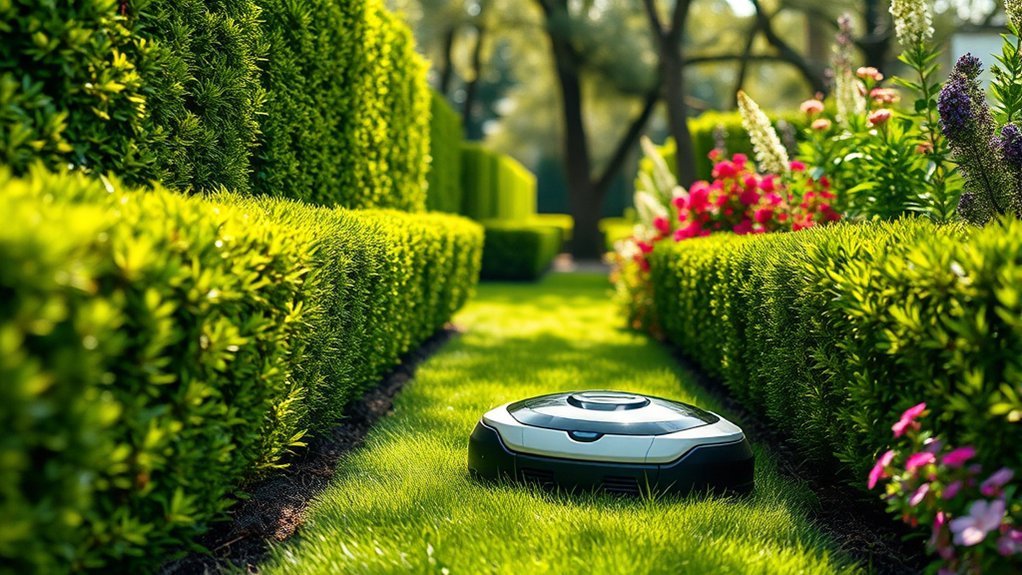
When selecting a robot mower for a narrow small garden, we need to take into account how well it fits the space and navigates tight corners. We also look at features like zone customization, obstacle detection, and battery life to guarantee efficient mowing. Let’s explore these factors to find the best match for your garden needs.
Size Compatibility
Choosing the right robot mower for a narrow small garden hinges on size compatibility. First, confirm the mower’s maximum coverage area aligns with your garden’s size, typically between 600 to 2,000 square feet. This prevents under- or over-mowing and ensures efficiency. Next, check the mower’s dimensions to confirm it can navigate through narrow passages, gates, or tight spaces within your garden’s layout. Adjustable cutting heights are essential to prevent damage in confined areas, so pick models that allow customization. It’s also important to verify that obstacle detection and navigation technology work well in small, cluttered environments, reducing the risk of collisions. Ultimately, consider how the boundary setup—wireless or boundary strips—fits your space, ensuring the mower stays confined within your narrow garden.
Navigation Technology
Navigation technology plays a crucial role in guaranteeing robot mowers efficiently and safely cover narrow, small gardens. Modern systems use visual recognition, ultrasonic sensors, bumper sensors, and magnetic boundary strips to achieve precise lawn coverage. Visual navigation employs cameras and AI to detect obstacles and differentiate grass from non-grass areas, optimizing path planning. Ultrasonic sensors help avoid objects as small as 6 inches, reducing collisions and protecting garden features. Magnetic boundary strips create virtual no-go zones without the need for buried wires, offering flexible area delimitation. Advanced algorithms allow mowers to manage slopes, narrow passages, and irregular shapes, enhancing coverage in tight spaces. Choosing a mower with smart navigation technology ensures thorough mowing while minimizing risks and adapting seamlessly to small garden layouts.
Zone Customization
In small, narrow gardens, precise zone customization becomes key to effective lawn management. It allows us to designate specific areas for mowing, keeping the mower away from delicate flower beds or decorative features. Many robot mowers make this easy with magnetic strips or no-go zones, eliminating the need for complex boundary wires. Adjustable zone settings let us create tailored schedules and coverage for different sections, making the most of limited space. Advanced AI vision and obstacle detection help the mower navigate within these zones accurately, avoiding damage and ensuring safety. Creating multiple zones or no-go areas offers better control over narrow pathways and tight corners. This level of personalization ensures our small gardens are well-maintained, efficiently mowed, and protected from accidental harm.
Obstacle Detection
Since narrow gardens often have tight spaces and numerous obstacles, effective obstacle detection is essential for robot mowers to operate safely and efficiently. Modern mowers use sensors like ultrasonic, bumper, or AI-powered vision to identify objects in real-time. Visual guidance with obstacle recognition helps the mower distinguish between grass and non-grass obstacles, reducing collisions and damage. The ability to detect small obstacles as little as 1.57 inches high or 6 inches wide is particularly important in cluttered spaces. Advanced obstacle avoidance features enable the mower to reroute automatically around unexpected objects, ensuring continuous coverage. Combining multiple detection methods, such as bumper sensors and AI vision, enhances safety and performance, making these mowers ideal for steering through confined outdoor areas effectively.
Battery Life Span
A key factor when selecting a robot mower for a narrow small garden is its battery life, as it determines how long the mower can operate before needing a recharge. Longer battery life means the mower can complete mowing sessions without frequent breaks, which is especially helpful for gardens with complex layouts. Recharge times vary, with some models recharging in as little as 30 minutes, enabling quick turnaround between cycles. Battery lifespan is generally measured in charge cycles, with most batteries lasting between 300 to 500 cycles before capacity drops notably. Choosing a mower with a replaceable or upgradeable battery can extend its overall lifespan. For small gardens, a battery providing at least 1 to 2 hours of continuous operation is typically sufficient to cover the entire lawn efficiently.
Ease of Setup
Are you looking for a robot mower that’s easy to set up and get running quickly? We recommend models with simple installation processes, like magnetic strips or visual mapping, which don’t require complex wiring or boundary setup. Look for mowers with user-friendly controls, such as app-based management or basic start buttons, to make setup straightforward even if you’re not tech-savvy. Opt for models that need minimal assembly—many come pre-assembled or only require a few quick steps. Consider systems that automatically recognize lawn boundaries or use visual navigation, saving time and effort. Additionally, choose mowers that come with clear instructions and accessible customer support, ensuring you can confidently set up and configure your mower without frustration.
Frequently Asked Questions
How Long Does a Typical Robot Mower Battery Last?
A typical robot mower battery lasts around 60 to 90 minutes on a full charge, depending on the model and grass conditions. We recommend checking specific product specs for more precise estimates.
Are Robot Mowers Suitable for Uneven or Hilly Terrain?
Robot mowers can handle uneven or hilly terrain, but their effectiveness depends on the model. We recommend choosing one with robust wheels and adjustable cutting heights to guarantee it navigates slopes safely and efficiently.
What Maintenance Is Required for Robot Lawn Mowers?
We keep our robot mowers running smoothly by regularly cleaning blades, checking for debris, and replacing dull parts. We also update software and guarantee charging stations are clear, so the mower can glide effortlessly over our lush, tiny gardens.
Can Robot Mowers Handle Pet Waste or Debris?
Robot mowers generally can’t handle pet waste or heavy debris safely. We recommend removing pet waste and large debris before mowing to prevent damage and guarantee your robot works efficiently, keeping your small garden tidy and safe.
How Secure Are Robot Mowers From Theft or Vandalism?
Robot mowers are fairly secure thanks to features like PIN codes, alarm systems, and GPS tracking. We recommend these security measures to help prevent theft or vandalism, giving you peace of mind while your mower works autonomously.
Conclusion
In the end, choosing the right robot mower for our narrow, small garden is like finding a needle in a haystack—challenging but rewarding. With the right features, these models turn lawn care into a breeze, freeing us from manual labor. They’re the perfect tiny titans, maneuvering tight corners and obstacles with finesse. So, let’s pick one that fits our needs and watch our garden transform into a neat, lush oasis—effortlessly and elegantly.